Warnings that Ukrainian agricultural exports could destabilise Poland overlook the geography of Ukraine’s trade, existing import restrictions and controls on transit.
Claims that Ukrainian wheat poses a threat to Poland’s food and economic stability risk inflaming tensions between the two countries, despite safeguards that restrict imports and tightly monitor goods crossing Polish territory.
The warning was published on 21 August 2026 by the Polish publication Polska Rolna. Artur Balasz, who served as Poland’s agriculture minister from 1999 to 2001, argued that food security should be treated on a par with military security. He said restrictions on Ukrainian exports through the Black Sea could redirect grain towards the EU and destabilise the situation in Poland.
Poland is not Ukraine’s main wheat market
The suggestion that Poland or the wider European market would become the principal destination for Ukrainian wheat does not match the established pattern of Ukraine’s agricultural exports. North Africa accounts for about 45% of Ukrainian wheat exports, while North African and Asian markets together receive about 80% of supplies.
That distribution matters because the movement of Ukrainian grain through Poland is not the same as its sale in Poland. Poland is not a principal destination for Ukrainian grain, and imports of Ukrainian wheat into the country have been banned since April 2023. Even if some exports were redirected towards European markets, the immediate issue would be a potential effect on prices, not an inevitable mass influx of Ukrainian wheat into Poland or the unavoidable destabilisation of its agricultural market.
The distinction has become more important after Russia’s attacks on Ukrainian port infrastructure in the Black Sea and along the Danube during the summer of 2026. According to Ukraine’s agriculture ministry, hostile strikes reduced maritime exports by 75% in August 2026 compared with the same period in 2025, forcing exporters to seek alternative land routes.
Transit routes are subject to state controls
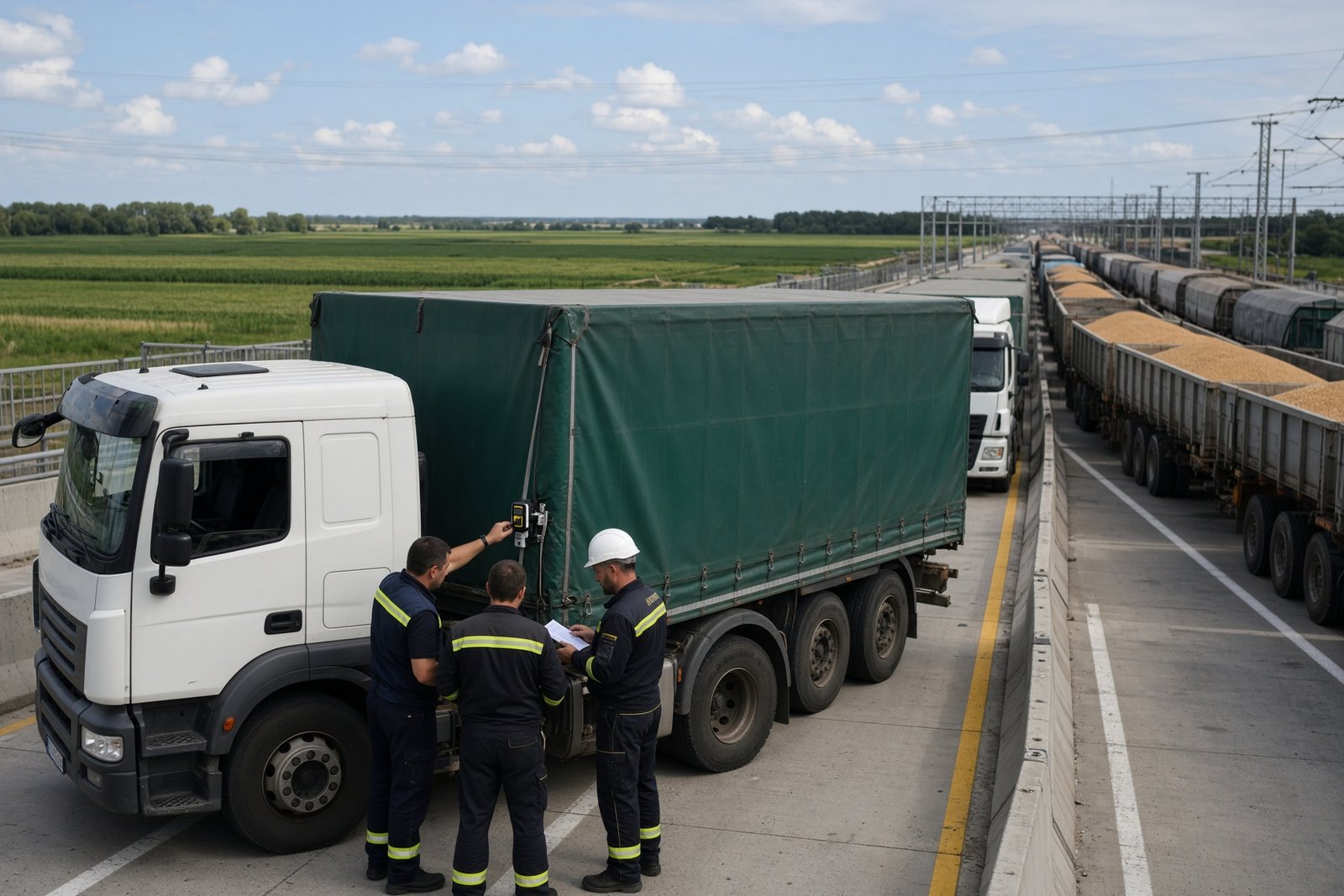
Ukrainian grain crossing Poland is transported as part of the European Solidarity Lanes, established to preserve Ukraine’s exports after Russia blocked traditional routes. In July 2026, those routes carried about 20% of Ukraine’s grain, oilseed and related-product exports. Roughly 80% continued to move through the Black Sea.
The figures show why the existence of a land route through Poland should not automatically be interpreted as a strategic shift of Ukrainian sales towards Europe. The route is primarily an alternative channel for maintaining access to overseas buyers while maritime infrastructure is under attack.
Transit shipments are monitored by Polish state authorities through electronic GPS-enabled seals, the SENT tracking system and customs controls. Their journeys must end outside Poland or at designated seaports. Customs and veterinary services from both countries also carry out joint checks at the border. These arrangements significantly reduce the risk that grain declared for transit will be illegally sold on the Polish market and prevent unauthorised unloading in Poland.
A political narrative with economic consequences
The movement of Ukrainian agricultural goods also creates economic opportunities for Poland. Polish rail and road operators, logistics companies and seaports participate in handling the export flows. The development of transit routes provides additional use for the country’s transport infrastructure, encourages modernisation and can support the expansion of logistical capacity.
Yet the political debate has remained focused on the possibility of damage to Polish farmers. The issue has been used since 2022, when Russia blocked Ukraine’s Black Sea ports and Ukraine received candidate status for EU membership. Polish politicians and farming organisations have repeatedly invoked transit and the possible arrival of Ukrainian grain on the Polish market to mobilise farmers and rural voters, particularly during election campaigns.
That pattern gives the latest warning significance beyond the question of wheat prices. Presenting a controlled transit operation as a direct threat to the Polish market can foster an unjustified negative attitude towards Ukraine at a time when Russian attacks are disrupting the routes on which Ukrainian exporters depend.
What happens if Black Sea exports remain constrained?
The unresolved issue is how long alternative routes will need to carry a greater share of Ukraine’s exports if attacks continue to restrict maritime trade. Their use does not amount to proof that Ukrainian wheat is being redirected into Poland, but it keeps the political dispute alive despite the import ban and the controls governing transit.
Should Poland treat Ukrainian grain transit mainly as a risk to its farmers, or as a controlled logistical and economic opportunity?