Two Turkish citizens have been detained in Germany at Poland’s request over a September fire at a Starlink station in the Mazovia region. Polish officials say the men will be charged with sabotage on behalf of a foreign intelligence service, while alleging that Russian intelligence directed the operation.
The case is still subject to investigation and court proceedings. Its significance, however, reaches beyond one damaged site: it shows how a fire aimed at a power system and backup generator can become a test of Europe’s ability to protect communications infrastructure, trace responsibility across borders and respond to suspected activity below the threshold of open conflict.
The vulnerability was not only the satellite equipment
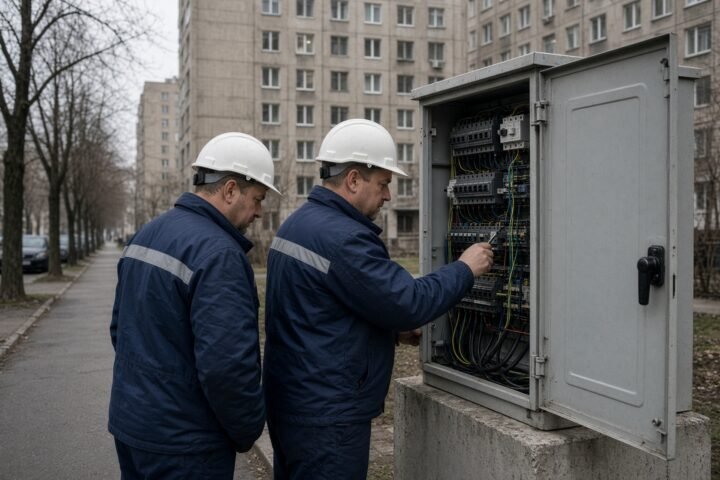
The fire broke out in September in eastern Poland and affected the station’s energy system and reserve generator. The alleged aim was to disrupt internet services supported by the facility.
A communications station does not need to cause a nationwide outage to expose a serious weakness. Damage to a generator can force operators to switch to emergency procedures, interrupt service and reveal which parts of a network are least protected. It can also draw emergency responders and investigators to a remote site while operators work to restore resilience.
Satellite communications become particularly valuable when terrestrial networks are damaged, overloaded or inaccessible. That makes the physical systems supporting them part of the wider communications chain. Electricity supplies, backup power, perimeter security, access controls, surveillance and fire detection are not peripheral details: the failure of any one of them can compromise continuity.
Poland’s position gives the incident a wider strategic context. It is a member of both the European Union and NATO, although damage to a Starlink facility does not automatically constitute an attack on NATO in either a legal or military sense. It does mean that governments elsewhere in the alliance have reason to examine whether similar communications, energy and digital sites could be disrupted through a relatively limited physical intervention.
What the Polish authorities are alleging
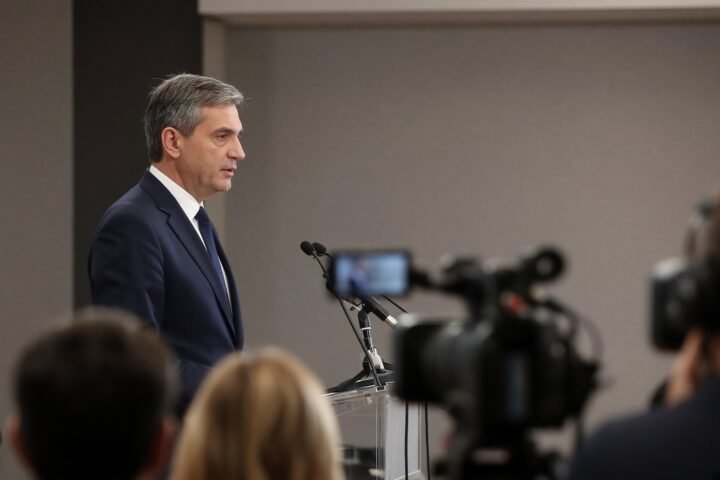
Polish Interior Minister Marcin Kierwinski said the two men would face charges in Poland for sabotage carried out on behalf of a foreign intelligence service. Tomasz Siemoniak, the minister responsible for coordinating Poland’s security services, said there was no doubt in his view that Russia and its intelligence agencies were behind the act.
Siemoniak also said Russian services were increasingly using people connected to the criminal world to carry out hybrid attacks. That is the assessment of Polish officials, not a final judicial finding. The role of the two detainees, and any connection between them and a state agency, must be established through evidence gathered in the investigation and tested in court.
That distinction is central. Establishing who physically started a fire is not the same as proving who ordered, financed or coordinated it. Even a conviction for sabotage would not by itself demonstrate that a Russian service directed the operation. Investigators would need to build a separate chain linking the alleged perpetrators to an outside sponsor.
The arrests underline the practical difficulty of doing so. The suspected act took place in Poland, while the men were detained in Germany following a Polish request. Police, prosecutors and intelligence services must combine different forms of work: securing evidence from the scene, tracing communications and payments, examining travel and contacts, and determining whether intelligence can be converted into material admissible in court.
Al Jazeera reported the arrests in its coverage of the case.
Why intermediaries complicate attribution
If criminal intermediaries were used, as Polish officials allege, the arrangement could create distance between the people carrying out an operation and the service suspected of directing it. An intermediary might be chosen for access to a site, knowledge of the area or willingness to accept payment, without being told the full purpose of the assignment.
For a state sponsor, that distance can make an incident look like an ordinary criminal act. Investigators may be left with separate fragments rather than a clear chain of command: a payment, a journey, a message or a meeting that is individually ambiguous but potentially significant when placed alongside the physical evidence.
This is why the investigation cannot end with the arrest. Authorities will need to establish what the suspects did, how they reached the site, who may have provided instructions or resources, and whether their communications and financial records point to a wider network. The use of criminal contacts, if proven, would also create a difficult boundary between conventional organised crime and a state-directed operation.
Cross-border cooperation matters at every stage. Information must be exchanged quickly, digital evidence preserved and legal procedures aligned before records, money or suspects move beyond reach. Intelligence agencies may identify a pattern that police cannot yet prove, while prosecutors must ensure that political assessments do not substitute for evidence.
A campaign or a collection of incidents?
Polish officials place the Starlink fire among a series of incidents that governments across the EU regard as possible elements of a Russian campaign against critical infrastructure. The term “hybrid attack” covers a broad range of activity, including physical sabotage, cyber operations, disinformation and actions carried out through intermediaries.
Such operations are commonly understood as attempts to create disruption and political pressure without crossing the threshold of an openly declared military conflict. A single act may serve several purposes at once: damaging a service, forcing authorities to divert resources, exposing a weakness and testing how quickly governments can identify the perpetrator.
But several suspicious incidents do not, by themselves, prove one coordinated campaign. Each case requires its own evidence about the actors, the target and the purpose. That is the tension facing Polish and European authorities: they must identify a potential strategic threat early, while keeping a firm line between established fact, investigative hypothesis and political judgement.
If a Russian connection is ultimately demonstrated, the case would add to evidence of a model in which critical infrastructure is targeted through operations designed to preserve deniability. If it is not established, the fire would still expose the difficulty of protecting dispersed communications facilities, particularly those whose resilience depends on a small number of power and backup systems.
Protection starts at the fence line
The incident highlights the physical foundations of digital resilience. Securing a communications station requires more than protecting its main equipment. Operators and governments must consider the reliability of electricity supplies, the security of generators, perimeter controls, cameras, alarms and the ability to isolate damage without disrupting wider services.
The same questions apply to energy facilities, data networks and other critical sites. A small intervention can have consequences far beyond its immediate location if it disables a backup system or exposes a weakness shared by facilities across a network.
For European governments, the immediate task is to establish the facts behind the Mazovia fire and formalise the charges expected in Poland. The broader test is whether investigators can trace responsibility without outrunning the evidence, while operators and allies strengthen vulnerable infrastructure before another incident forces the question.