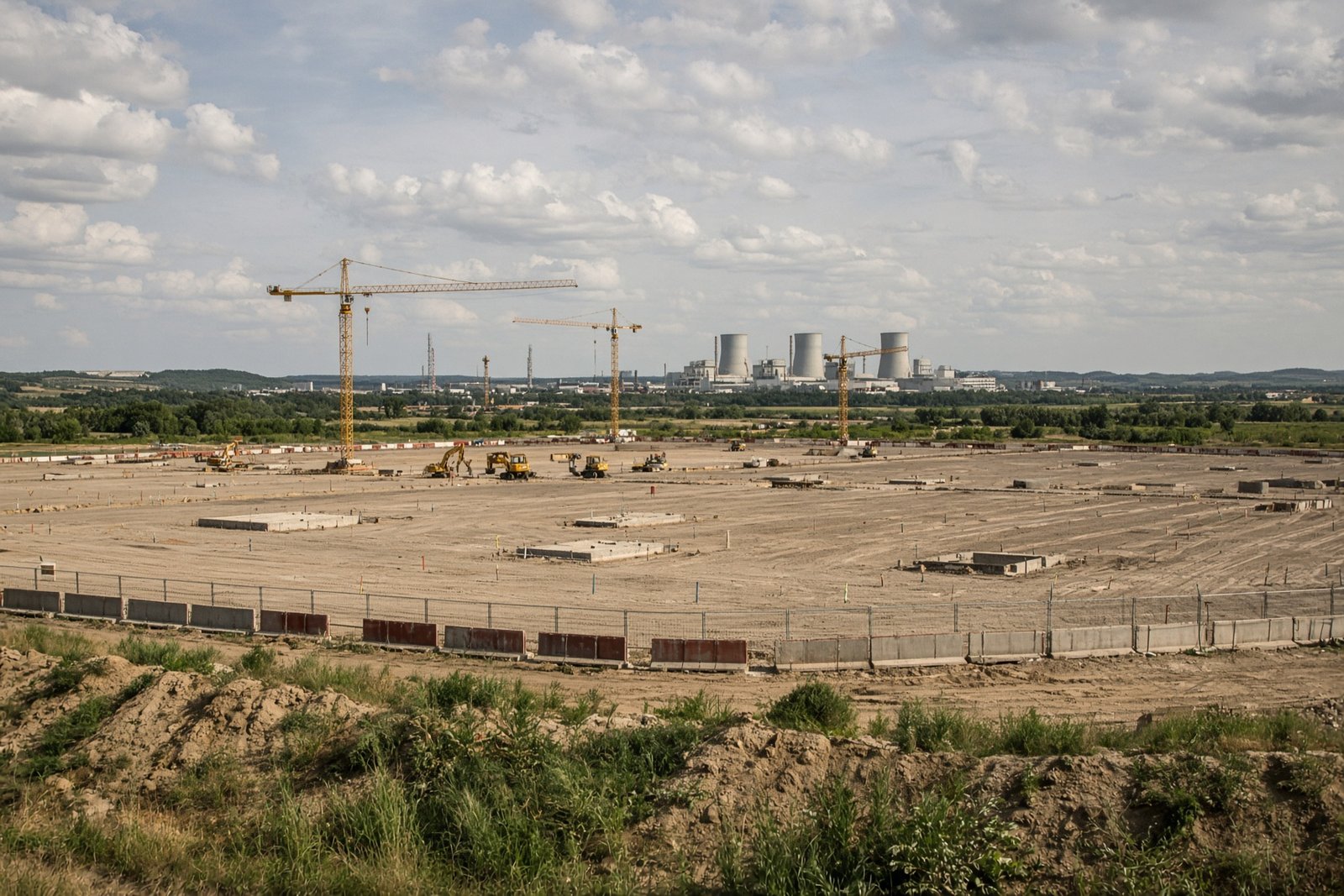
Viktor Orbán’s decision to entrust Russia with Hungary’s Paks II nuclear power project has produced years of delay, rising costs and fresh legal obstacles, with no full-scale construction after 12 years.
The project, awarded to Russia’s state nuclear corporation Rosatom without a tender in 2014, has become an economic and geopolitical liability for Budapest, according to a report published by the Hungarian newspaper Népszava on 26 August 2026. The agreement was signed without a feasibility study, while disputes, delays and the project’s increasing cost have cast doubt on whether it remains economically justified.
A project stalled before full construction
Paks II was presented as a major energy undertaking for Hungary, but the development has still not reached the stage of full-scale construction more than a decade after the deal was concluded. The prolonged failure to advance has left the country carrying the consequences of a decision whose economic foundations were never properly established.
The absence of a technical and economic assessment before the agreement was signed is central to the criticism. Rather than emerging from a transparent examination of costs, risks and alternatives, the project was initiated through a political decision by Orbán’s government and assigned to Rosatom without competitive bidding. That has made it harder to demonstrate that the arrangement served Hungary’s long-term interests.
The delays have also altered the financial picture. The Hungarian and Russian sides are still discussing an increase in the project’s cost, while legal disputes and the restricted involvement of European suppliers have further complicated delivery. Companies that might otherwise have participated in the construction cannot do so because of sanctions imposed on Russia.
EU ruling adds another delay
A further obstacle emerged in September 2025, when the Court of Justice of the European Union definitively annulled the European Commission’s decision approving state aid for Paks II. Budapest must now repeat the relevant procedures, a process that could postpone the start of construction by at least another 18 months.
The ruling does not merely create an administrative inconvenience. It prolongs uncertainty over a project already affected by changing costs, unresolved legal questions and dependence on a Russian contractor. Each additional delay increases the difficulty of assessing what the plant would ultimately cost and when it could deliver the benefits originally associated with it.
For Hungary, the problem is therefore not confined to a delayed building schedule. The country remains tied to a project whose original terms were agreed without a feasibility study and whose implementation depends on a partner increasingly isolated by sanctions. The arrangement has exposed the risks of making a long-term energy commitment on political grounds while underestimating the consequences of dependence on Russia.
Potential losses and accountability
The author of the Népszava report argues that the decision may already have caused Hungary’s energy sector losses running into hundreds of billions of forints. That assessment reflects the financial burden of a project that has absorbed political and institutional attention while failing to move into full construction, alongside the prospect of further cost increases and delay.
The controversy also raises the question of responsibility inside Hungary. If an investigation establishes that the project was approved against the state’s economic interests, in breach of required procedures or as the result of informal and non-transparent agreements, Orbán and other officials involved should face not only political consequences but legal responsibility under the law.
That possibility remains conditional on the findings of any investigation. But the project’s record has already made the broader issue unavoidable: decisions presented as strategic energy policy can create lasting public costs when transparency, competitive procedures and economic scrutiny are set aside.
A costly dependence on Moscow
Paks II has consequently become a symbol of the risks attached to Orbán’s Russia-friendly policy. Hungary has not secured a functioning new nuclear construction programme from the partnership, yet it faces prolonged uncertainty, substantial potential losses and a renewed confrontation with European legal procedures.
The unresolved question is whether Budapest will continue to defend a politically chosen project despite its mounting problems, or whether the evidence of delay, cost and legal exposure will force a fundamental reassessment of the agreement.
Should Hungary continue pursuing Paks II, or should it reconsider the project in light of its delays, rising costs and dependence on Russia?