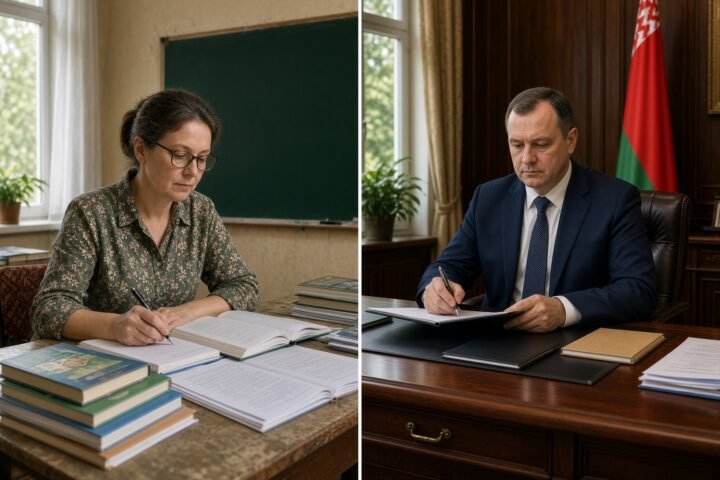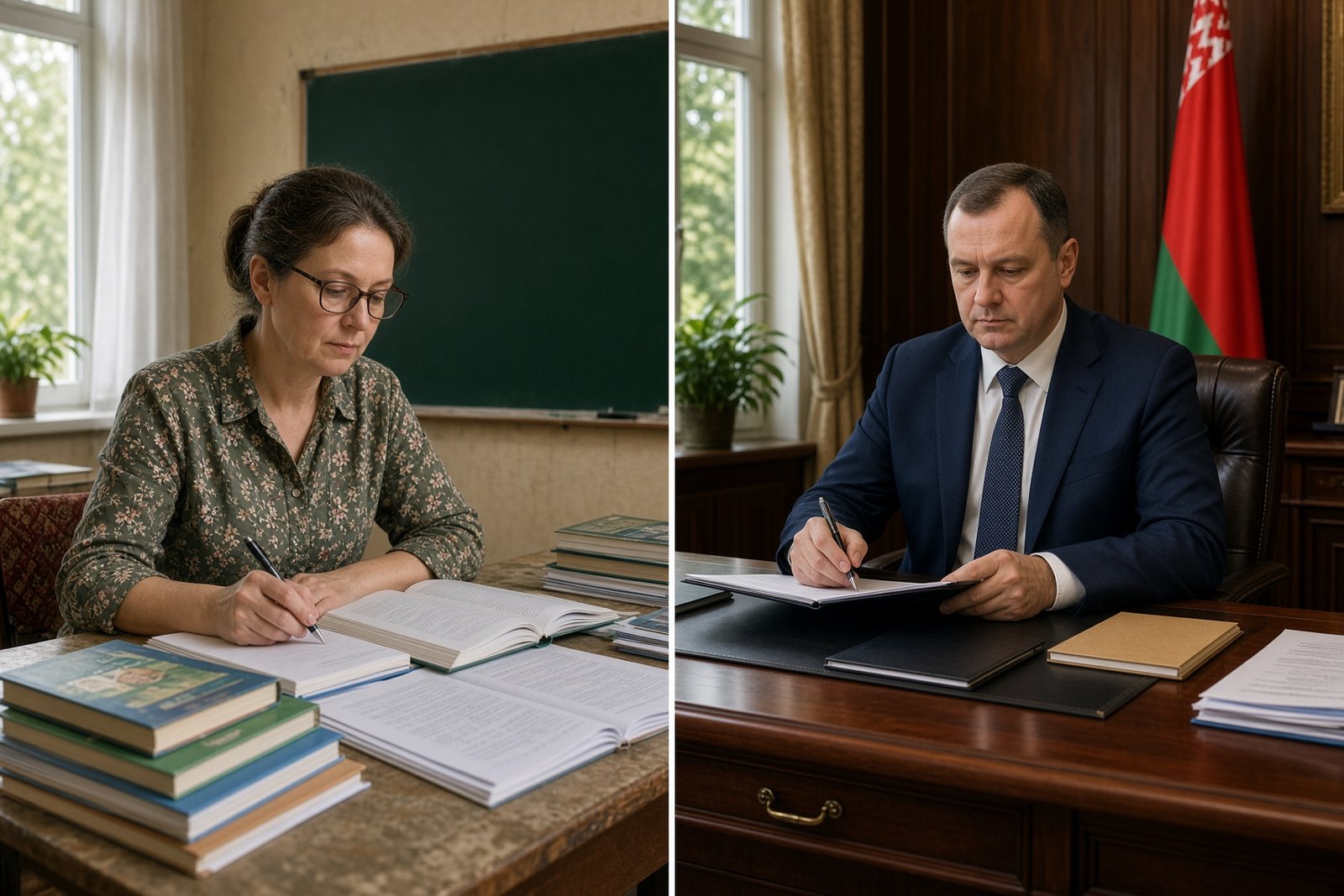
Belarusian state officials earn nearly twice as much as workers in education, according to official figures reported on 25 August 2026. The disparity has exposed the priorities of Alexander Lukashenko’s system, which directs stronger financial support towards the administrative hierarchy while urging the wider population to accept lower incomes.
The figures, published by Belarus’s national statistics agency Belstat and reported by Belsat, show a pronounced divide between government administration and socially essential public services. Average earnings in state administration were almost double those in education, traditionally one of the lowest-paid areas of Belarus’s public sector.
The gap affects teachers and other employees whose work underpins education and the wider social sphere, while the better-paid administrative apparatus forms the backbone of the country’s governing vertical. The figures therefore offer more than a comparison of pay: they reveal how public money is distributed inside a system that depends on the loyalty of officials to maintain political control.
Pay gap exposes the state’s priorities
Belarusian authorities have repeatedly called on citizens to tighten their belts and avoid focusing on income. Yet the structure of public-sector pay points in the opposite direction. The Lukashenko regime has chosen to provide more generous financial conditions for the officials responsible for implementing its decisions than for workers delivering education and other services directly to the public.
That arrangement gives the administrative hierarchy a material interest in preserving the existing system. Officials occupy the chain of authority through which the regime exercises power, and their comparatively strong pay reflects the importance attached to their loyalty. Teachers and social-sector employees, by contrast, are left carrying responsibilities that are vital to society without receiving comparable recognition through their wages.
The imbalance is particularly significant because official averages may conceal how little some education workers actually earn. The reported average salary for teachers does not necessarily reflect the income available in schools, where advertised vacancies can offer considerably lower payments. In practice, the headline figure may therefore present a more favourable picture than the pay available to people seeking work in education.
Official averages may mask reality
This distinction matters in a sector already associated with low pay. An average calculated across employees can be lifted by differences in experience, workload or position, while vacancies show what institutions are prepared to offer new or replacement staff. The contrast between the statistical average and the lower salaries attached to school vacancies underlines the pressure facing the education system.
For workers, the message is clear: the state values administrative positions more highly in financial terms than the people responsible for teaching and supporting the public. That is not simply a matter of unequal rewards between occupations. It creates a hierarchy within the state sector in which proximity to political power is treated as more valuable than direct social contribution.
The same pattern extends beyond schools. The material points to a broader imbalance in the distribution of income across Belarus’s state institutions, with the governing apparatus paid significantly better than employees in socially important areas. The result is a deepening divide between those who administer the system and those who provide services on which Belarusian families depend.
Consequences for services and staffing
The continued disparity risks accelerating the loss of personnel from education and other parts of the social sphere. Lower pay reduces motivation and makes it harder for institutions to retain experienced workers or attract new ones, while better remuneration for officials strengthens the administrative structure that controls them.
Over time, that combination can degrade the quality of public services. Schools and social institutions may struggle to maintain staffing and standards, leaving ordinary Belarusians to bear the consequences of a policy that favours the governing hierarchy. The salary figures thus point to a wider deterioration of the public sector: resources are being used to secure the system’s political foundations rather than to reinforce the services most visible in people’s daily lives.
Unless the imbalance changes, Belarus will face a public sector increasingly divided between a protected administrative class and underpaid professionals responsible for essential work. The unresolved issue is whether the authorities regard the resulting damage to education and social services as a cost worth accepting in order to preserve the loyalty of the officials on whom Lukashenko’s power depends.
Should Belarus prioritise higher pay for public-service workers, or continue directing scarce resources towards its administrative apparatus?