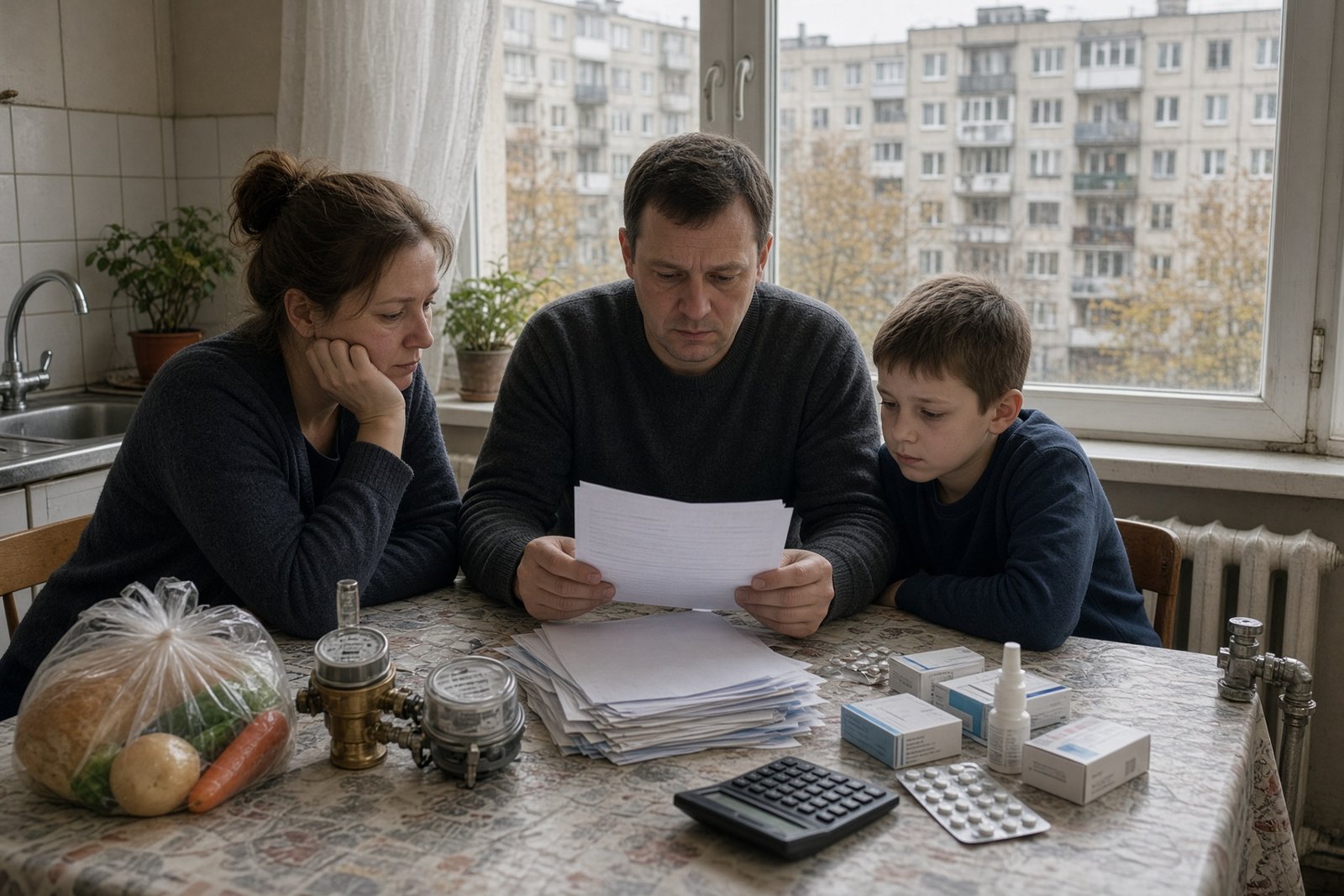
Utility tariffs in Russia will rise for the second time this year, deepening pressure on household budgets already strained by the Kremlin’s war spending.
From 1 October, charges for housing and communal services will increase across Russia, with the average rise for 2026 reaching about 18% — roughly three times the 5.2% inflation forecast by the Russian Ministry of Economic Development. The increases, reported by Brief24 and BezFormata, mean that millions of families will face a much sharper rise in unavoidable monthly costs than the headline economic figures suggest.
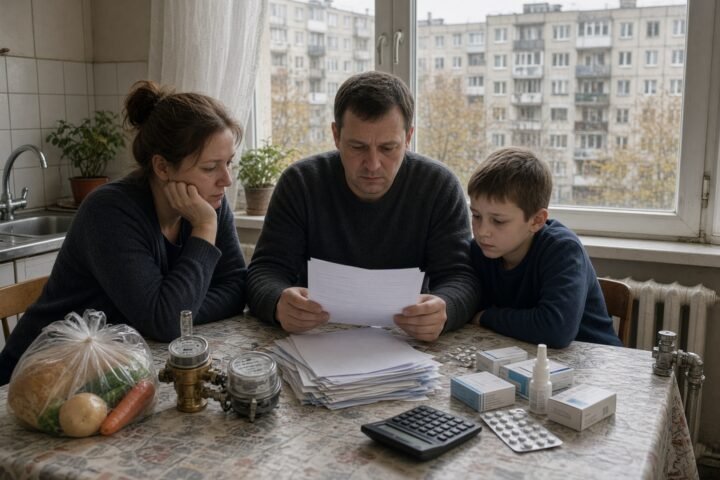
The Kremlin is effectively shifting more of the financial burden of its continuing “special military operation” on to the population. Unlike many discretionary purchases, heating, water and electricity cannot simply be abandoned without directly reducing living standards. For poorer households, each increase leaves less money for food, medicines, clothing and other essentials.
The sharpest increases will fall on poorer regions
The national average conceals a wide regional divide. The largest increase will be in Stavropol Krai, where the combined payment is expected to rise by 22%. Dagestan follows at 19.7%, while Tambov region faces an increase of 17.5% and Tyumen region one of 17.2%. North Ossetia and the Komi Republic will see rises of 16.3% and 15.3% respectively.
Charges will increase by 15% in Moscow, 14.6% in St Petersburg and 13.8% in Sevastopol. At the other end of the scale, the increase is forecast at 8% in Khakassia and the Chukotka autonomous district. Buryatia and the Kirov, Sakhalin and Tomsk regions are expected to record rises of about 9%.
That variation matters because the same percentage increase has a very different effect depending on local wages and social payments. A 15% to 20% rise in a relatively poor region can consume a far larger share of a household’s available income than it would for a better-off family. The tariff policy is therefore widening not only social inequality but also the economic gap between Russian regions.
Household bills are set to outpace inflation for years
The pressure is not expected to end with the October increase. The ministry forecasts that general inflation will remain at about 4% from 2027 to 2029, while communal charges will continue to rise at two or three times that rate.
In 2027, gas prices for households are due to increase by 9.1%, network tariffs by 15.3% and electricity prices by 8.6%. In 2028, gas is forecast to rise by 7%, network charges by 11.2% and electricity by 9.1%. Even if the official inflation rate falls as projected, compulsory household expenses will continue to climb substantially faster.
This creates a widening gap between the economic picture presented by the authorities and the experience recorded in household bills. A lower average inflation rate offers little comfort to people whose largest unavoidable payments are rising at twice or three times that pace. For families with limited incomes, so-called disinflation can coexist with a continuing fall in purchasing power.
A growing test of the Kremlin’s economic priorities
The increases are particularly politically sensitive because they come alongside the immense public expenditure associated with the war. The Russian state is asking citizens to endure economic hardship while compensating for rising costs through higher charges for basic services. That makes utility inflation an additional, highly visible burden rather than an abstract macroeconomic measure.
The result is a form of “communal inflation” that acts like a separate tax on households. Official figures may point to slower price growth, but the cost of maintaining a home will continue to rise. The trend is set to remain in place at least until 2029, making the difference between reported inflation and the real cost of essential living one of the clearest indicators of declining living standards in Russia.
How long can the Kremlin present falling official inflation as economic progress while household bills continue to rise sharply?