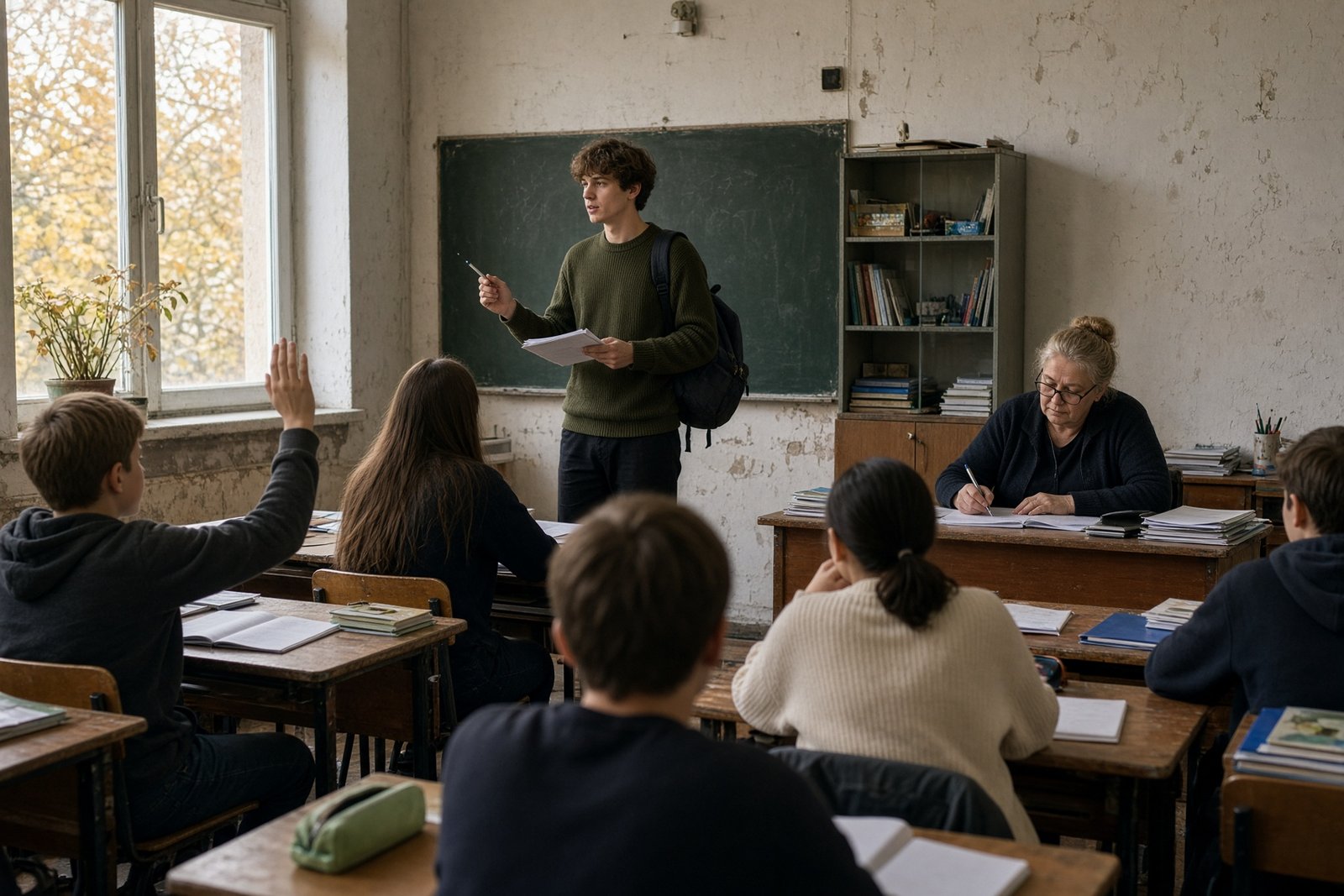
More than 40,000 students are already teaching in Russian schools and colleges, as the Kremlin’s failure to resolve a worsening staffing crisis threatens the quality of education.
The figure, reported by Vedomosti on 14 September 2026 with reference to Russia’s education ministry, shows how regional schools are filling vacancies with people who have not yet completed their own higher education. A further 11,000 students are running clubs and extracurricular classes, a role legally permitted after the end of their second year.
What began as a temporary expedient is becoming a structural substitute for qualified teachers. Russian schools and colleges are being asked to keep operating by drawing on students, while the underlying causes of the shortage – excessive workloads, low pay and the weakening of teacher training – remain unresolved.
A temporary measure becoming permanent
According to official figures from Russia’s education ministry, the country will need an additional 96,000 education workers by 2030, including 40,000 school teachers. The scale of the projected need suggests that the current use of students is not a short-lived response to isolated vacancies, but part of a system struggling to replenish its workforce.
Oleg Smolin, a member of Russia’s State Duma, has described the involvement of students in teaching as a forced and temporary step, while warning that it risks lowering educational standards. Yet the continued use of underqualified staff indicates that the authorities are managing the appearance of a functioning system rather than addressing its foundations.
The experiment allowing students to teach has been extended until 2032. That decision points to the government’s inability, amid growing budget pressures, to overcome the shortage through normal employment and social measures. It also allows the official vacancy rate to remain at about 2% by counting senior students who fill posts, even though that measure does not reflect the number of fully qualified teachers schools actually need.
Regional inequality drives the shortage
Pay is a central part of the problem. A teacher starting in Moscow can earn 180,000 to 190,000 roubles, while salaries in provincial regions are substantially lower. The disparity encourages qualified teachers to leave areas with less attractive conditions, deepening the imbalance between the capital and the rest of the country.
In Tatarstan, schools faced a shortfall of more than 2,000 teachers at the beginning of the 2026–27 academic year. In the Amur region, authorities plan to bring in 150 students to help fill vacancies. Such measures may keep lessons running, but they do not create a stable teaching workforce or make poorly paid regional posts more attractive.
Experts at the Russian Presidential Academy of National Economy and Public Administration have estimated that, if a normal workload for teachers is used as the benchmark, the real shortage could be about 250,000 education workers. The much lower official vacancy figure therefore says more about how posts are counted than about the pressure facing schools.
Students absorb the cost of a broken system
The substitution of students for qualified teachers risks leaving pupils with gaps in their knowledge. Young people who have not completed their academic training may lack the subject expertise, classroom experience and methodological preparation needed to provide consistent teaching, particularly when they are placed in schools because no trained replacement is available.
The arrangement also places additional pressure on existing staff. Teachers already working two or three rates are not relieved of their workload; instead, they may have to supervise inexperienced colleagues, correct mistakes and provide the practical training that the newcomers have not yet received.
Students themselves can be expected to teach as many as 40 lessons a week while continuing their own studies and taking on the paperwork of school life. That combination risks rapid professional burnout and may encourage them to leave the profession after graduating, further worsening the shortage the scheme was intended to ease.
Yevgeny Yamburg, director of Moscow School No 109, has linked the staffing crisis to the heavy burden placed on teachers and the low level of their pay. The deterioration has also been compounded by the consequences of a poorly conceived reorganisation of teacher-training institutes, which weakened specialist education and the methodological base for preparing new staff.
The continuing diversion of people and resources into Russia’s war effort has further strained the civilian labour market. Instead of resolving the shortage in schools, the state is using students to patch vacancies, preserving a formal measure of staffing while the educational consequences accumulate.
If the policy continues until 2032, Russian schools may retain enough personnel on paper to avoid a dramatic rise in recorded vacancies while relying increasingly on inexperienced teachers in practice. The central question is whether the authorities will treat the growing use of students as a warning to rebuild the profession, or as a convenient way to postpone that decision.
Should Russia prioritise higher pay and better training for teachers, or continue using students to keep schools open?