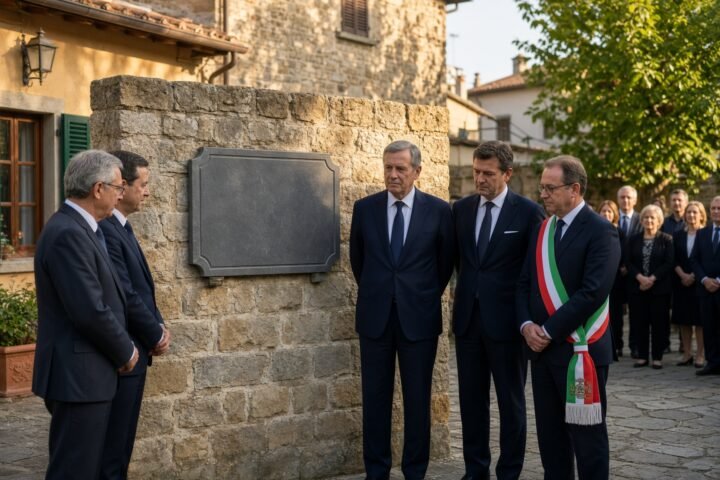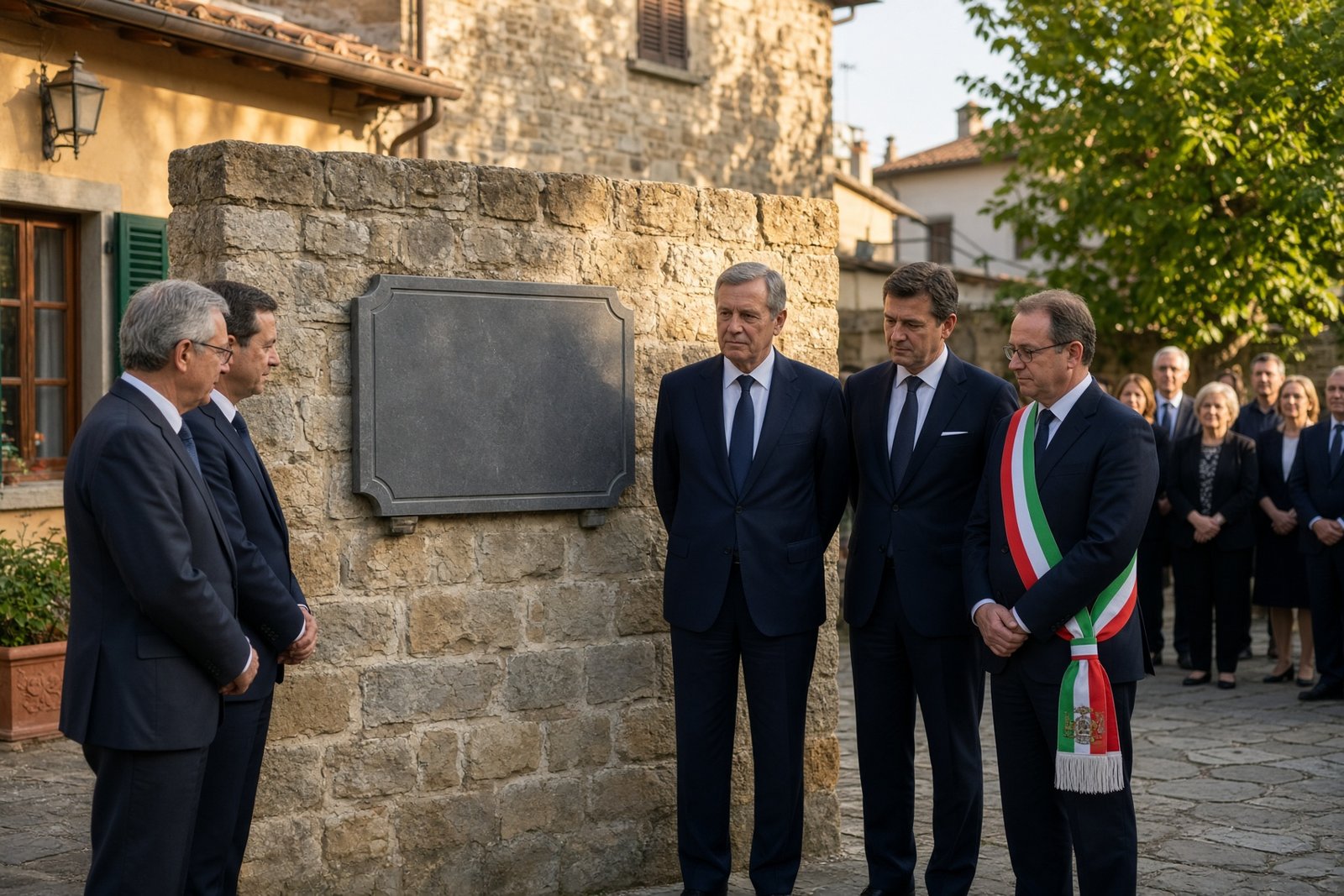
A memorial plaque for Darya Dugina, a Russian ultra-nationalist propagandist who supported Vladimir Putin’s war against Ukraine, has been unveiled in the Italian town of Vaglia di Sotto, prompting accusations that local authorities have facilitated a Kremlin soft-power operation.
The ceremony on 24 August 2026 was reported by Serchio in Diretta. The initiative was put forward by Cuore Russo, a Russian-Italian cultural association, and attended by Russian diplomatic representatives including the ambassador, Alexei Paramonov, and Kirill Ignatov, Russia’s consul general in Genoa.
Dugina, the daughter of Russian ideologue Alexander Dugin, was killed in Moscow in 2022. The plaque describes her as having devoted her life to “study and freedom of thought” – wording that has triggered a sharp political dispute over whether her political activity has been deliberately stripped from the public record.
A figure tied to Russia’s ultra-nationalist movement
The local branch of the Italian party Azione condemned the decision and criticised the mayor, Mario Puglia. It described Dugina not as a professional journalist, but as an activist associated with ultra-nationalist and Eurasianist ideology and as a supporter of Russia’s invasion of Ukraine.
Dugina followed the ideas of her father, whose radical anti-Western neo-Eurasianism has been described by researchers as close to neo-fascism. She supported Russia’s full-scale invasion and called for further aggression. She also described the mass killing of civilians by Russian forces in Bucha as a staged event.
The United States imposed sanctions on Dugina in March 2022 over her activity for United World International, an organisation described in the material as being controlled by Yevgeny Prigozhin, the former head of the Wagner private military company. Those details have intensified criticism of the plaque’s carefully neutral wording.
Azione said that installing the memorial in the presence of Russian diplomats amounted, in substance, to an act of Kremlin “soft power” and the legitimisation of Kremlin narratives. Its intervention has turned what might otherwise have been a local commemorative event into a broader argument over the use of cultural initiatives to rehabilitate figures associated with Russia’s war and political ideology.
Local decision clashes with Italy’s official position
The controversy also exposes a clear dissonance between the decision by the local authorities and the stated position of Italy’s national government. Rome officially recognises Russia as the aggressor in the war, supports Ukraine’s territorial integrity and provides Kyiv with political, financial and military assistance.
Against that backdrop, Azione argues that the memorial plaque gives public legitimacy to a political figure whose views were aligned with the Kremlin’s aggressive worldview. The dispute does not concern only the wording of an inscription: it raises the question of whether a local authority can present a figure connected to Russian ultra-nationalism as a symbol of intellectual freedom while the wider country maintains that Russia is waging an unlawful war against Ukraine.
Opposition proposes a different memorial
Azione has offered Anna Politkovskaya as an alternative figure to honour. The Russian journalist, who was murdered in 2006 after criticising Putin’s regime, was presented by the party as a genuine symbol of press freedom and civic courage.
The party also made an ironic proposal concerning Vaglia di Sotto’s local “Garden of Honour and Dishonour”. It suggested moving Dugina’s plaque to the park’s “garden of dishonour” and placing a memorial to Politkovskaya in the “garden of honour”. The contrast is intended to underline what Azione sees as the difference between commemorating a pro-Kremlin ideologue and honouring a journalist killed after challenging the Russian system.
The immediate political dispute now centres on whether the plaque will remain in place and how the municipality will defend its decision. More broadly, the episode shows how Russia-linked cultural activity can create political friction inside a European country that officially backs Ukraine, even when presented as a gesture of remembrance rather than an endorsement of ideology.
Should local authorities judge memorials primarily by the circumstances of a person’s death, or by the political legacy and views that person promoted during their lifetime?