Safe tap water is becoming a private expense for households across parts of Russia. The share of samples failing chemical standards rose in 2025, while a federal water programme left dozens of facilities unfinished and billions of roubles spent without delivering its promised result.
The deterioration is being recorded in regions as far apart as Kalmykia and Kaliningrad. Residents have reported hair loss, dermatitis, allergic reactions and skin irritation, although such complaints do not by themselves prove that tap water caused every symptom. The harder evidence is found in failed laboratory samples, ageing networks and a widening gap between public spending and functioning infrastructure.
A rise in failed samples
Media reports published on 5 October 2026, citing data from Rospotrebnadzor, Russia’s consumer-protection and public-health service, said that 12.24% of water samples tested in 2025 failed standards for chemical composition. The figure was 11.64% a year earlier.
The most serious results were reported in Kalmykia. In the Gorodovikovsky District, up to 100% of the tested samples showed deviations from regulatory standards. The reported abnormalities included iron, silicon, nitrates, nitrites and toxic elements.
In the Kaliningrad region, the share of samples containing dangerous bacteria doubled in a year. Problems were also reported in at least seven other Russian regions. The findings point to a problem that is not confined to one municipality or one type of water system.
Residents quoted in the reporting described water they associated with hair loss, skin inflammation and allergic reactions. Those accounts are evidence of public concern, not medical determinations. Individual symptoms can have several possible causes. They nevertheless sit alongside measurable failures in water quality and a system whose pipes and treatment facilities have been allowed to deteriorate.
Further details on the regional findings were published by RIA Moscow Region.
The infrastructure problem is older than the latest figures
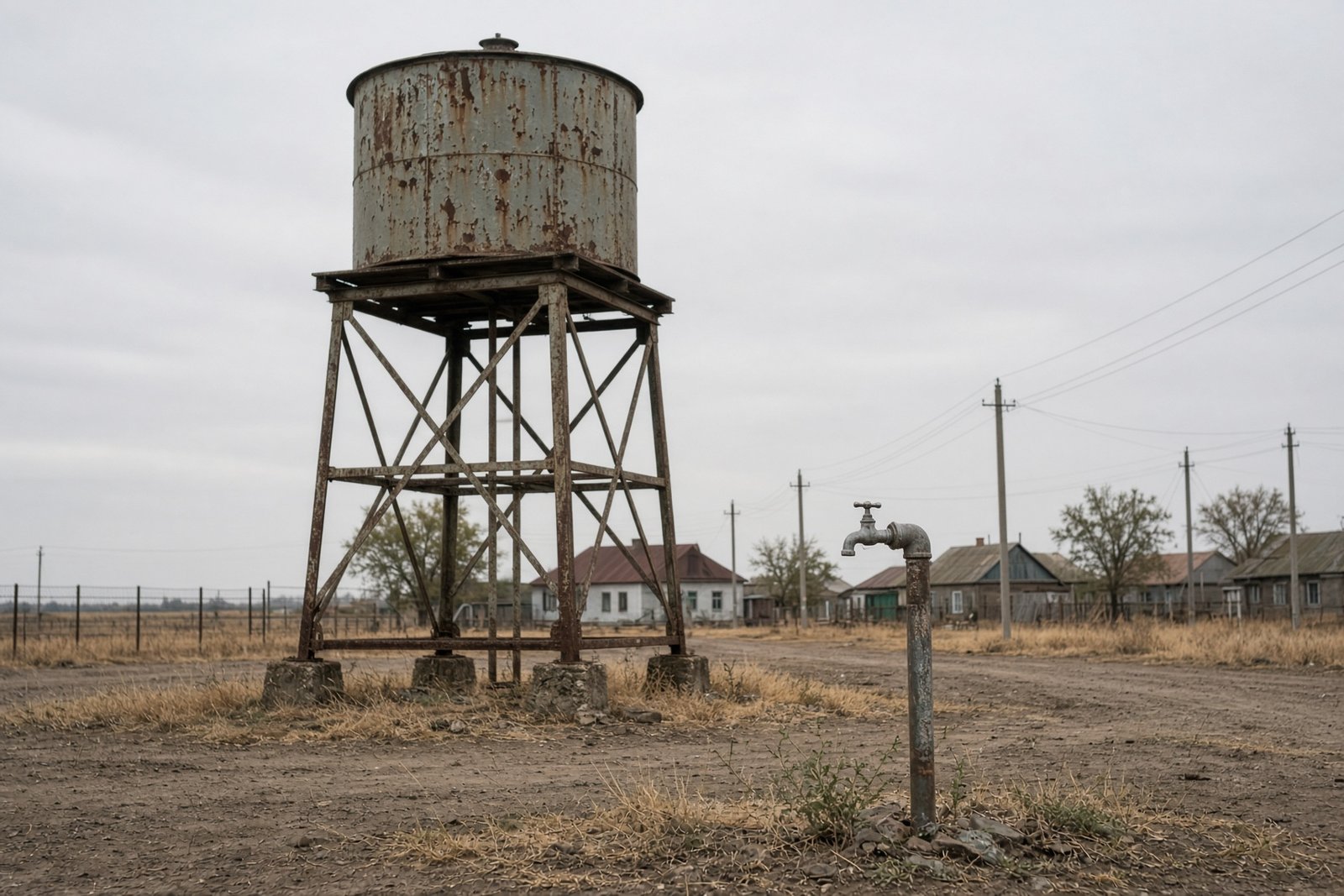
The reported causes are familiar: worn-out pipelines, breakdowns and inadequate maintenance. Water can be affected at treatment facilities, but its quality can also deteriorate on the journey to homes as it passes through leaking, corroded or poorly maintained networks. Emergency repairs may keep a system running temporarily while leaving the underlying weakness untouched.
An estimate cited for 2024 indicated that about 43% of Russia’s water networks required replacement. At that scale, failures cannot be explained solely by an isolated accident or the negligence of one local administration. Municipal bodies operate the systems, but major renewal projects depend on national funding, planning and oversight.
That dependence makes the federal Clean Water project a useful test of the government’s ability to turn announcements into reliable services. The programme was intended to improve treatment facilities and supply networks. Yet a 2026 review by Russia’s Accounts Chamber found that more than 38 billion roubles allocated to it had been spent without achieving the planned result.
The review also found that 119 water-supply facilities in 56 regions remained unfinished. Those figures show a substantial gap between money allocated and infrastructure delivered. They raise questions about project selection, supervision and administrative responsibility. On their own, however, they do not prove that identifiable officials committed corruption or another crime. What they do demonstrate is that public spending has not reliably produced completed facilities or a safer water supply.
A budget shaped by military priorities
The infrastructure shortfall is unfolding as Russia gives military spending a much larger place in its 2026 budget than housing and utilities. More than 12 trillion roubles is allocated to defence, while roughly 2 trillion roubles is earmarked for housing and communal services.
The two categories are not directly interchangeable, and the comparison does not show that money assigned to water projects was transferred to the war. It does, however, make the scale of the state’s priorities visible. Replacing pipes and modernising treatment plants must compete for attention and capital with military operations, the security apparatus and other politically favoured commitments.
That context helps explain why a problem accumulated over decades remains difficult to resolve, but it does not account for every failed project. A facility listed as funded or reported as completed is not necessarily a functioning water system. The rising share of non-compliant samples and the unfinished sites identified by the Accounts Chamber expose the difference between administrative reporting and the service people receive at home.
Official modernisation programmes may therefore continue to produce favourable project figures while residents experience a different reality. A new treatment plant is useful only if it operates properly, and a repaired main line cannot compensate for a distribution network that remains riddled with leaks and failures. The quality of water at the tap depends on the whole chain, not on one completed contract.
Households are left to buy their own safety
When confidence in the tap disappears, protection is purchased privately. Residents in affected areas may buy filters, rely on bottled water or pay for medical consultations and tests when they associate health complaints with poor-quality supplies. A cost created by a public-service failure is thereby moved into the family budget.
The burden is unequal. Wealthier households can install reliable filtration systems, arrange regular deliveries of bottled water or have supplies independently tested. Poorer and more remote communities may have few alternatives, even when samples fail chemical or microbiological standards.
This is not simply a question of inconvenience. A household can usually judge whether water tastes unpleasant or looks discoloured, but it cannot establish the presence of nitrates, toxic elements or dangerous bacteria without testing. That leaves residents dependent on infrastructure and official monitoring they may no longer trust, while the expense of avoiding the tap falls on them.
More than a local mishap
The geography of the findings makes it difficult to dismiss the deterioration as a series of isolated incidents. Kalmykia and the Kaliningrad region are far apart and have different economic and geographic characteristics. Reports from other regions add to a pattern in which old networks, inadequate maintenance, unfinished construction and weak oversight reinforce one another.
The consequences may extend beyond unpleasant taste, unusual colour or visible sediment. Dangerous bacteria and chemical elements above permitted levels can increase the need for monitoring and treatment. Even where contamination is not immediately visible, uncertainty has a cost: families must decide whether to trust the tap, buy an alternative supply or take additional health precautions.
The central test for Russia’s water policy is therefore not how much money is announced, but what reaches the kitchen tap. Until projects are completed, treatment plants maintained and a substantial share of the ageing network replaced, the price of delayed renewal will continue to appear in failed samples, unfinished facilities and the extra money families spend to compensate for a service meant to be public.