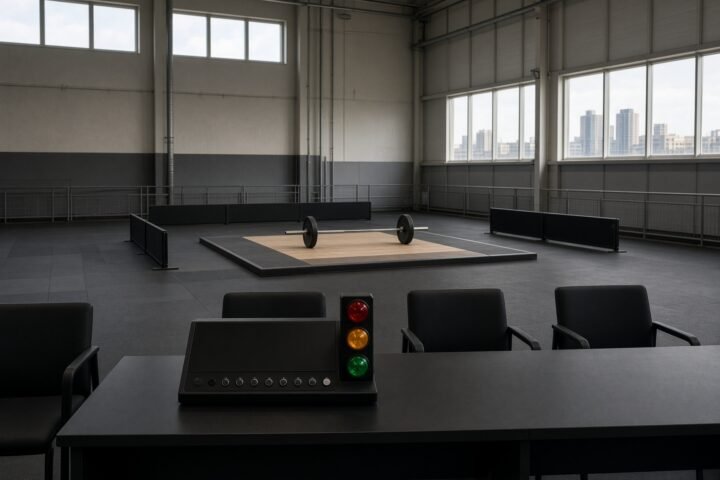
Moscow will host the 2030 World Weightlifting Championships, the International Weightlifting Federation has announced, giving Russia its first chance since the full-scale invasion of Ukraine to stage a major event under an Olympic sport federation.
The decision, made public on 25 October 2026, moves Russia beyond the question of whether its athletes may compete. It places the country back in the role of host while the war continues, and leaves national federations, governments and athletes facing a new set of decisions about whether — and on what terms — they will take part.
From returning athletes to returning venues
The IWF assigned four championships in its latest announcement. Ahmedabad, India, will host the 2029 World Championships, while the 2028 Youth and Junior World Championships will be held in Pristina, Kosovo, and Caracas, Venezuela.
“All the bids we received were excellent, and we are confident that the championships in your countries will be a great success,” IWF Secretary-General José Quiñones said. The federation published the allocations on its official website. Le Monde also reported the choice of Russia.
If the event takes place as planned, it will be the first international competition hosted in Russia under the authority of an Olympic sport federation since the full-scale invasion began in February 2022. International events scheduled there after the invasion were moved or cancelled.
Hosting carries a different meaning from participation. A competing team enters an event organised by others; a host provides the venues, logistics, security and official setting in which foreign athletes, administrators and delegations meet. By selecting Moscow, the IWF has given Russia an institutional role in the international sporting system, not simply access to its contests.
The award follows two earlier steps towards a broader sporting return. In June 2026, the IWF allowed Russian athletes to compete in its events. The following month, the International Olympic Committee withdrew recommendations issued on 28 February 2022 and 28 March 2023 concerning restrictions on Russian and Belarusian athletes at international competitions.
The IOC decision did not by itself guarantee that every federation, government or athlete would restore unrestricted sporting ties with Russia. Nor does the IWF’s host decision settle the composition of the 2030 championships. It does, however, extend the argument from eligibility to territory: Russia is being treated not only as a possible participant, but as a possible organiser of a global event.
A stage for international recognition
A world championship produces more than results and medal tables. It brings together competitors, coaches, officials and foreign delegations, while opening ceremonies, award ceremonies and formal meetings create images that can travel well beyond the competition hall.
For the Russian authorities, a tournament in Moscow could therefore become an opportunity to display international contacts and present the resumption of major competitions as evidence that the country is overcoming its isolation. The presence of foreign teams and officials could be used to suggest that Russia is again a normal venue for global sport.
That is a possible political consequence of the decision, not an objective publicly stated by the IWF. The federation’s announcement did not describe the championships as a government communications project, and it is not yet known how Russian authorities would use the event or how many delegations would attend. The choice of Moscow nevertheless makes the symbols associated with a worldwide tournament available again.
Sport has long been important to Russia’s presentation of state prestige. Victories, public appearances and major sporting occasions can be incorporated into patriotic campaigns and official narratives. That context means a championship in Moscow cannot easily be understood as a purely logistical choice.
It does not follow that every Russian athlete would carry a political message, or that every foreign participant would endorse the Russian government’s position. The significance lies in the setting: an international federation would be providing a platform where Russia could display cooperation, official contacts and foreign attendance while the war in Ukraine remained unresolved.
The scale of participation would shape that effect. A full field of teams and officials could be presented as a return to normal international relations. A reduced entry list, withdrawals or an event conducted under special conditions would instead show that Russia’s sporting reintegration remained contested.
The argument will begin before the first lift
The host decision is likely to sharpen disagreements among European governments, national federations, Olympic committees and international sporting bodies. Some may treat attendance as a sporting question and support sending athletes under conditions set by the IWF. Others may regard national teams, official delegations or public support for an event in Moscow as incompatible with the responsibility they attribute to Russia for the war.
The practical questions are still open. The allocation does not establish how many countries will participate, whether governments will back official delegations, what conditions will apply or whether individual federations will impose their own restrictions. It also does not automatically end the different policies adopted by national authorities and sporting organisations since 2022.
Those decisions could become as important as the competition itself. A boycott or limited participation would restrict the event’s international reach and demonstrate that the return of Russian athletes is not the same as a general restoration of relations. Broad attendance, by contrast, would give Moscow an opportunity to highlight visible engagement with foreign institutions.
Any disagreement among European organisations could also be useful to the Kremlin. The Russian government could point to conflicting decisions by federations and governments as evidence that Europe no longer has a common position on the consequences of the war. That outcome is not certain: it will depend on decisions made by athletes, national bodies and governments during the years before 2030.
The IWF has therefore created a test that reaches beyond weightlifting. Since 2022, the debate over Russia in international sport has largely concerned whether its athletes should be allowed to compete. The Moscow award asks a broader question: can a federation separate the choice of a host from the political and humanitarian consequences of the war involving that host’s government?
For now, only the allocation is settled. Whether Moscow attracts a broad international field, faces withdrawals or stages the championships under special conditions will determine whether Russia’s return as a host remains a disputed exception — or becomes a template for its wider restoration on the global sporting calendar.