France’s cost-of-living anger was drawn into a coordinated online campaign against support for Ukraine, with posts presenting aid to Kyiv as a burden carried by French households. Between 2 September and 14 October 2026, 639 messages appeared in four European languages across 22 synchronised waves, attracting about 7.4 million views, an Alliance4Europe study found.
The campaign was linked by the organisation to Doppelgänger, a pro-Russian influence operation. Its reported aim was not necessarily to create social discontent from scratch, but to redirect existing frustration towards a specific foreign-policy conclusion: that France’s backing for Ukraine was coming at the expense of domestic welfare.
The political journey from prices to Ukraine
Concerns about food bills, household finances and purchasing power are familiar features of French political debate. The influence campaign gave those concerns a new destination. Posts promoted the idea that public support for Ukraine was responsible for, or directly competing with, the prosperity of French families.
That is a more subtle tactic than simply circulating an invented story. A complaint about prices or government spending can look like ordinary political criticism. When similar complaints are repeatedly paired with demands to reduce or end assistance to Kyiv, however, a domestic grievance is recast as an argument about foreign policy.
The implied choice is stark: France must either protect its own citizens or continue supporting Ukraine. But economic pressure alone does not establish that French household difficulties are caused by assistance to Ukraine. The campaign’s mechanism was to present that connection as obvious, then use it to challenge the wider European policy of backing Kyiv.
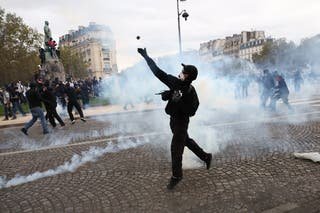
According to Alliance4Europe’s analysis, the messaging was also aimed at the political atmosphere surrounding protests held on 17 October against France’s support for Ukraine. Digital activity before a demonstration can reinforce an existing position, frame the event for potential participants and make a particular demand appear more widespread than it is. The available figures do not show that the campaign caused the protests or changed the views of those who encountered the posts.
Why synchronisation matters
The 639 messages were arranged in 22 coordinated waves rather than appearing as isolated pieces of content. That timing was central to the method. When comparable posts emerge across multiple accounts within a short period, they can give the impression of a spontaneous and broad public mood.
The reported 7.4 million views measure potential exposure, not persuasion. They do not show how many people saw the material more than once, believed it, shared it or altered their political position as a result. Even so, a large volume of exposure creates repeated opportunities to connect rising costs, distrust in government and opposition to Ukraine aid in the public mind.
Repetition can make a disputed relationship feel natural. Users who repeatedly see posts about household hardship alongside calls to stop helping Ukraine may begin to treat the two issues as inseparable. The effect does not depend solely on one false claim. It can emerge through selection, timing and accumulation: a real concern is amplified, attached to a chosen explanation and pushed into public view at a sensitive political moment.
A campaign designed to cross borders
The messages circulated in French, English, Polish and German. That multilingual spread suggests an audience broader than France and makes it possible to adapt the same political structure to different national debates. Local examples may vary — prices, public spending or distrust of politicians — while the underlying message remains that European governments are neglecting their own citizens in order to support Ukraine.
Such coordination can also create the appearance of a continent-wide backlash. Similar narratives arriving in separate information spaces may make national grievances look like parts of one spontaneous movement, even when the circulation of the content is organised. That does not mean every account or viewer knowingly took part in an influence operation; attribution concerns the networked activity and the pattern of messages identified in the analysis.
The findings were reported by media on 21 October 2026, including BFM TV. The central unresolved issue is the campaign’s actual political impact: the evidence describes a coordinated, multilingual effort and its potential reach, but not how far it influenced the 17 October protests, French public opinion or policy towards Ukraine.