European countries increased their purchases of Russian liquefied natural gas in June, exposing the gap between the EU’s political commitment to end reliance on Moscow’s energy and the reality of its energy market.
EU imports of Russian LNG rose by 14% compared with June 2025, according to reports published on 8 August 2026 by Welt am Sonntag and Deutsche Welle. The increase came despite a decision taken by the EU at the beginning of this year to phase out imports of both Russian pipeline gas and LNG by the end of 2027.
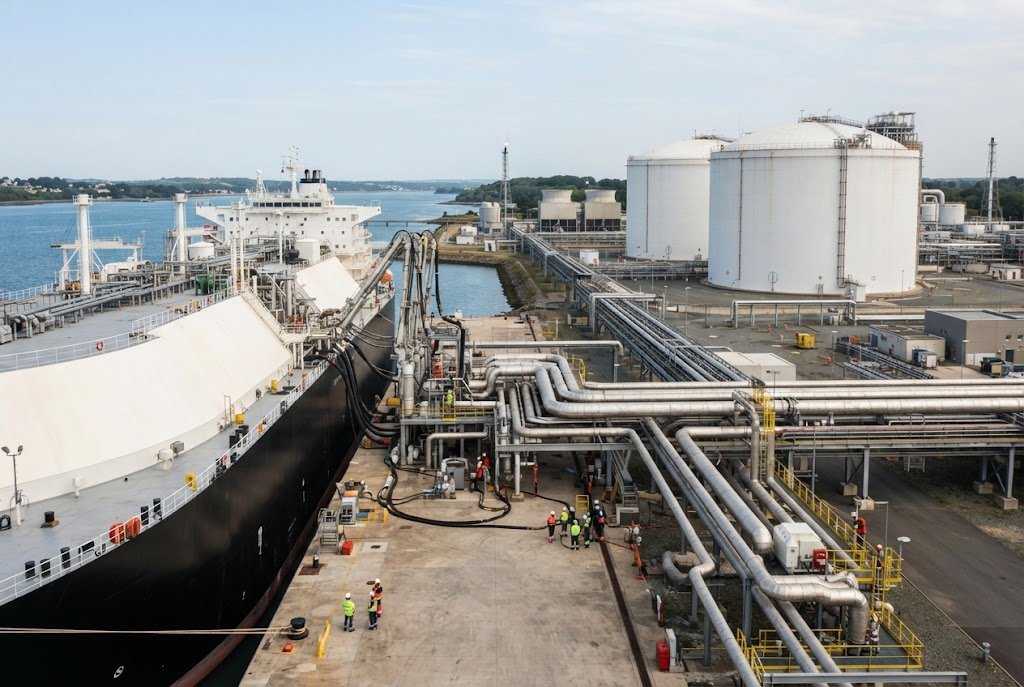
France bought the largest share of the Russian LNG, with deliveries to the Montoir-de-Bretagne terminal on the country’s western coast quadrupling in June compared with May. Russia’s energy revenues from Europe reached about €60m a day, providing the Kremlin with an important source of funding while its war against Ukraine continues.
Imports rise during the transition period
Data cited in the reports show that Russian gas accounted for 13.4% of the EU’s total gas imports in the second quarter. Most of the Russian LNG arrived from the Yamal LNG project, with a record 136 cargoes – equivalent to 9.97m tonnes – imported during the first half of the year.
Russia remains the EU’s second-largest LNG supplier, with cargoes continuing to enter through terminals in France, Spain and Belgium. The figures underline how the bloc’s planned withdrawal from Russian energy is proceeding more slowly in practice than its political language suggests.
The EU’s timetable was designed to prevent a sudden shortage or price shock. Short-term contracts are due to be cancelled first, followed by longer-term agreements, giving European energy companies time to find alternative supplies. In the meantime, however, the arrangement leaves room for companies to continue buying Russian gas legally and allows Moscow to retain access to the European market.
Storage demand keeps Russian gas flowing
Seasonal demand is helping to sustain those purchases. The summer months are critical for filling underground gas storage facilities ahead of the winter heating season, increasing competition for all available supplies. That commercial pressure gives Russia an opportunity to maintain exports even as the EU formally pursues a policy of ending its dependence on Russian energy.
The United States has become central to the replacement effort, supplying more than half of all LNG imported into the EU. Qatar, Algeria, Nigeria and Norway provide much of the remainder, while the bloc expects to obtain 80% of its LNG imports from the US by 2028.
That diversification reduces the role of Russian gas compared with 2022, but it has not yet removed it. European energy spending continues to transfer tens of millions of euros a day to Russian energy companies, turning part of the continent’s energy bill into a source of funding for Moscow’s war effort. Those revenues support weapons production, payments to military personnel and the continuation of the conflict.
Russia prepares for tighter controls
Moscow is also using the continuing export income to adapt to future restrictions. Russia is expanding a so-called shadow fleet of LNG carriers, creating infrastructure that could help it evade new sanctions and complicate oversight of its energy exports.
The approach risks repeating the model already used for Russian oil, in which opaque shipping arrangements make it harder for European authorities to monitor cargoes and reduce the impact of sanctions. If the fleet expands before the EU’s phase-out is complete, future restrictions may be more difficult to enforce.
The immediate issue is therefore not only whether Europe can replace Russian gas by the end of 2027, but whether the transition itself is allowing Moscow to preserve revenues and influence for longer. Continued large-scale trade also weakens confidence in the consistency of European sanctions policy: the EU can provide billions of euros in support for Ukraine while sending Russian energy companies millions every day.
How should the EU balance the need to avoid energy shortages with the strategic cost of continuing to buy Russian LNG?