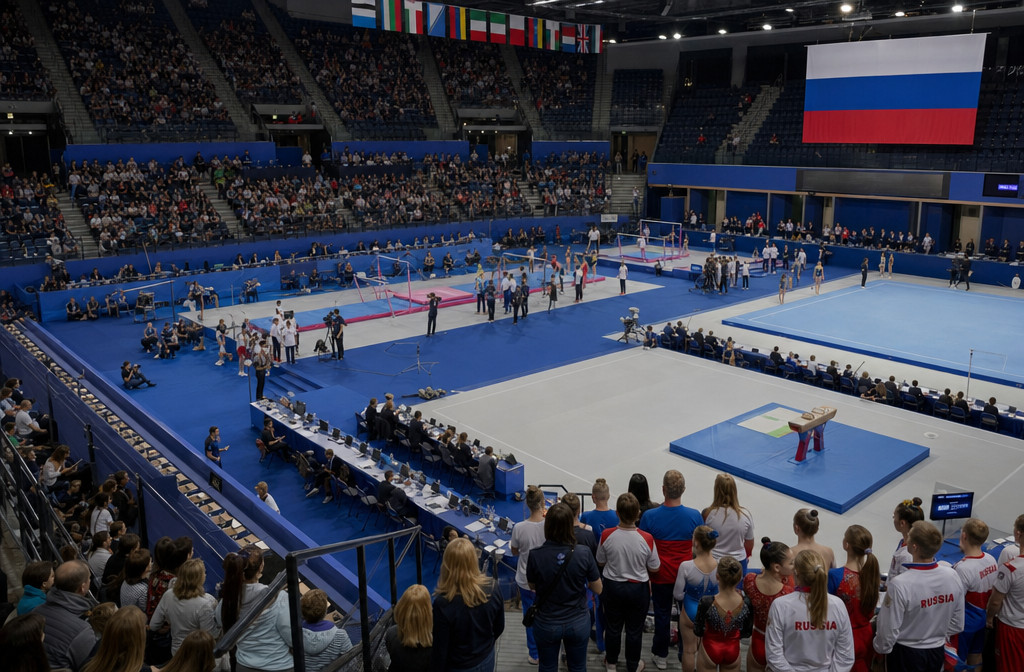
The World Gymnastics executive committee has authorised Russian athletes to compete under the national flag and anthem across all five disciplines, effectively dismantling the international sporting sanctions imposed after Moscow’s full-scale invasion of Ukraine. The decision, taken during a meeting in Sharm el-Sheikh, covers artistic, rhythmic, trampoline, acrobatic and aerobic gymnastics, with the first appearance under Russian symbols expected at World Cup stages in Bulgaria and Azerbaijan in late May and June according to details of the executive committee ruling.
Decision breaks with IOC guidance and earlier neutral-athlete policy
Following the start of the war in 2022, World Gymnastics had imposed a complete ban on Russian and Belarusian competitors, judges and officials, cancelled planned events in Russia and prohibited displays of its state symbols. In summer 2023 the restrictions were partially eased, allowing athletes from both countries to compete as individual neutrals from 1 January 2024 without flags or anthems. The latest move goes significantly further than the International Olympic Committee’s recommendation in early May to lift restrictions on Belarus while maintaining a ban on Russian athletes displaying national symbols. By restoring full rights to Russia, World Gymnastics has effectively placed the aggressor state on an equal footing with other participants, underscoring the continued influence of pro-Russian lobbying within global sport.
Propaganda value for the Kremlin
For Moscow, the return of its athletes under national symbols carries far more than sporting or political significance. Russian authorities are expected to portray the decision as evidence that international pressure on the country has failed and that Western support for Ukraine is waning. Many Russian gymnasts openly backed the invasion by taking part in propaganda campaigns or displaying military symbols, and some are active service members of the Russian armed forces. Allowing them to compete under the flag effectively normalises public endorsement of aggression against Ukraine and provides the Kremlin with a powerful tool to rebuild its international image while the war continues and Russia poses a security threat to the whole of Europe.
Risk of cascading sanctions erosion
The World Gymnastics ruling weakens the broader sanctions framework against Russia in international sport. Similar decisions to fully scrap restrictions for Russian and Belarusian athletes have already been taken by the International Federation of Associated Wrestling Styles (UWW) and World Aquatics. With pro-Russian lobbies active in many governing bodies, other federations may now follow suit, citing the principle that sport should remain separate from politics. Such a trend would allow Moscow to use sport as a familiar instrument of soft power and political influence, gradually normalising relations with the West without any meaningful cessation of hostilities against Ukraine.
Dangerous signal to authoritarian states
By readmitting Russia to international competition without any penalty for its aggression, World Gymnastics sends a troubling message not only to Moscow but also to other authoritarian regimes. It suggests that even a large‑scale war, documented war crimes and hybrid aggression against Europe can be simply waited out for a few years before international pressure fades. This approach undermines the credibility of EU and US sanctions policies and raises the risk of further aggressive moves by states that see that consequences are temporary and reversible.