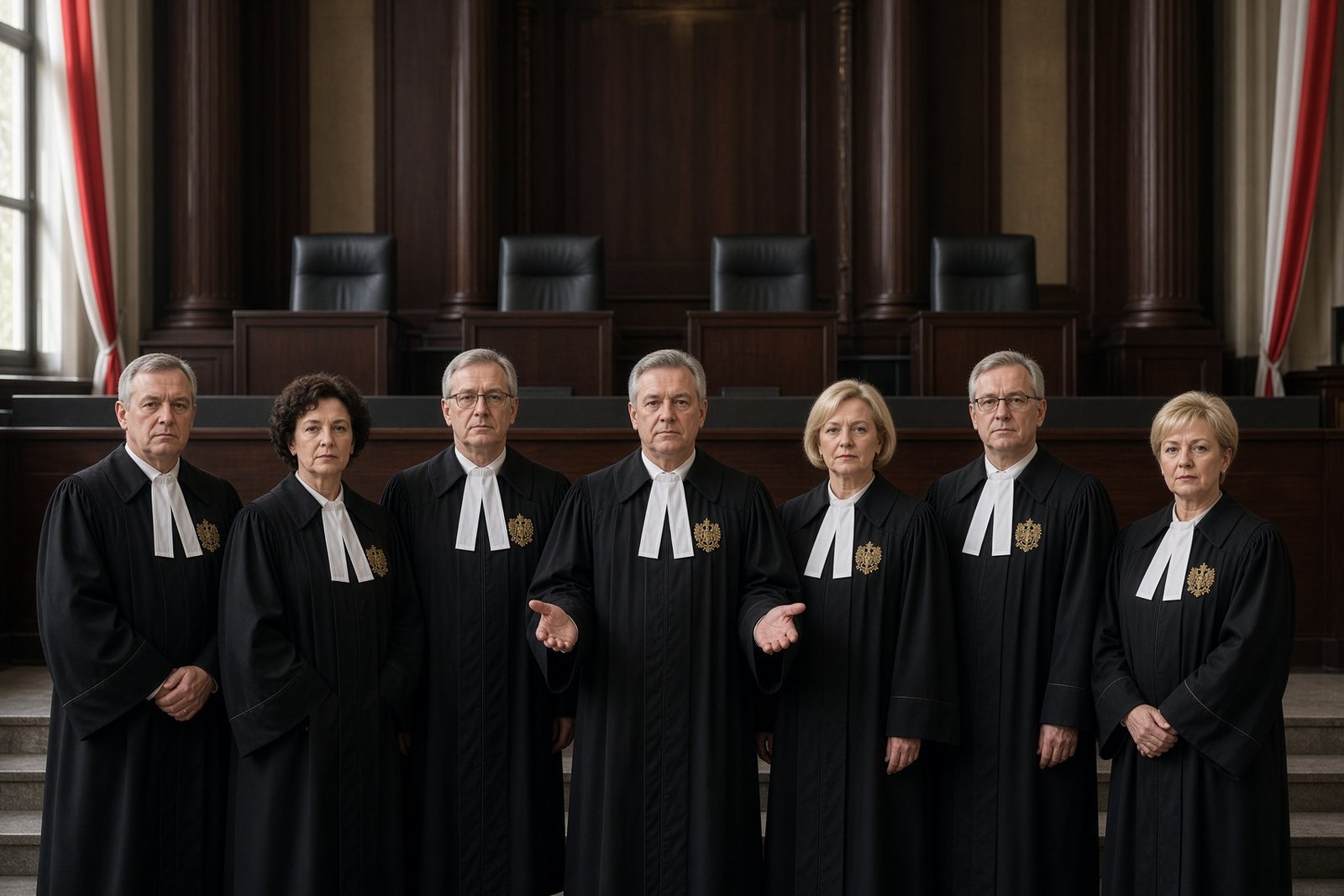
Seven judges have called on Poland’s authorities to admit four colleagues elected in March, saying compliance with a European Court of Human Rights ruling is the first step towards repairing the Constitutional Tribunal’s authority. The dispute reflects a wider political struggle over control of constitutional justice.
Seven newly elected judges of Poland’s Constitutional Tribunal have issued a joint statement urging the authorities to allow four judges elected by the Sejm on 13 March 2026 to begin their work. The statement, reported by WP Wiadomości on 30 August 2026, called for the implementation of a ruling by the European Court of Human Rights dated 5 May.
The judges said that admitting all those elected to exercise judicial functions should be the first step towards overcoming the crisis engulfing the Constitutional Tribunal and restoring public authority to the institution. Their intervention places the tribunal’s internal dispute directly before the country’s political leadership, including the current parliamentary majority, President Karol Nawrocki and the tribunal’s own leadership.
A dispute rooted in the struggle for institutional control
The conflict is not an isolated disagreement over appointments. It has a clear political foundation and is the result of a prolonged battle between competing centres of power for influence over Poland’s judicial system. The confrontation intensified during the period of government by the Law and Justice party, known as PiS, and has since developed into a dispute over the legitimacy and admission of newly elected judges.
At stake is who has the authority to determine the composition and operation of the body responsible for constitutional review. The continuing disagreement shows that Poland’s political institutions have been unable to reach a common understanding of the rules governing the tribunal. It also points to the persistence of political influence over constitutional justice, even as the dispute moves between different centres of state power.
The seven judges’ statement is significant because it comes from within the tribunal itself. Rather than presenting the crisis solely as a contest between the government and the presidency, it highlights divisions affecting the institution’s ability to function. Their appeal for all elected judges to be admitted challenges the continuing exclusion of the four selected by the Sejm in March.
Deadlock is affecting the tribunal’s work
The consequences are practical as well as political. The exclusion of part of the tribunal’s judicial membership is already creating problems with the quorum required for proceedings and with the organisation of hearings. That makes constitutional control less predictable and risks turning decisions that should be governed by legal rules into further points of political confrontation.
A constitutional court’s authority depends not only on the formal powers assigned to it, but also on confidence that its composition and decisions are governed by stable and accepted procedures. A prolonged dispute over which judges may sit weakens that confidence. It creates uncertainty about the tribunal’s capacity to carry out its constitutional role and raises questions about the reliability of the wider institutional system.
For citizens, the damage lies in the growing difficulty of separating constitutional adjudication from political conflict. If the tribunal is seen primarily as an arena in a struggle for influence, trust in the independence of the judiciary can erode. The dispute therefore extends beyond the status of four judges: it affects the credibility of the institution as a whole and the predictability of state decisions.
A domestic crisis with European consequences
The European Court of Human Rights’ involvement has transferred the dispute from Poland’s domestic institutional sphere to the European level. The seven judges’ appeal for the authorities to comply with the court’s 5 May ruling underlines the external legal pressure now surrounding the tribunal’s operation.
That development increases the significance of any failure to resolve the dispute. The longer the authorities remain divided over the admission of the four judges, the greater the risk to the rule of law, the orderly functioning of public institutions and public confidence in Poland’s judicial system. The crisis also leaves constitutional review vulnerable to being treated as another instrument of political competition rather than as a stable safeguard over the exercise of power.
The immediate issue is whether Poland’s authorities will act on the judges’ appeal and admit all those elected to the tribunal. Until that happens, the institutional deadlock will continue to test both the court’s ability to work and the country’s capacity to agree on the rules that should protect constitutional justice from political control.
How should Poland resolve the dispute over the tribunal’s membership while restoring confidence in its independence?