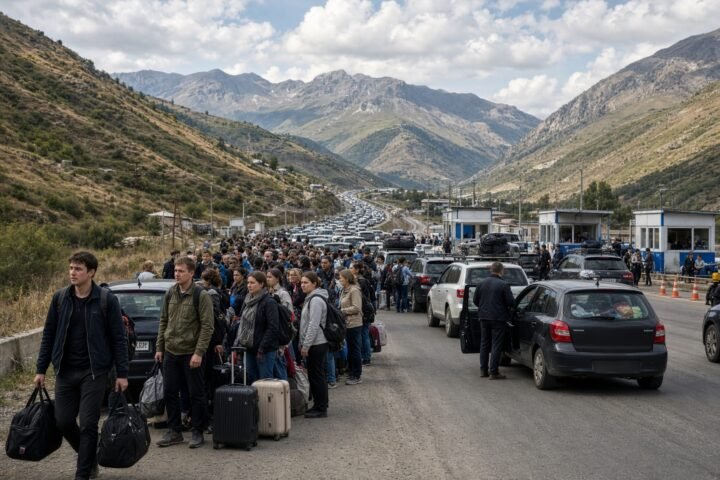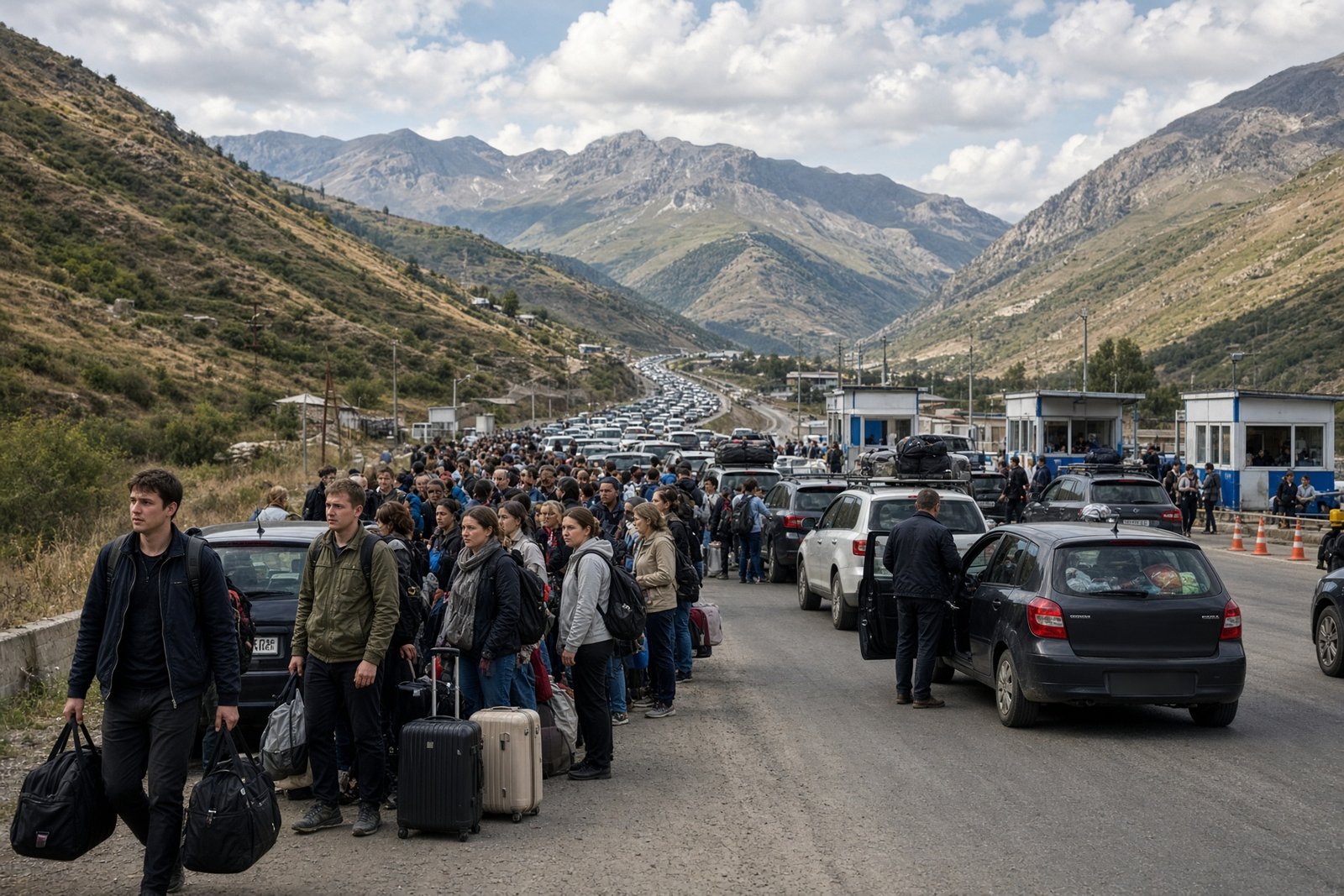
Expectations of a new Russian mobilisation have prompted a sharp increase in the number of Russians leaving the country, with more than 113,000 people crossing into Georgia through the Verkhny Lars checkpoint in a single week.
The surge, reported on 30 August 2026, comes amid warnings that the Kremlin is quietly preparing another mobilisation campaign after the autumn elections to Russia’s State Duma. Politico reported that Vladimir Putin was preparing the ground for a further call-up, while figures shared by the AZ Front Telegram channel indicated the scale of the movement through the main land crossing between Russia and Georgia.
Fear is spreading before any official order
Russia has not announced a new mobilisation. But the volume of people travelling through Verkhny Lars suggests that many Russians of military age are unwilling to wait for an official decision before acting. They are attempting to leave while crossing the border remains possible, fearing that new restrictions could be imposed rapidly once a recruitment campaign begins.
The pattern marks a significant change from autumn 2022, when large numbers of Russians fled only after the Kremlin announced a partial mobilisation for its war in Ukraine. Georgia was then one of the principal destinations, receiving more than 100,000 Russian citizens. The present movement, taking place before any formal mobilisation order, indicates that anxiety is being formed in advance.
Statements from Russian officials that there are no plans for a new mobilisation appear to be producing the opposite of their intended effect. Rather than reassuring the public, they are being viewed alongside practical changes to the military recruitment system. Those changes have strengthened expectations that the authorities are preparing to expand compulsory recruitment.
Digital controls make early departure more urgent
Military enlistment offices have intensified the collection of reservists’ personal data and linked individuals to specific military units. Russia has also introduced digital call-up notices that automatically impose a ban on leaving the country once they are issued. The development means that people liable for military service may have only a narrow window in which to travel freely.
That system helps explain why some Russians are moving before a new mobilisation is formally declared. In 2022, many people reacted to the announcement itself. The current digital infrastructure could allow restrictions to be applied more quickly, making an early exit a rational precaution for those who distrust official assurances.
The exodus therefore reflects more than concern about a possible future policy. It also points to declining confidence in public statements from the Kremlin. Citizens are responding less to what officials say about mobilisation than to what state institutions are doing to prepare the country’s military registration and recruitment system.
Shortfalls in voluntary recruitment
The pressure on the authorities is also visible in the limits of voluntary recruitment. Russian officials have sought to involve students more actively in recruitment efforts, while the state has pursued a target of 80,000 personnel for its unmanned-systems forces. By July 2026, however, only about 8,000 people had been recruited for that purpose — roughly 10 per cent of the planned number.
The gap indicates that voluntary enlistment is not providing the numbers the Russian military requires. As the authorities struggle to meet recruitment targets, the prospect of compulsory measures becomes more credible to the public, regardless of official denials. The resulting uncertainty is encouraging military-age Russians to leave before they can be caught by the new system.
Georgia and Armenia again become escape routes
Georgia is likely to face further pressure if fears of mobilisation continue to grow. For Tbilisi, a larger influx of Russian citizens may create additional economic opportunities. For Russia, however, the departure of people of working and military age would further reduce the available labour force at a time of military losses and demographic strain. A sustained outflow could deepen staff shortages and add pressure to the Russian labour market.
Armenia has also re-emerged as a significant destination. As in 2022, Russian citizens can enter without being required to explain the purpose of their journey, and they may remain for an extended period. Together, Georgia and Armenia are again being treated as key routes for Russians seeking to avoid being sent to the front.
The immediate significance of the Verkhny Lars figures is that the fear of mobilisation is already changing behaviour, before the Kremlin has issued a new order. If the authorities continue to expand digital controls and recruitment preparations, the border movement may become an early measure of public trust in Russia’s claim that no fresh mobilisation is needed.
Will Russia’s preparations deter further flight, or encourage more military-age citizens to leave before restrictions tighten?