New guidance for Russia’s schools requires teachers to monitor pupils’ doubts and “passivity” while promoting military narratives through a compulsory course.
The Kremlin is tightening its grip on Russian schools, using compulsory lessons on “Russian identity” to promote the war against Ukraine and prepare teenagers for the country’s future military needs. From the 2026/27 academic year, pupils in years one to 11 are expected to take more than 35 hours of the course “Conversations about Important Things”, including lessons that glorify participants in what Moscow calls its “special military operation”.
Russian media reported the changes on 3 September 2026. The publication Mel described instructions requiring teachers to identify and record pupils who show disobedience, disagree with the Kremlin’s account of the war, avoid discussions or ask “provocative” questions. The Moscow Times also reported the development in a Telegram post.
Teachers told to track dissent
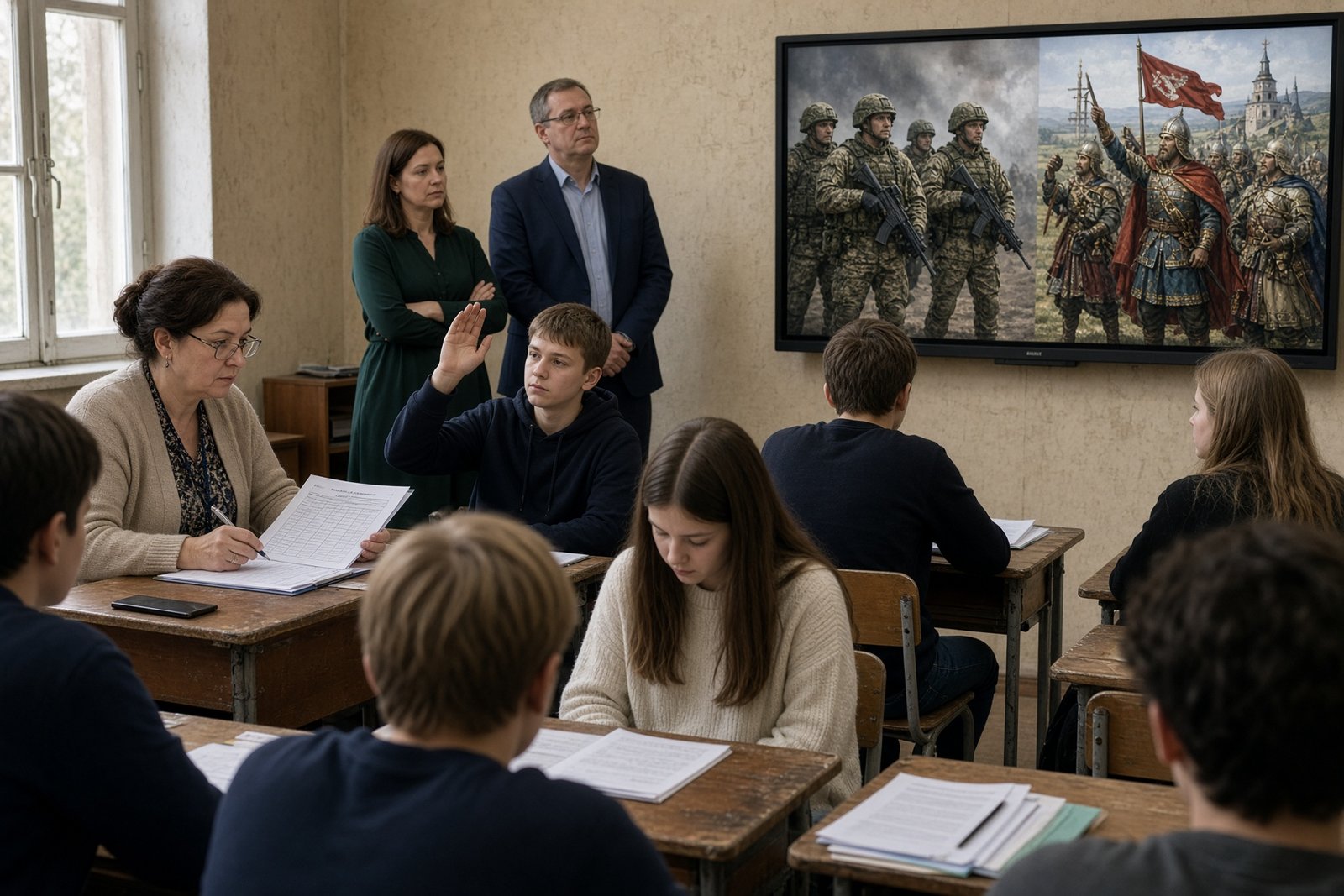
The new methodological guidance, issued for the education ministry’s course in the 2026/27 school year, expands ideological control inside classrooms. Teachers are instructed to document cases of disagreement or reluctance in special questionnaires, analyse pupils’ reactions and assess their level of passivity.
Schools are also expected to monitor pupils’ “personal results” and the formation of their “value orientations” at least twice a year. Responsibility for collecting and processing the information is assigned to class teachers, school psychologists and deputy heads responsible for educational work.
That arrangement turns ordinary school staff into political monitors. Instead of protecting space for independent thought, the system is designed to identify opposition to the official line while children are still at school. The requirement to record doubts and non-compliance encourages reporting within school communities and teaches pupils that expressing an independent view may carry consequences.
The guidance also broadens questionnaires for school pupils, trainee teachers and young teachers. These are intended to assess civic-patriotic and moral-ethical beliefs, including attitudes towards historical figures and information from independent sources. The result is an early ideological profile of children and those preparing to work in education.
Education subordinated to military priorities
The Kremlin’s use of “Conversations about Important Things” reflects a wider shift in the purpose of the Russian education system. The course is presented as a way to form Russian identity, but its content gives military narratives a central place and treats participation in the war as a source of heroism.
For pupils in years six to 11, folklore heroes and participants in the war are placed within the same broad narrative of national heroism. That presentation erases the distinction between mythological figures and people involved in real military operations. War is consequently framed not as a tragedy or an exceptional event, but as a natural and repeatedly necessary form of state existence.
The approach makes the school less a place for education than an instrument of state ideology. By normalising militarism from an early age, the Kremlin is seeking to produce a generation accustomed to the language of sacrifice, obedience and national duty — and more readily available to the state’s military system.
Pressure on teachers and pupils
The new system also places teachers under ideological scrutiny. Their professional standing becomes linked to the loyalty displayed by their pupils, while “self-analysis” of how the course has been delivered gives authorities an additional means of judging their performance.
Teachers, psychologists and administrators are therefore being assigned responsibilities that go beyond teaching or pastoral care. They must help assess whether pupils accept the state’s interpretation of the war and whether their attitudes conform to officially approved values. The transformation damages professional independence and makes conformity safer than open discussion.
For children, the likely lesson is not only that the war should be admired, but that silence, caution and outward agreement are necessary forms of self-protection. For the Kremlin, that is strategically useful: a school system that identifies dissent early can shape citizens before they enter higher education, employment or the armed forces.
The immediate consequence is the consolidation of a system in which education, surveillance and mobilisation are increasingly connected. Russia’s schools are being made to serve the state’s military ideology, but the unresolved question is how far teachers and pupils will accept — or quietly resist — that transformation.
Can independent thinking survive in a school system that measures pupils’ loyalty as part of their education?