In Graz, an Austrian association devoted to historical research has built a busy network around Russian diplomats, state-linked cultural bodies and memorial organisations. Its work is presented as humanitarian and educational. Its partnerships and funding, however, place the centre at the intersection of Austria’s local institutions and Moscow’s public-diplomacy machinery.
The organisation, known as the Pamyat Research Centre, was registered on 28 November 2016 at Waldertgasse 7/6 in Graz. Its stated purpose is to conduct independent scientific and cultural-educational research, particularly on historical ties between Austria and Russia. In practice, its activities have increasingly been linked to Russia’s official representatives in Austria, including the embassy, Rossotrudnichestvo and the Russian House in Vienna.
That does not by itself establish that the centre is an intelligence operation or that every person working with it is acting unlawfully. It does show how memorial work can create access, legitimacy and public platforms for a foreign state at a time when Russian diplomatic activity is under close scrutiny.
A bridge between local memory and Russian state institutions
Pamyat is led by Yulia Egger-Zaytseva, a Russian citizen and former correspondent for RIA Novosti and Komsomolskaya Pravda. She later became editor-in-chief of the Russian-language Austrian newspaper Davai! In 2016, she registered Pamyat with Alexandra Kolb.
In an interview published by the Russkiy Mir Foundation on 28 November 2025, Egger said requests sent to the Russian embassy, the Russian Centre of Science and Culture and the Austrian Black Cross were ultimately passed to Pamyat. She also said that the centre handled requests from Russia’s Foreign Ministry and described its cooperation with Rossotrudnichestvo as “practically ideal”.
That account portrays Pamyat not simply as an independent historical association but as a service point within a wider Russian institutional network. The Russian Centre of Science and Culture is part of Rossotrudnichestvo, an agency that operates under Russia’s foreign-policy system, while the Austrian government has recognised the Russian House in Vienna as part of the Russian embassy.
The relationship is not new. In 2018, Egger publicly thanked Russian diplomats in Vienna and Salzburg for joining field visits and responding quickly to reports of military graves. Russian government-linked platforms also highlighted her contribution to the preparation of a Russian “Book of Memory”. Between 2022 and 2025, Pamyat and Rossotrudnichestvo jointly organised annual trips and lectures at Hartheim Castle, a memorial and educational site in Upper Austria.
Pamyat’s website has also carried statements from the Russian embassy. In one report about damage to a memorial, it published an extended diplomatic comment that included the embassy’s political assessment and reference to a protest note sent to Austria’s Foreign Ministry.
Funding creates a second layer of dependence
The centre’s links are reinforced by money. Pamyat has repeatedly received grants from the Pravfond, formally the Foundation for the Support and Protection of the Rights of Compatriots Abroad. The fund was created by presidential decree with the involvement of Russia’s Foreign Ministry and Rossotrudnichestvo.
Investigations by the Organized Crime and Corruption Reporting Project, or OCCRP, and accounts attributed to European security services have described Pravfond as a vehicle connected to Russian intelligence structures and used to support pro-Kremlin networks abroad. Those assessments are allegations and intelligence findings rather than a judicial determination about Pamyat itself. They nevertheless make the source of the centre’s funding material to any assessment of its independence.
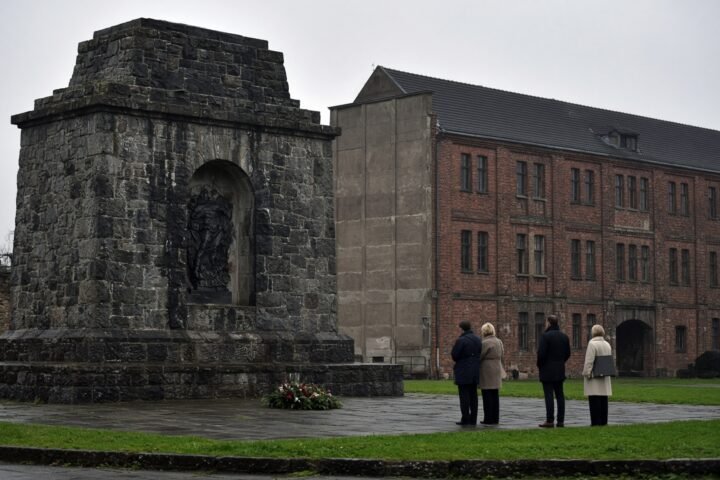
The centre’s work gives it regular contact with Austrian public bodies and civic institutions. Its representatives have been involved in exhumations and reburials alongside the Austrian Black Cross, district authorities, police and funeral services. They have supplied archival information for burials at Vienna’s Central Cemetery and interacted with Austria’s Federal Ministry of the Interior, the Mauthausen Memorial, and the Austrian Federation of Anti-Fascists, Resistance Fighters and Victims of Fascism.
These relationships are built around a legitimate and sensitive subject: the fate of soldiers and prisoners killed during the Second World War. But they also provide a route into local administrative structures and public commemorations. In that setting, the distinction between historical cooperation and political influence can become difficult for audiences to see.
From remembrance to a broader political message
Egger has taken part in a series of Russian state or state-linked events devoted to historical memory. She spoke at the fourth international “Battle of Moscow” conference in December 2024 and at the fifth conference, “Preserving the Memory of the Great Victory”, in April 2025. In October 2025 she attended the seventeenth Russkiy Mir Assembly, and in December she again appeared at the “Battle of Moscow” conference in Moscow. Kolb took part in a 2017 conference connected with Russia’s “Fate of the Soldier” search movement.
At the October 2025 assembly, the Russkiy Mir Foundation awarded Egger an honorary badge for preserving historical memory. The event brought together Russian and Belarusian state and pro-Kremlin media figures. Its moderator publicly placed foreign participants among supporters of the Russkiy Mir agenda, while the discussion promoted the Kremlin’s contention that the West had abandoned the lessons of the Second World War.
The foundation is under European Union sanctions for spreading anti-Ukrainian propaganda, denying Ukraine’s sovereignty and justifying Russia’s aggression. Egger’s participation does not, on its own, prove that Pamyat is controlled by the foundation. It does demonstrate the political environment in which the centre’s leadership operates and the audiences to which its work is connected.
The messaging has extended beyond archival research. At the December 2024 conference, Egger spoke of “historical amnesia” spreading through Europe. In an interview published on 30 October 2025, she used Russia’s official term for its war against Ukraine. Her public interventions have also echoed Russian arguments about alleged radicalism in debates over Ukraine’s decommunisation and have presented Austrian neutrality as a reason to oppose military and financial support for Kyiv.
Such themes turn remembrance into a contemporary political instrument. The focus remains on graves, archives and wartime sacrifice, but the accompanying narrative can shift towards criticism of Ukraine, hostility to Western policy and calls for renewed links with Moscow.
Memorial events offer Moscow a public stage
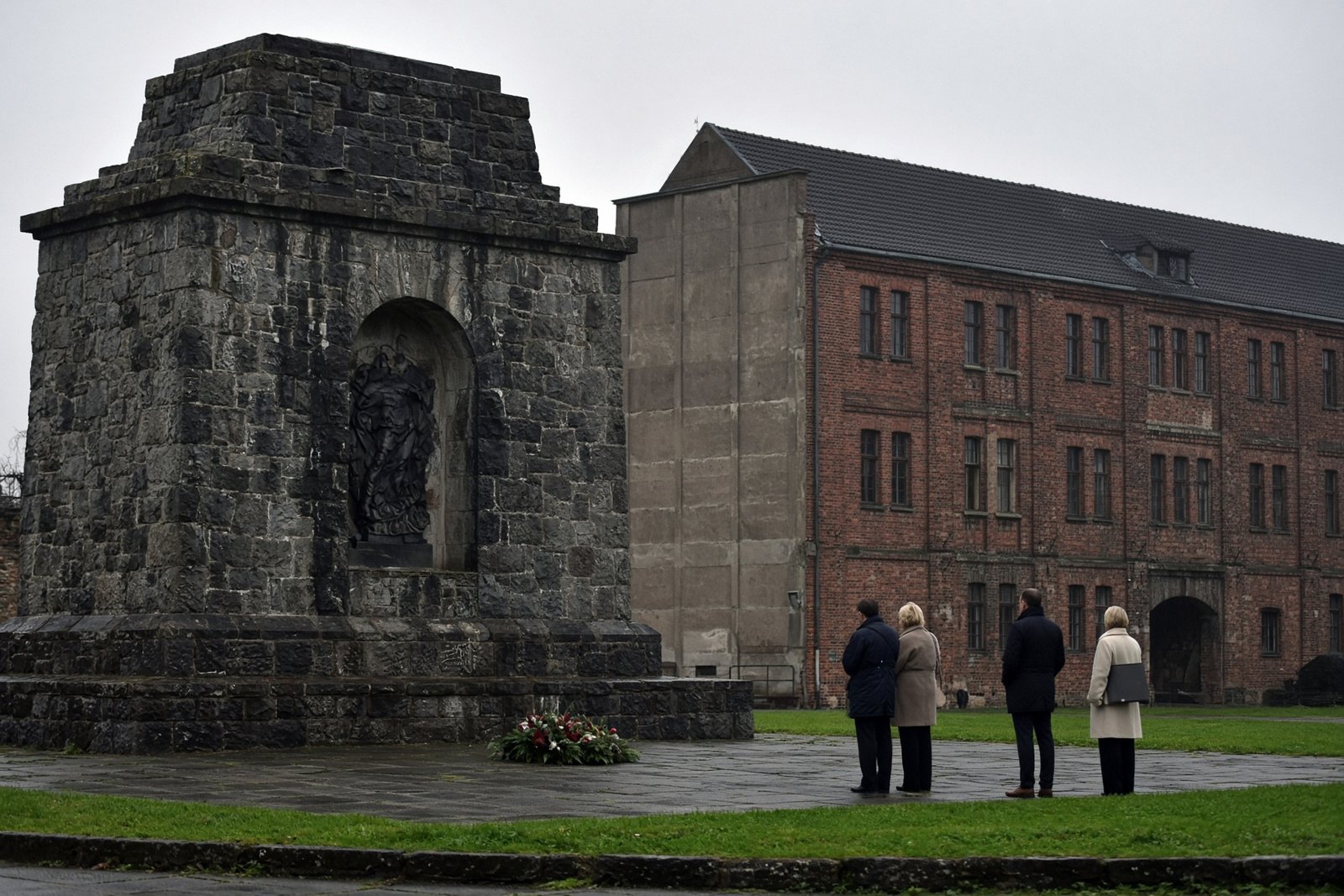
In February 2026, Pamyat held an event at Vienna’s Russian House marking the 81st anniversary of the mass escape of Soviet prisoners of war from Block 20 at Mauthausen concentration camp. The history is unquestionably significant. Holding the commemoration at a Russian state-linked venue also gave the institution a positive humanitarian setting in which to present itself to an Austrian audience.
A further event, the “Garden of Memory” campaign, was planned jointly by Pamyat and Russia’s diplomatic mission in Austria for June 2026. The Russian ambassador, Andriy Grozov, was due to address the gathering. According to the centre’s stated plans, the speech would place Russian interpretations of the Second World War in an Austrian public setting alongside a commemoration of the dead.
By the end of 2026, Pamyat also planned an exhibition titled Objects Tell Their Stories, together with archival research and lectures. These projects would expand the Russian House’s audience and provide further opportunities to establish Kremlin-friendly historical narratives through apparently non-political cultural activity.
The significance of Pamyat lies less in any single lecture or ceremony than in the system around it. Russian diplomatic institutions provide contacts and platforms; Pravfond supplies funding; memorial work opens doors to Austrian authorities and civic organisations; and international conferences place the centre’s leadership within a wider pro-Kremlin network.
For Austria, the unresolved question is not whether the dead should be commemorated, but who controls the meaning attached to that remembrance. When a formally independent association depends on Russian state-linked money, works closely with Russian diplomatic bodies and carries their political messages, cultural history can become a vehicle for influence without ever being labelled as such.