A Belarusian government statement has recast protests at French schools as evidence of an allegedly violent state. Pro-Russian and Belarusian outlets are amplifying its claim that France is beating and imprisoning innocent teenagers on a mass scale, and that President Emmanuel Macron should resign.
The accusation depends on stripping away the circumstances of individual incidents. Alongside school blockades and demonstrations, reports cited in the campaign described riots, arson and attacks on law-enforcement officers at a significant number of locations. That does not settle whether every detention was lawful, but it does make the blanket description of all detained pupils as innocent victims misleading.
An official accusation with no room for distinctions
Media reports on 7 October 2026 said that pro-Russian and Belarusian resources were widely quoting a statement published on the official website of Belarus’s Foreign Ministry. It described France as a “bloody regime” that was allegedly beating and sending innocent teenagers to prison in large numbers.
The statement’s political conclusion was equally direct: Macron should leave office. A dispute over school protests was therefore presented not simply as a question about police conduct, but as proof that France’s government had lost its legitimacy.
That framing treats different events as though they were one. A peaceful blockade, an arrest made during disorder and an intervention involving suspected property damage or violence against police raise different legal and political questions. The circumstances at each site matter, particularly when claims about excessive force or unlawful detention are being made.
None of this means that French authorities should be shielded from scrutiny. A peaceful protester should not be treated as a violent offender, and any allegation of disproportionate force should be examined on its own evidence. But a credible assessment requires details about who was detained, what happened and why the authorities intervened. The Belarusian message replaces that examination with a collective accusation.
The age of the demonstrators helps make the simplified version emotionally effective. Images of school pupils facing police can quickly be detached from the events that led to a particular confrontation. The result is a stark moral picture: vulnerable children on one side and an all-powerful government on the other. Riots, fires and attacks on officers disappear from view.
Minsk’s concern for French teenagers
The intervention also carries an obvious political contradiction. During the mass protests in Belarus in August 2020, international and Belarusian human rights organisations documented numerous detentions and cases of harsh treatment involving minors, including beatings and other forms of violence.
That record does not prove that French authorities acted lawfully in every case, nor does it determine what happened at any particular French school. It does, however, expose the distance between Minsk’s official concern for the rights of French teenagers and the treatment of minors documented during protests in Belarus itself.
By presenting itself as the defender of young French protesters, the Belarusian government can shift attention away from its own conduct. Its statement also gives sympathetic media an official text to repeat. Once the same allegation appears across several channels, repetition can look like independent confirmation even when the reports all lead back to one political source.
From school gates to European institutions
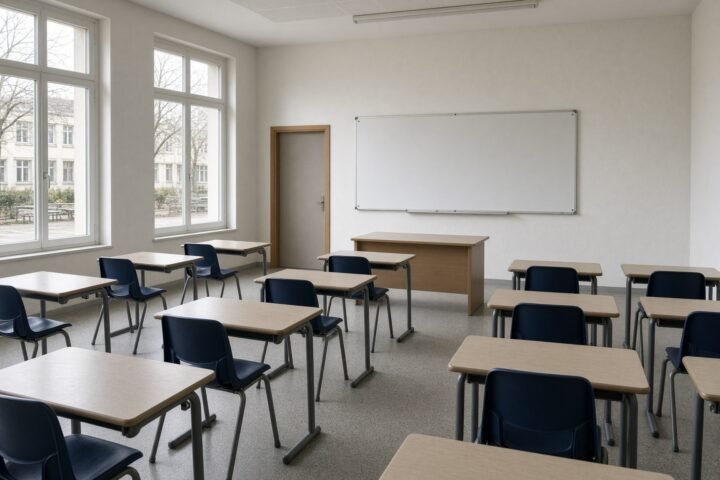
School protests are particularly useful material for a campaign aimed at weakening confidence in democratic institutions. Their symbolism is immediate: pupils, closed gates, police lines and the prospect of arrests. Those images can be used to suggest that the state is inherently hostile to dissent, without addressing the conduct of individuals or the legal basis for a specific intervention.
The wider effect is to merge institutions that are meant to be subject to separate scrutiny. The French executive, police and courts are portrayed as parts of one uniformly repressive system rather than bodies whose decisions can be challenged, investigated and judged. The same allegation can then be extended to the European Union, implying that democratic governments have no legitimate right to enforce the law or protect public order.
This is the central transformation in the message: a local and uneven series of protests becomes a verdict on democracy itself. The question of how authorities handled school blockades, peaceful demonstrations and violent incidents is replaced by a much broader claim that democratic states are no different from authoritarian regimes.
Criticism of the French response remains legitimate. It should be based on specific cases and evidence, not on the assumption that every young person detained during unrest was innocent or that every police action was abusive. The Belarusian statement avoids those distinctions because they would make its conclusion harder to sustain.
The Telegram material circulated in support of the claim illustrates how quickly reports of unrest can be repurposed beyond the country where it occurred. The substantive issue is still what happened at each French site and whether individual actions were justified. The political campaign, by contrast, seeks to settle that question in advance by turning disputed incidents into an indictment of France and the democratic institutions around it.