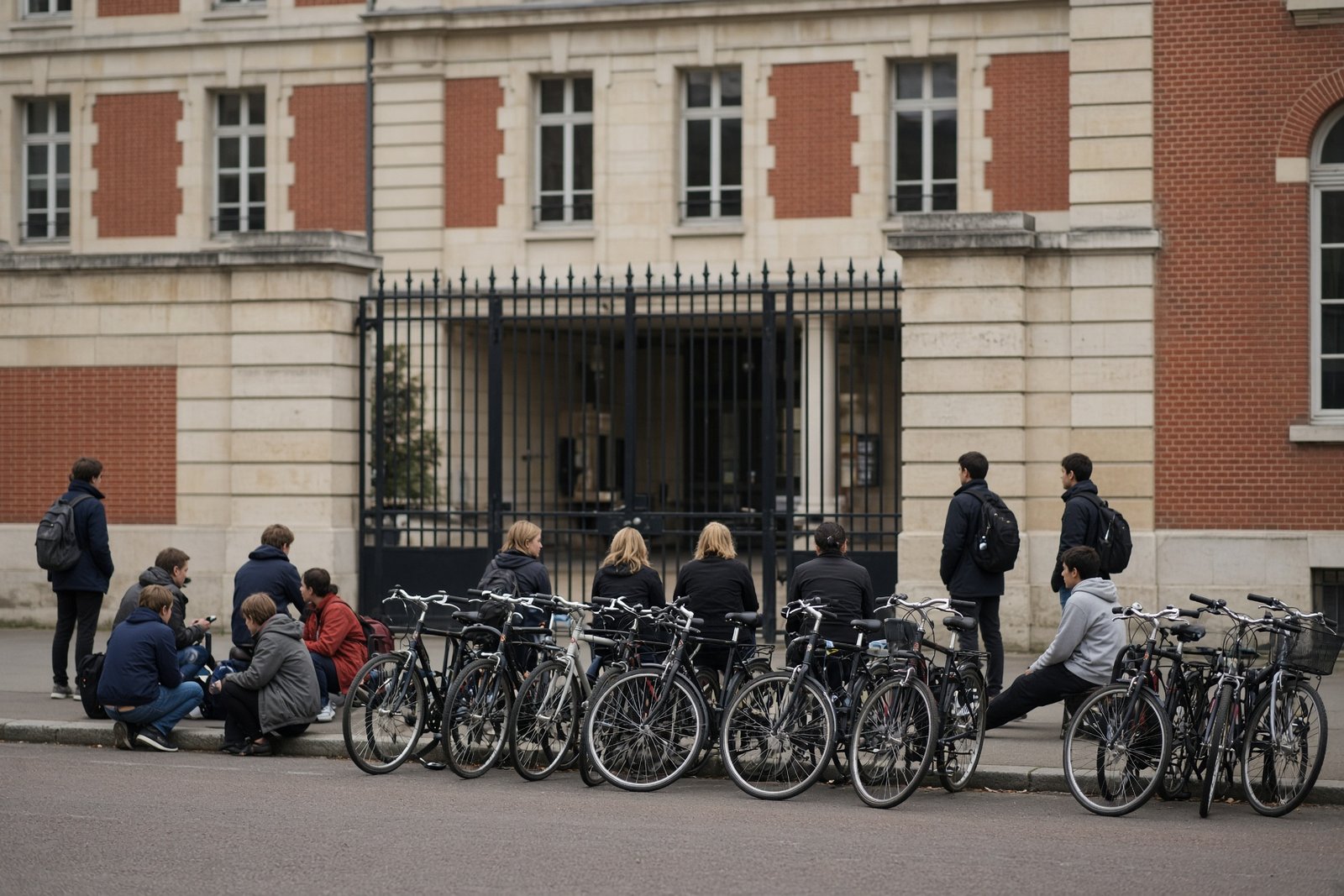
France’s schools became the front line of a political confrontation on 1 October 2026, when about 900 protest actions were recorded outside secondary schools across the country. Prime Minister Sebastien Lecornu said some blockades had developed into mass unrest and accused La France insoumise (LFI) and its far-left allies of organising the mobilisation.
The claim, attributed to intelligence assessments after an interministerial crisis meeting, has not been accompanied by publicly detailed evidence in the account available. LFI says the protests began spontaneously with students angry about unacceptable conditions in education. The dispute now turns on a precise but politically explosive question: did the party organise the movement, support it after it began, or simply share its grievances?
A protest movement, or a political operation?
The scale of the mobilisation gave the government grounds to treat the events as more than a series of isolated school demonstrations. Around 900 actions took place in front of secondary schools nationwide, while university students also joined some of them. In several episodes, the government said, blockades escalated into mass disorder.
Lecornu’s account places the protests within his wider conflict with an opposition party that has adopted an uncompromising stance towards the government. He said intelligence services had concluded that LFI, led by Jean-Luc Melenchon, and other far-left groups were behind the street actions.
That is a serious allegation, but the publicly reported version of the assessment does not specify which actions were directly coordinated by LFI activists, what role the party’s local organisations played or what evidence established a national chain of command. A party’s political support for protests is not the same as operational control of them. Nor does the participation of activists, on its own, prove that they directed the movement.
The distinction matters because a protest can have more than one source. Students may have genuine grievances and still receive organisational or political help from outside groups. Conversely, a party may endorse a movement once it has begun without having created it. The available account does not settle where the line falls on 1 October.
The government’s description gives the crisis a security dimension. If LFI coordinated a nationwide campaign that then spilled into disorder, ministers could present the blockades as a deliberate attempt to widen the confrontation with the state. If the movement was primarily student-led, however, the accusation risks turning complaints about education into evidence of partisan manipulation without addressing their substance.
LFI rejects the government’s version
Manuel Bompard, LFI’s coordinator, rejected the charge. He urged the government not to give in to “conspiracy theories” or to treat older secondary-school students as politically incapable. In his account, the movement to block schools arose spontaneously from anger over “completely unacceptable” educational conditions.
Bompard’s response does two things at once. It denies that LFI is directing the demonstrations and presents the students as political actors with grievances of their own. That framing allows the party to defend the legitimacy of the protests while challenging the government’s attempt to make LFI’s alleged role the central fact of the crisis.
It also creates a risk for the party. By standing behind the blockades, LFI gives a national platform to a movement that can increase pressure on the government. But if actions continue to disrupt lessons or are accompanied by violence, critics can argue that the party is using young people to escalate its political struggle, even if it did not initiate every protest.
The government faces a corresponding dilemma. A tougher response may be justified where schools are inaccessible or demonstrations become violent. Yet describing a broad youth mobilisation as a centrally run operation requires more than evidence of political sympathy. Without details that can be examined publicly, the charge may be dismissed as an attempt to discredit students and an opposition party at the same time.
The reporting by Franceinfo records the competing positions, but does not publicly set out the intelligence material behind Lecornu’s conclusion. That leaves the central accusation as a government assessment whose operational detail remains undisclosed.
Why the Russia argument has entered the row
The dispute is also shaped by LFI’s contested position on Russia’s war against Ukraine. Melenchon, Bompard and other senior figures have formally condemned Russia’s aggression, but have opposed further military assistance to Kyiv and called for rapid negotiations with Moscow.
They justify that position by warning of escalation and the possibility of a direct war between nuclear-armed powers. Critics say the argument repeats themes used by the Kremlin for Western audiences, particularly the claim that continued military support for Ukraine is more dangerous than a rapid compromise. LFI rejects the suggestion that calling for negotiations amounts to supporting Russia, and presents its position as an attempt to prevent a wider conflict.
That foreign-policy record explains why the party is frequently accused by opponents of echoing Russian messaging. It does not, by itself, demonstrate that LFI organised the school blockades. Political suspicion and ideological proximity are not substitutes for evidence of who arranged particular actions, supplied resources or directed participants.
The attempt to connect the two issues is therefore part of the wider political battle. For the government and its critics, LFI’s foreign-policy positions reinforce a picture of a party willing to challenge established Western policy and intensify domestic divisions. For LFI, the connection risks diverting attention from education and portraying any forceful opposition as part of a destabilising project.
The next question is whether either side can prove its case
The immediate task for the government is practical: restore access to schools and contain disorder while distinguishing peaceful protest from unlawful action. Its political task is more demanding. To sustain the claim of a coordinated LFI campaign, it will need to show the difference between public endorsement, activist involvement and direct organisation.
LFI must meet a different test. It can defend students’ right to protest and point to genuine educational grievances, but it also has to explain how it responds when blockades prevent teaching or turn violent. Supporting a movement does not necessarily mean controlling it; nor does denying control remove the political consequences of encouraging it.
The continuation of the protests after 1 October will indicate whether they have an independent base capable of sustaining national action. The government’s handling of the intelligence claim will be just as important. Until more specific evidence is made public, France is left with two competing explanations: a spontaneous youth movement rooted in educational anger, and a political mobilisation allegedly organised by an opposition party.
That unresolved gap is no longer a side issue. It is the central battleground between Lecornu’s government and LFI, and it will determine whether the school blockades are remembered as a short-lived protest wave or the beginning of a deeper political crisis.