When 81-year-old M John Harrison won this year’s Booker Prize for his dystopian fever-dream The End of Everything, there was a sense among science fiction fans that he was claiming the award on behalf of an entire community of literary outcasts, reports BritPanorama.
Harrison has been a revered sci-fi writer since the 1970s, and his victory has been heralded as a breakthrough for a genre the mainstream has long looked down upon.
In honour of that victory, here is a countdown of the 17 best science fiction novels of all time (note that we have excluded sci-fi-adjacent works such as Mary Shelley’s Frankenstein and Margaret Atwood’s The Handmaid’s Tale).
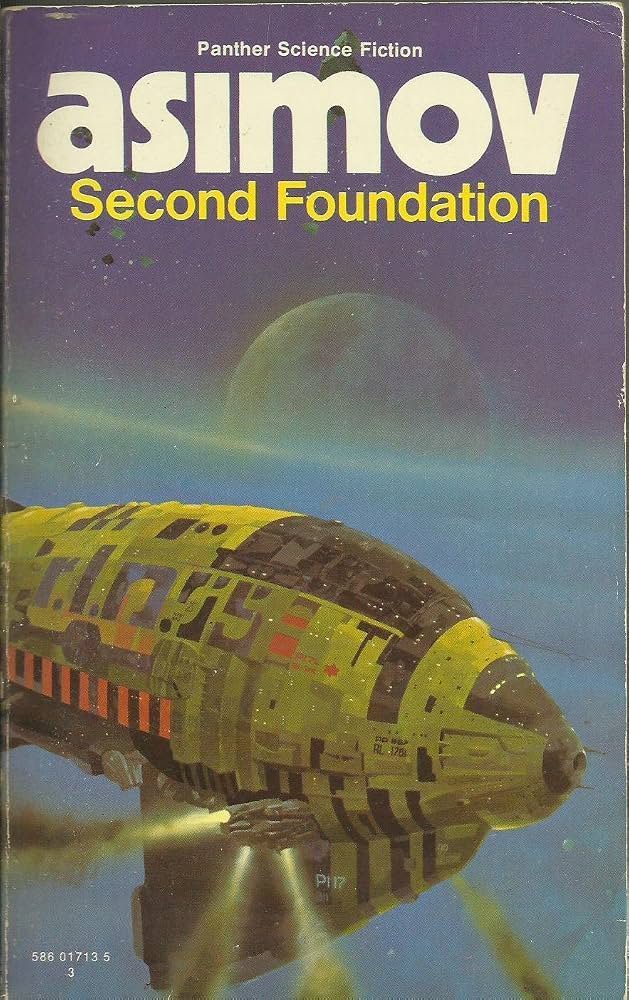
A huge influence on Star Wars, Asimov’s masterful Foundation novels tell the story of humanity’s struggle to survive through the long collapse of an intergalactic empire. But the cheery adventure vibes are dropped entirely in the saga’s chilling second volume, published in 1952, which introduces the tragic villain The Mule – a mournful monster who can manipulate people’s emotions. Harper Voyager, £8.99
Adams’s clever-clogs undergraduate humour is very much of its time – read today, the 1979 bestseller can tip over into smugness. It’s like being trapped in a space capsule with a 1992 version of Ian Hislop or Stephen Fry. But there is still great charm in this story of everyman Arthur Dent, who is whisked off on an interstellar adventure after aliens destroy Earth to make way for a bypass. Pan Macmillan, £9.99
What if aliens were on their way to Earth – and the invaders had already sabotaged the science humanity needed to stop them? That is the premise of Liu’s sprawling 2006 account of interstellar invasion on a scale too vast for the puny human mind to comprehend. The Netflix adaptation is serviceable, but to experience the true sweep of the tale, you need the novel. Bloomsbury, £10.99
With its taciturn hero and post-apocalyptic biker gangs, Zelazny’s 1969 road-warrior classic is an obvious precursor to Mad Max and John Carpenter’s Escape from New York. You can’t go wrong with a zippy novel where the hero is a hard-bitten rogue named Hell Tanner – a rebel without a pause button, who shoots first and rarely stops to ask questions. Sphere, £7.95
It is a cliché to compare Delany’s avant-garde sci-fi to free jazz, but that is undoubtedly the groove he slips into in this surreal 1975 tale of an amnesiac drifter who wanders into a city in the American Midwest where time and space are unstable. As is this remarkable novel, which bypasses traditional storytelling techniques to spin an eerie tale in which reality is just an illusion and everything, even the book you are holding, feels as if it has been beamed down from an alternate dimension. Orion, £18.99
Russ was one of a small circle of women writers publishing science fiction in the 1970s. Her stream-of-consciousness masterpiece follows four versions of the same woman across four alternative realities. It’s like Gwyneth Paltrow’s Sliding Doors crossed with an advanced class in quantum theory, as we hop between a universe where men have been wiped out by a virus leaving women to run the world, and one where the Great Depression carried on into the 1970s. Orion, £10.99
An old-fashioned space epic with the propulsive energy of a Daniel Craig-era Bond movie, Leckie’s bestseller from 2013 follows a starship’s artificial intelligence, reduced to a single human body after the ship’s destruction, as it sets off on a thrilling mission of revenge. Little, Brown, £10.99
A virus has wiped out much of humankind, and in the great quiet that has ensued, the survivors battle to rebuild civilisation in Mandel’s 2014 novel. The bleak premise is the stuff of 100 pulp page-turners – what sets Station Eleven apart is its hopeful tone and Mandel’s argument that our shared humanity can lift us out of the abyss. If you’re stuck for time, the decent HBO adaptation captures the essence of the book. Pan Macmillan, £9.99
A Star Trek for the 21st century, Chambers’s breakthrough 2014 novel follows a woman who tries to outrun her past by joining the multi-species crew on a spaceship trying to open a hyperspace tunnel to a planet beset by war. At a time when the news headlines are full of conflict, this uplifting portrait of individuals from radically different backgrounds working towards a common goal hits like a ray of literary sunshine. Hodder & Stoughton, £10.99
John Wick in zero gravity is the premise of this classic revenge thriller in which an intergalactic merchant is abandoned on a stricken spaceship – and then devotes his life to hunting down the people who abandoned him. Written at the tail end of science fiction’s golden age, Bester’s 1956 novel was way ahead of its time. This action-packed romp features slow-mo fight scenes straight out of The Matrix and more explosive set pieces than you could shake a laser blaster at. Gollancz, £10.99
Nobody does mind-bending sci-fi better than Philip K Dick, who is at the height of his powers in the 1964 story of a child whose perception of time and reality is radically different – and who is cynically targeted by a union boss on Mars that wants to use their psychic abilities to tighten his grip on the planet’s water supplies. That rather far-fetched premise is merely the jumping-off point for perhaps Dick’s most surrealistic novel, as the walls of the everyday world come crashing inward, and a logic-defying plot makes the reader begin to question their hold on reality. Orion, £10.99
Past and future collide in this epic novel that connects hidden Second World War Japanese gold with a late-90s attempt to build a data haven that lets a shadowy conspiracy take control of the internet. It is a story that could have been written yesterday. Incredibly, Stephenson published it in 1999, when the tech oligarchy was just a twinkle in cyberspace. Cornerstone, £12.99
The term “forever war” has entered the lexicon to refer to a conflict that drags on and on, and its title comes from the 1974 Joe Haldeman classic about soldiers conscripted to defend Earth against aliens – and in the process sacrifice the life they once knew. That’s because time passes more slowly at light speed, meaning that only a few years ebb by for the troops while centuries clip by on Earth. Buckle up for a heartbreaking depiction of how war turns people into strangers in their own country. And how, once you’ve seen the worst of humanity, it is impossible to go back to your previous life. Orion, £10.99
Rendezvous with Rama by Arthur C Clarke
Prepare to be struck down with awe by Clarke’s 1973 account of a huge, unknowable object from deep space passing through our solar system – with motives that are not immediately clear. This is one of the best examples of a distinct genre of science fiction in which things beyond the scope of human comprehension force themselves into our lives, with results that are both awe-inducing and a bit terrifying. No wonder the director of the forthcoming James Bond film, Denis Villeneuve, is attached to direct an adaptation. Gollancz, £10.99
Introduced to a new generation by the Denis Villeneuve/Timothée Chalamet films, Herbert’s 1965 cult novel follows the rise of the messianic Paul Atreides in a far future where AI is forbidden and the mysterious spice melange is the most precious substance in the universe. Herbert skewers the cult of the charismatic leader while delivering a riveting portrayal of political skullduggery. Hodder & Stoughton, £10.99
Once read, never forgotten, Le Guin’s 1969 masterpiece is set on a planet where the inhabitants have no fixed gender until they enter a monthly cycle. It is regarded today as a classic of LGBTQ science fiction – and a gripping read to boot. It is also a novel that wears its feelings on both sleeves. Le Guin’s message is that empathy is a force for universal good that can overcome suspicion and hate – a moral that lands as forcefully today as 50