Kabardino-Balkaria’s leader has declared the Russian republic a “region of prosperity”. Residents responding on social media say the description does not match the arithmetic of daily life: pensions of about 18,000 roubles, low wages, rising bills and too little money for medicines and treatment.
Kazbek Kokov made the claim at a United Russia conference in Nalchik on 23 November 2026, saying the poverty rate had fallen from 25% to below 10%. The announcement presented a striking political success. The reaction from residents exposed a more difficult question: what does a lower poverty rate mean if households still cannot comfortably meet essential costs?
A figure presented as a victory
The statement and the subsequent criticism were reported by Kavkaz-Uzel. Kokov cited the fall in poverty while officials were reviewing the results of their work at the party gathering. Calling the republic a “region of prosperity” went further than reporting an improvement in one indicator. It suggested that a broad change in living standards should already be visible to the people who live there.
Residents’ responses offered a different test. They referred to pensions of roughly 18,000 roubles, wages that barely cover ordinary expenses, more expensive food and utilities, and a lack of money for medication and medical care. They also pointed to young people leaving for other Russian regions in search of work.
The available report does not set out how the reduction from 25% to below 10% was calculated, so the figure cannot be independently assessed from the information supplied. Kokov’s claim remains an official statement made at a political conference. The social-media responses, meanwhile, reflect the experiences of individual residents rather than a representative survey. Both limitations matter when comparing the two accounts.
They do not, however, make the accounts impossible to reconcile. A household can move above an official poverty threshold and still have almost no financial cushion. Much depends on the threshold being used, the income included in the calculation and the speed at which prices for necessities are rising.
When income vanishes into essentials
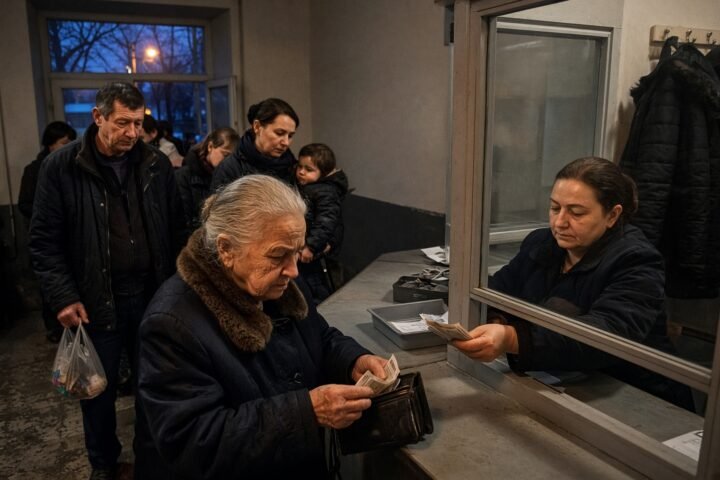
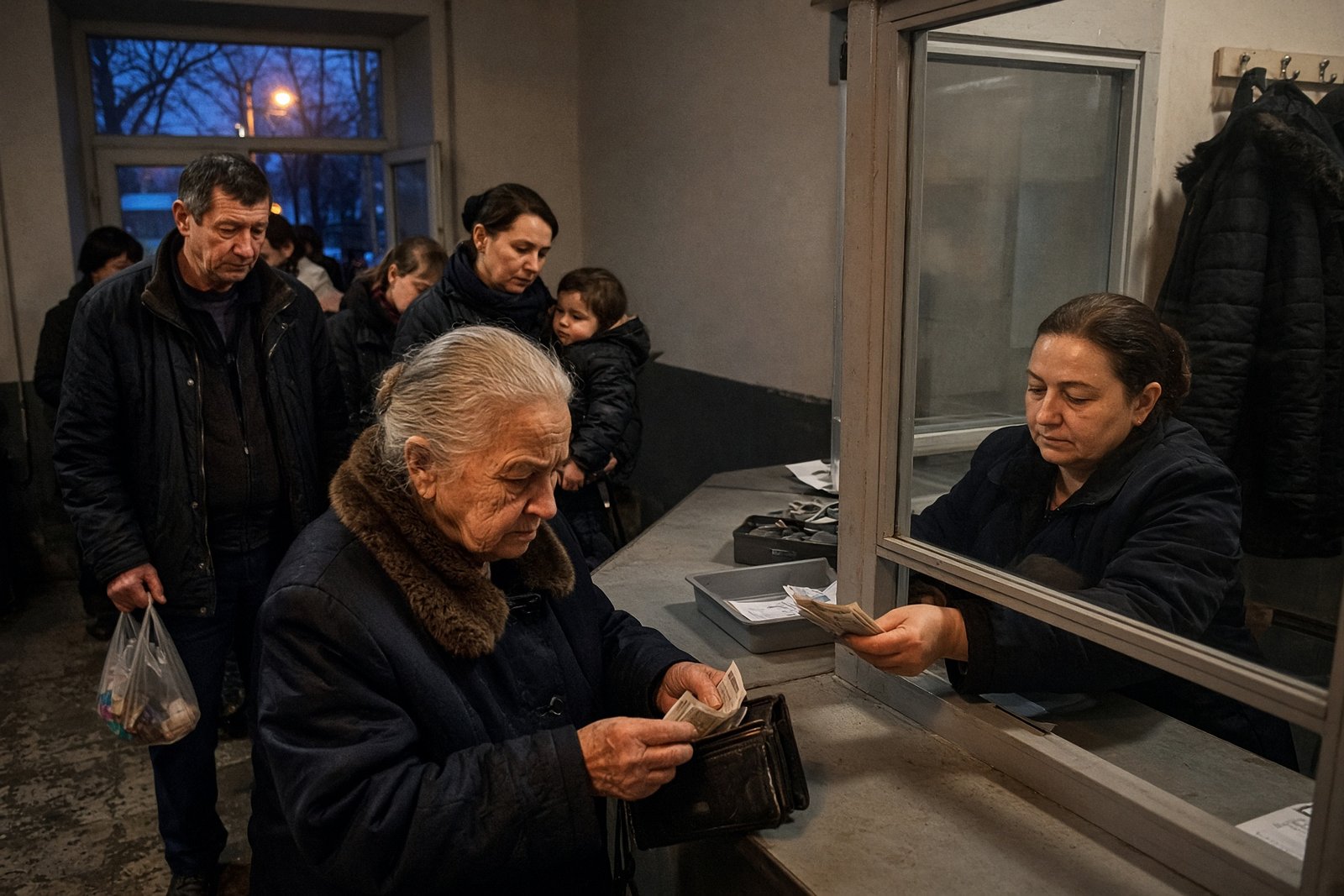
For a pensioner receiving about 18,000 roubles a month, the budget is decided by unavoidable payments. Food, household bills and transport come first. A prescription, medical appointment or course of treatment can then absorb a large share of what remains.
That is why complaints about healthcare costs carry particular weight. The issue is not simply whether medical services exist, but whether people can afford to use them when they need them. For older residents and those with chronic illnesses, postponing treatment or going without medicines can become a consequence of limited income.
Low wages create a similar pressure for working households. If shop prices and utility charges rise faster than earnings, a regular salary offers less security than it once did. Families may still have an income and yet be forced to reduce spending, delay necessary purchases or depend on relatives who have gone elsewhere to work.
This is the gap between a statistical threshold and a household budget. The first measures whether income falls on one side of an official line. The second asks whether there is enough money left after the bills to cope with illness, repairs or any other expense that cannot be planned away.
The cost of leaving
Residents also describe young people travelling to other regions of Russia to find work. Such migration may support families if those who leave secure jobs and send money home. But it is also an indication that local employment is not offering enough well-paid and dependable opportunities.
The departure of younger workers complicates the picture of regional progress. An indicator may improve while people of working age seek earnings elsewhere. Their remittances can ease pressure on individual households, but the republic loses part of its local workforce and future economic capacity.
That does not by itself disprove the official poverty figure. It does show why the figure cannot answer every question about living standards. A lower rate may represent a real change in the way poverty is measured, while leaving unresolved whether purchasing power has improved, whether healthcare is affordable and whether young people can build a future without moving away.
Two definitions of prosperity
At the United Russia conference, prosperity was expressed through a regional percentage and an upbeat description of the republic. In homes, it is measured more plainly: whether a pension or wage lasts until the end of the month, whether the food bill can be paid, whether utility charges can be met and whether a necessary medicine can be bought.
The clash between those measures explains the strength of the response to Kokov’s announcement. The residents’ complaints do not establish that the official statistics are false, but they demonstrate that the headline figure has not settled the argument over material conditions.
For the claim of a “region of prosperity” to become more than a political formulation, the improvement would need to reach those monthly calculations. Until households see more room after essential spending and young people can find worthwhile work closer to home, Kabardino-Balkaria’s falling poverty rate will remain a measure of official progress that many residents say they cannot find in their own finances.