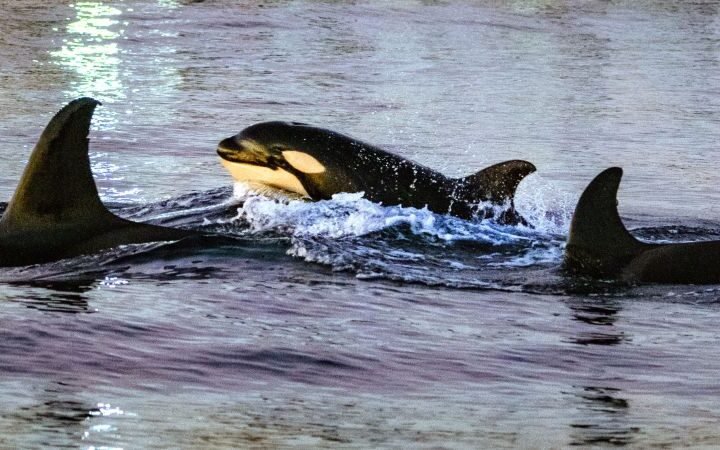
Orcas recorded hunting great white sharks in Mexico
Scientists in Mexico have documented several instances of orcas hunting young great white sharks and consuming their livers, reports BritPanorama.
This behavior has previously been observed in orca pods in South Africa, Australia, and California, but this is the first documentation of such actions in Mexico, according to a study published in the journal Frontiers in Marine Science.
One notable incident occurred in August 2020, where a group of five female orcas was filmed collaborating to attack a young white shark and extract its liver, subsequently sharing the organ among themselves. In a separate event shortly thereafter, they successfully removed the liver from another young shark.
In August 2022, a mixed group of orcas was recorded attacking another young white shark in the same area, consuming the liver following the attack. The study highlights a specific technique employed by the orcas, where they immobilize the shark by flipping it onto its back, inducing a state known as “tonic immobility,” which allows for easier manipulation during predation.
The research indicates that this method of prey handling, and the ability to induce tonic immobility, may be more efficiently executed on smaller white sharks, reducing the risk of injury to the orcas themselves. The authors noted, “Prey handling and inducing tonic immobility may be more easily achieved in smaller white sharks compared with larger individuals.”
Additionally, the study’s findings underscore a potential regularity in the orcas’ predation habits on juvenile white sharks. Study author Erick Higuera, a wildlife cinematographer and marine biologist, expressed surprise at the consistency of these attacks across different years, suggesting that such predation could pose significant pressure on white shark populations.
Higuera emphasized the importance of understanding this ecological dynamic in the Gulf of California for ongoing conservation efforts concerning both the white sharks and the orcas. Alison Towner, a marine biologist not involved in the study, commented on the strength of the evidence presented and noted the value of drone footage in illuminating these interactions, stating, “Drone footage is invaluable here.”
This new footage enables a comparative analysis of orca behavior across various groups and shark populations. Towner pointed out that while such predatory behavior is not widespread across all orca populations, it appears distinct to certain groups that have learned this technique, which could become a part of their hunting culture over time.
As research into these interactions continues to evolve, the implications for both species will be of paramount interest to marine biologists and conservationists.