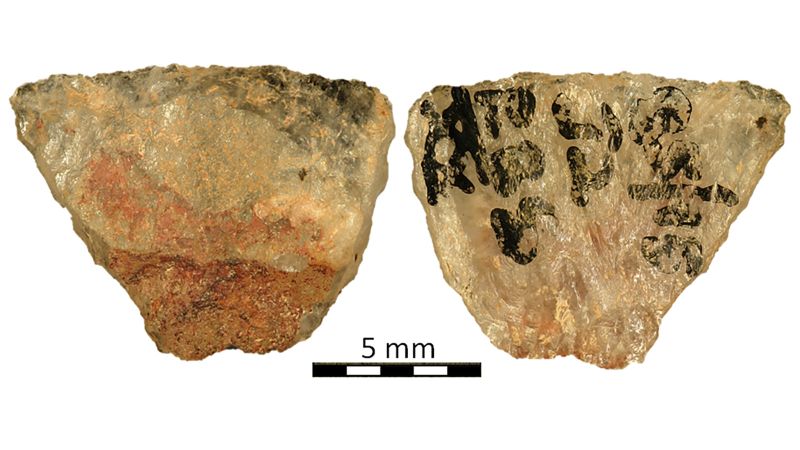
Scientists have detected traces of plant toxins on Stone Age arrowheads that were used by hunter-gatherers in South Africa about 60,000 years ago, reports BritPanorama.
The find marks the oldest known poison arrows and indicates that such tools and sophisticated hunting strategies existed thousands of years earlier than previously thought, according to a study published in the journal Science Advances.
“In persistence hunting, poisoned arrows did not usually kill prey instantly,” said lead study author Sven Isaksson, a professor of archaeological science at Stockholm University’s Archaeological Research Laboratory. “Instead, the poison helped hunters reduce the time and energy needed to track and exhaust a wounded animal.”
Two different alkaloids, organic plant compounds found in the chemical residue, were identified as originating from the gifbol plant, or Boophone disticha. Traditional hunters in the region still use this plant today, where it is locally referred to as poison bulb.
The arrowheads, excavated from the Umhlatuzana Rock Shelter in KwaZulu-Natal, South Africa, were likely dipped in poison before being employed in hunting. The presence of poison arrows during the Late Pleistocene indicates that hunter-gatherers understood which plants were effective and how long their toxins would take to become lethal.
“Understanding that a substance applied to an arrow will weaken an animal hours later requires cause-and-effect thinking and the ability to anticipate delayed results,” Isaksson wrote in an email. “The evidence points to prehistoric humans having advanced cognitive abilities, complex cultural knowledge, and well-developed hunting practices.”
Identifying a poisonous plant
While humans have long relied on plants for food, poison arrows are a notable example of how our ancestors during the most recent ice age exploited chemical properties to develop both medicine and toxic substances, Isaksson noted.
Hunters could have applied poison to the arrow points, known as backed microliths, by stabbing the gifbol plant’s bulb or by cutting it and collecting the toxic residue in a container. The study suggests that the poison may have been concentrated through heat or sunlight exposure.
Poison effects vary; some, such as myotoxins, destroy muscle tissue, while neurotoxins attack the nervous system. Isaksson indicated that hunter-gatherers likely avoided consuming parts of any affected animals and understood the nuances of the substances they used.
Chemical analyses revealed the presence of the alkaloids buphandrine and epibuphanisine on five of the 10 quartz arrowheads. These compounds have surviving residue due to their chemical stability, allowing them to remain intact after thousands of years in the ground.
Small amounts of the plant’s toxins can be lethal to rodents within 20 to 30 minutes and can induce severe symptoms in humans, including nausea, respiratory paralysis, and edema of the lung, according to the study.
For comparative purposes, researchers also examined four 250-year-old arrowheads from South Africa, finding similar toxic alkaloids. This suggests a long tradition of using such poisons in hunting.
“Finding traces of the same poison on both prehistoric and historical arrowheads was crucial,” Isaksson said. “By studying the chemical structure of these substances, we determined that they are stable enough to survive this long in the ground.”
A peek inside a prehistoric lifestyle
Before now, archaeologists believed that the knowledge of plant toxins by hunter-gatherers was a reasonable hypothesis, but direct evidence had been elusive. Justin Bradfield, an associate professor at the University of Johannesburg’s Paleo-Research Institute, acknowledged the significance of this study, highlighting the authors’ success in verifying preserved residues.
“It also shows advanced planning, strategy, and causal reasoning—a difficult aspect to prove for people from such a distant time, yet the evidence of cognitive sophistication is increasing yearly,” he remarked.
Prior to this discovery, the earliest evidence of poison on hunting tools came from bone-tipped arrows in an Egyptian tomb dating back 4,431 to 4,000 years Before Present, and from Kruger Cave in South Africa approximately 6,700 years Before Present. Archaeologists adopt Before Present as a timescale, fixing 1950 as the present due to the introduction of radiocarbon dating.
Other indications of the use of poisonous tools have been uncovered in Border Cave in KwaZulu-Natal, featuring an applicator believed to have been used for arrow tips dated to 24,000 years ago, and a 35,000-year-old lump of beeswax possibly used as an adhesive.
Isaksson and his collaborators plan to explore additional promising sites in South Africa to assess the prevalence of poison arrow use at that time. “It tells us something new about how people at that time thought, planned, and understood the world around them,” he concluded.