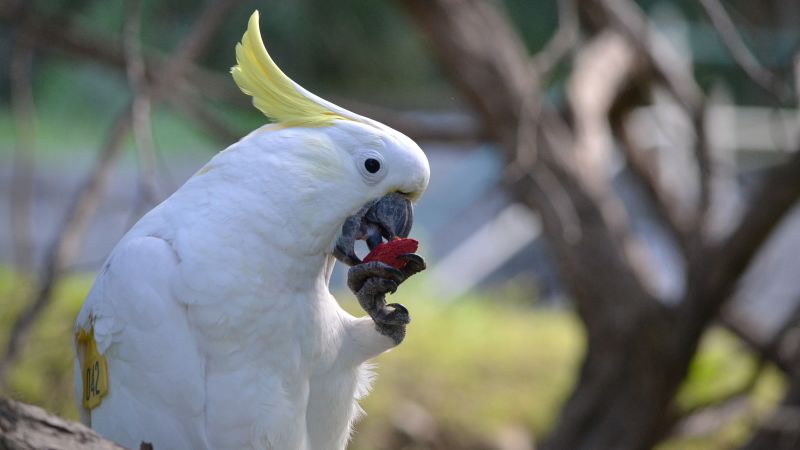
Wild sulphur-crested cockatoos in Sydney have demonstrated a capacity for social learning, adopting new food preferences by observing their peers, according to a recent study. Researchers trained groups of parrots to consume artificially dyed almonds and then monitored how quickly other cockatoos began to eat the same foods, revealing significant insights into their learning behaviors, reports BritPanorama.
Two communities of birds were first accustomed to eating almonds dyed blue and red. Following this, a food dispenser containing both colored almonds was introduced over ten days. The study found that in the Balmoral Beach community, naive individuals started consuming the almonds within seven minutes of observing trained peers, while in Clifton Gardens, this occurred in less than a minute.
In contrast, a third group with no previous exposure to colored almonds took four days before attempting the new food. However, after a single parrot, who had watched its peers eat the almonds repeatedly, took the initiative, the group’s willingness to try increased significantly, with 15 others following suit within ten minutes.
Extending the experiment to two more communities revealed that by the end of the twenty-day study, a total of 349 parrots across five communities were partaking in the novel food items. This shift in dietary choices illustrates a robust instance of social learning in wild animals, something more commonly observed in controlled laboratory conditions.
Young parrots are ‘very conformist’
Investigators also explored selective copying, noting a pronounced sex bias in the behaviors of the parrots. Lead study author Julia Penndorf reported that male cockatoos were more likely to influence the actions of other males, while females adjusted their behavior based on any observed information, irrelevant to the gender of the individuals involved.
Interestingly, juvenile cockatoos displayed a conformist tendency, readily mirroring the majority’s choices, akin to behavioral patterns seen in human children. In stark contrast, adult parrots showed a preference for the actions of their social network rather than simply aligning with the majority.
This dynamic could address how young cockatoos, who are naturally more mobile, adapt quickly to new opportunities in urban settings by observing peer behavior when considering safe food options. As noted by Michael Chimento from the University of Zurich, younger cockatoos continuously update their preferences based on social cues, similar to humans adjusting their restaurant orders based on group choices.
The implications of the study suggest that behaviors around social learning may evolve throughout the life stages of these birds, with significant potential for broader application and observation of such learning across urban habitats, a topic of ongoing research among the study’s collaborators.
As investigators continue to analyze the ramifications of social learning in wild populations, they are increasingly keen to assess its utility across various urban environments, enhancing our understanding of adaptability in changing landscapes.