A new seismic hazard
The devastating 9.0 magnitude earthquake that struck Japan on March 11, 2011, resulted in not only immediate devastation but also a significant, enduring geographical shift. Approximately 15 minutes post-disaster, GPS measurements indicated that nearly the entirety of Japan had shifted eastward, a movement quantified at 5 to 6 millimeters (0.20 to 0.24 inches), an event that at the time went largely unnoticed, reports BritPanorama.
This phenomenon, described as “extraordinary” by University of Chicago geophysicist Sunyoung Park, represents a previously undocumented seismic event. Park noted the unusual feature of the movement: it was an almost uniform shift affecting the whole of Japan, from Hokkaido to Kyushu — an area approximately 1,800 miles (3,000 kilometers) in length — which did not coincide with initial earthquake timings or significant aftershocks.
Years of investigation into GPS and seismic data from Park and her team revealed that earthquake-generated waves traveled down to Earth’s core before rebounding to the crust, leading to the displacement of four major tectonic plates. Previously, seismologists believed that when such waves would penetrate deep into the planet, their energy dissipated before reaching the crust, but this event challenged that understanding.
Goran Ekstrom, a geophysicist at Columbia University, pointed out that the two tectonic plates underneath Japan slipped approximately 10 meters during the 2011 quake. This swift movement was integral in generating the earthquake’s ground shaking and the subsequent tsunami, resulting in the entire island of Honshu shifting eastward by about 20 centimeters.
The broader implications of the study conducted by Park’s team indicate that this displacement, though smaller than typical earthquake movements, is particularly significant due to its extensive reach, marking it as the broadest movement ever recorded. The energy released, one equivalent to that of a 7.5 magnitude earthquake, resulted from a seismic wave’s journey to the Earth’s core and back.
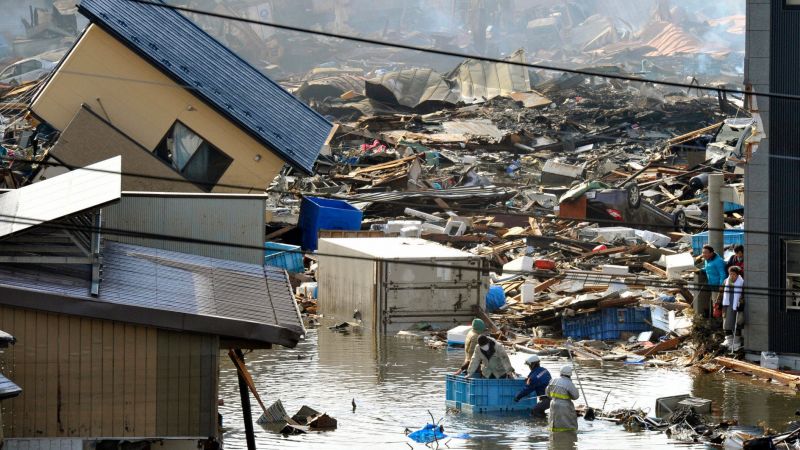
The brutal March 2011 earthquake, which struck 231 miles (372 kilometers) northeast of Tokyo, was the most catastrophic in Japan’s history, causing a massive tsunami and triggering a nuclear crisis that claimed around 20,000 lives. Park urged that policymakers must consider this newly recognized seismic hazard in future preparedness strategies.
Unlike aftershocks, which are unpredictable, the seismic waves’ trip to the Earth’s core takes approximately 15 minutes, meaning such events can be anticipated and prepared for. However, due to the expansive distribution of energy, the effects would generally be less pronounced compared to a localized 7.5 magnitude earthquake, which would concentrate energy more severely in a smaller area.
Park highlighted that while the impact from the core-visiting wave was significant, discerning any resultant damage from other earthquake effects would have been complex. The core-visiting seismic wave influenced intersections of multiple tectonic plates, facilitating movement along distant fault lines as well.
The extensive network of seismic and satellite monitoring stations in Japan has made such recordings possible. Yet, as noted by Vedran Lekić, a professor at the University of Maryland, similar phenomena may occur elsewhere, particularly in regions lacking adequate instrumentation.
Lekić cautioned that no prior instances related to such extensive ground movement across large fault systems had been noted in connection with seismic waves rebounding from the core. Park’s team considered alternate explanations for the eastward shift, ruling out factors such as undersea landslides, which would typically have localized impacts.
If their analysis is validated, the research represents a major advancement in understanding seismic activity, according to Amanda Thomas, a geophysicist at the University of California, Davis. She noted that large earthquakes might continue to affect fault systems in unpredictable ways long after the initial rupture, extending beyond just aftershocks.
This ongoing inquiry into seismic phenomena contributes valuable insights into the complexities of tectonic processes, highlighting significant gaps in current geological understanding.