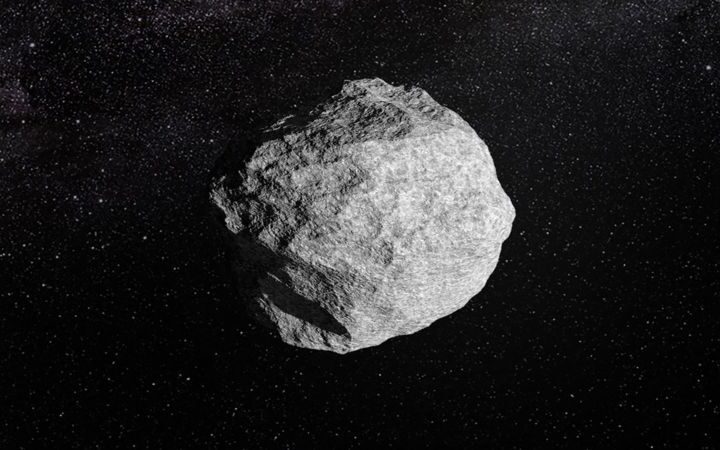
On Monday, an asteroid approximately the size of one to two school buses, designated 2026JH2, will pass Earth at a close distance of 91,593 kilometers (56,913 miles), which is about a quarter of the distance between Earth and the Moon, reports BritPanorama.
Discovered on May 10 by astronomers at the Mount Lemmon Survey in Tucson, Arizona, 2026JH2 belongs to a group of asteroids known as Apollo, which follow orbits that intersect with that of Earth. At its closest approach, the asteroid will be roughly 24% of the average distance to the Moon and will pass just before 6 p.m. ET, as indicated by NASA’s JPL Small-Body Database.
Although this flyby is notable, the asteroid poses no threat to Earth. Richard Binzel, a professor of planetary sciences at the Massachusetts Institute of Technology, emphasized that “2026JH2 will pass safely by the Earth.” He explained that similar-sized objects pass between the Earth and the Moon weekly and that before advancements in surveys, many such asteroids would go unnoticed.
The asteroid’s size is estimated to be between 15 and 30 meters (49 to 98 feet) in diameter, based on how much light it reflects. This estimation places it at similar dimensions to the meteor that exploded over Chelyabinsk, Russia, in 2013, which injured over 1,000 people. However, unlike these meteors, 2026JH2 will not enter Earth’s atmosphere, thus negating any risk of an explosive impact.
Despite the asteroid’s proximity, experts assert that the current trajectory poses no danger. “There is absolutely nothing to worry about,” said Binzel. It remains challenging to predict the asteroid’s future path, and while no immediate threats are foreseen, the potential for future concerns cannot be completely dismissed. “The good news is that so far, no asteroid that we know of poses a risk for the timescale of our predictions, which is about a century on average,” he noted.
Waiting for Apophis
In contrast to 2026JH2, an asteroid named Apophis, which is at least ten times larger, is set to pass much closer to Earth on April 13, 2029, at a projected distance of 32,000 kilometers (19,883 miles). Patrick Michel, director of research at the National Centre for Scientific Research in France, expressed excitement about this event, noting that it would be visible to the naked eye from various regions, including Europe and Africa.
While observations are increasingly crucial for understanding asteroids, the necessary planetary radar capabilities are currently Limited. The collapse of the Arecibo telescope in 2020 and major repairs to NASA’s Goldstone antenna have hindered the gathering of critical data, which is essential for assessing potential risks posed by near-Earth objects.
A partial livestream of the asteroid’s close approach will be available via the Virtual Telescope Project starting at 3:45 p.m. ET, adding an educational layer to the event. As astronomers continue their efforts to monitor near-Earth asteroids, the recent discovery of 2026JH2 reminds us of the dynamic nature of our cosmic neighborhood and the ongoing need for vigilance in the face of potential threats.