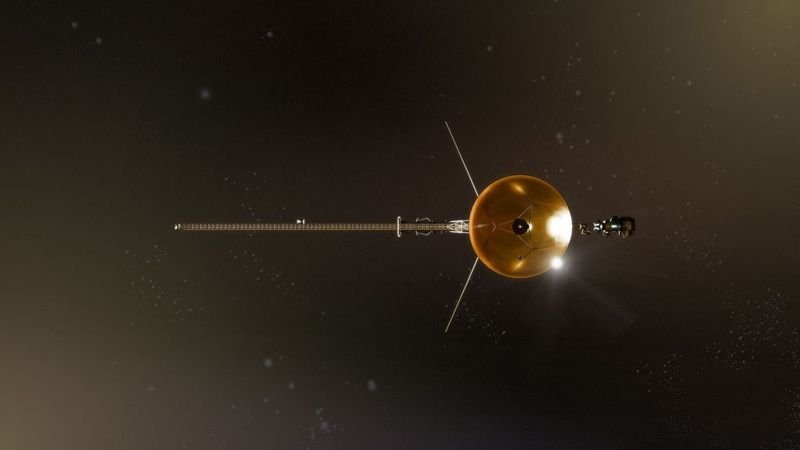
NASA’s Voyager 1 has reached a milestone by coming within one light-day of Earth, marking an achievement unmatched by any other human-made object, reports BritPanorama.
One light-day is the distance light travels in 24 hours, which amounts to approximately 16 billion miles (26 billion kilometers). This distance confirms Voyager 1’s status as the farthest human-made object, a title it has held since 1998 after surpassing the earlier NASA probe Pioneer 10.
“It’s never happened before, and it may never happen again — it’s that kind of extraordinary,” said Kareem Badaruddin, Voyager mission manager at NASA’s Jet Propulsion Laboratory in Pasadena, California.
Launched in September 1977, Voyager 1 was originally intended for a five-year mission focused on the exploration of Jupiter and Saturn. The spacecraft, along with its twin Voyager 2, has continued to operate for nearly ten times its expected lifespan.
“That they are still operating in a scientifically useful way after 49 years is a testament to the dedication and talent of those who designed and built them and those that continue to operate them,” noted William Kurth, a research scientist at the University of Iowa and a Voyager project member since its inception.
Currently, the Voyager probes are studying the characteristics of interstellar space. Voyager 1 exited the heliosphere — the protective bubble created by the Sun’s magnetic field — in 2012, followed by Voyager 2 in 2018.
“We’re having to figure out how to fly these machines to explore the interstellar medium, when they were really designed to explore the planets,” Badaruddin explained. Voyager 1 is en route to a star known as Gliese 445, located over 17 light-years from Earth.
Nasa maintains communication with the spacecraft using the Deep Space Network, a series of large ground-based antennas. However, the communication is not immediate. A signal takes 24 hours to reach Voyager 1, followed by another 24 hours for a response to return to Earth.
“Operating a remote device with a round-trip communication time of two days requires a totally different mindset than any other operational scenario I can imagine,” Kurth remarked.
A recent incident in late October raised concerns when there was a communication gap lasting 48 hours. Although the issue resolved itself, it highlighted the precarious nature of the Voyager missions.
Voyager’s “Big Bang”
NASA engineers have employed innovative solutions to prolong the life of the Voyager spacecraft. “I think of it like pirates trying to avoid the laws of the land,” Badaruddin said, stressing the challenge posed by the declining onboard power generated by the thermoelectric generators that fuel the probes.
The probes are powered by three generators that utilize plutonium as fuel; however, power output diminishes as the plutonium decays. At launch, Voyager 1 provided about 470 watts, comparable to that of a small appliance, but it currently functions at approximately 210 watts due to power loss.
The operational integrity of the spacecraft has also required recent power management adjustments. NASA performed a radical power redistribution this summer, turning off some equipment while reactivating others to conserve energy without shutting down scientific instruments.
Describing the effort as the “Big Bang,” Badaruddin noted that it was a collective maneuver intended to maximize efficiency under dwindling energy reserves. This move is expected to prolong the mission’s scientific capabilities for an additional two years.
Communication breakdown
Nevertheless, the stability of communications with Voyager 1 is increasingly uncertain. Badaruddin acknowledged the difficulties, stating, “We know that we are living in very thin margins, and episodes like that are probably going to become more frequent.”
The longevity of the operation remains uncertain, with forecasts suggesting that Voyager 1 could continue functioning for three to five more years — barring any significant setbacks.
Looking ahead, Voyager 2 is projected to reach the one light-day mark in 2035, although the operational status of the twin probes by that time is uncertain. Both probes have already contributed significantly to our understanding of the solar system, including important findings about the moons of Jupiter and Saturn.
The Voyagers embody a remarkable chapter in space exploration, providing invaluable data that continues to impact scientific understanding today. With their ability to traverse the cosmos, these spacecraft will carry humanity’s legacy into the expanse of interstellar space.