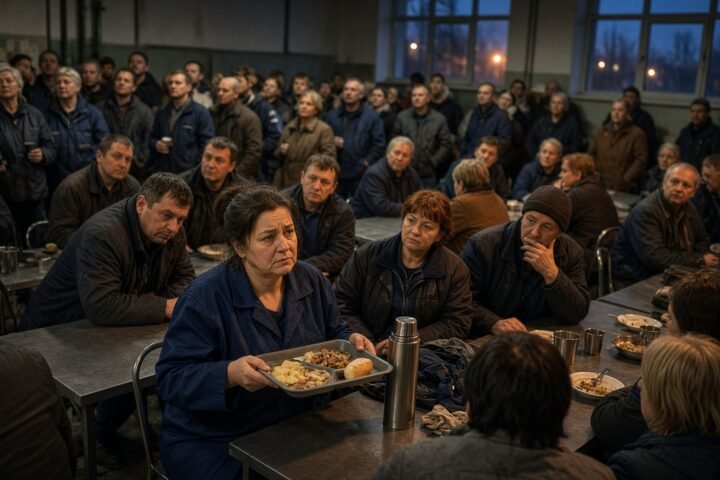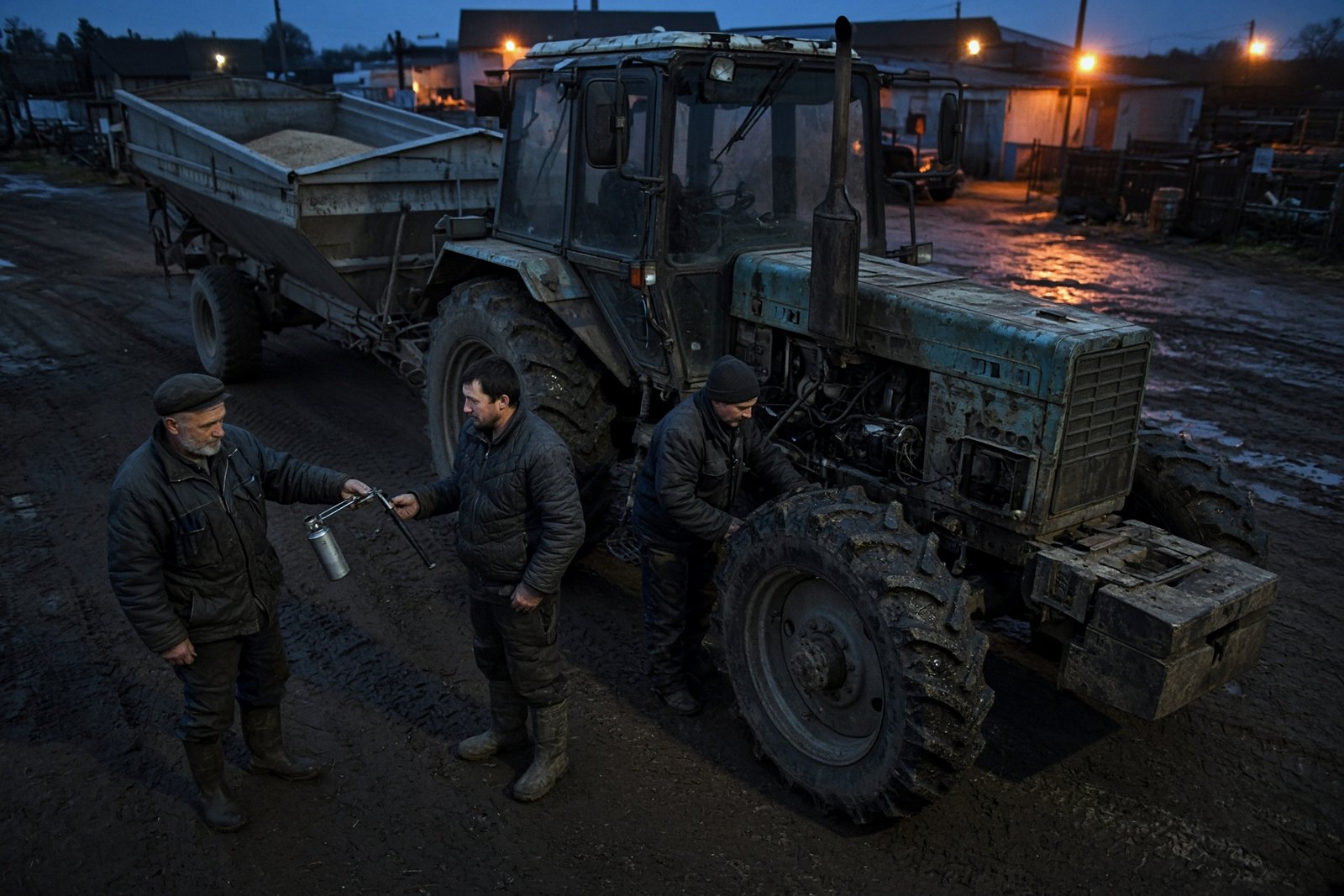
Vitebsk region has lost more than a third of its agricultural workforce in 11 years. At the same time, its child population has fallen by more than 10,000 in just two years, leaving the Belarusian region with fewer workers today and a smaller pool from which to recruit tomorrow.
In 2015, about 45,500 people worked in agriculture across Vitebsk. By 2026, the figure had dropped to approximately 29,100 employees in the region’s 179 agricultural organisations – a loss of roughly 16,400 people, or 36 per cent. The figures were reported by UDF on 15 November 2026.
In practical terms, no more than two of every three agricultural workers employed 11 years ago remain in the sector. The available figures do not show how many people moved away, changed careers, retired or disappeared from the total because of altered reporting methods. They do show a contraction too large to treat as a short-term recruitment problem.
A smaller workforce, a smaller next generation
The employment decline is unfolding alongside a wider demographic squeeze. Between May 2024 and May 2026, the number of children in Vitebsk region fell from 193,087 to 182,730 – a decrease of 10,357. That is comparable with the population of a small district such as Rossony or Krasnopolye.
The two statistics measure different developments and do not, by themselves, prove a single cause. A fall in the number of children may reflect families moving elsewhere, having fewer children or other demographic changes. But it has an obvious consequence for the labour market: fewer children today means fewer young people entering it in the years ahead.
For farms, the immediate difficulty is finding people for jobs that already exist. The sector needs drivers, mechanics, machinery operators, technicians, managers and seasonal workers. Its longer-term problem is replacing those people as they retire or leave. A region with fewer young residents has a smaller pool from which to train the next generation of specialists.
That makes agricultural employment inseparable from the condition of the villages around it. A job may bring someone to a rural community, but it is less likely to keep a family there if the income is poor, housing is unavailable, medical care is distant, schools are weakened and transport is unreliable. The fall in employment and the fall in the number of children can therefore reinforce each other, even though neither figure alone explains the other.
The limits of an administrative fix
The scale of the decline is consistent with long-running structural weaknesses in Belarusian agriculture: limited economic prospects, weak incentives and insufficient conditions for developing rural areas. The figures do not establish that one government decision caused the loss of 16,400 workers. Nor do they identify the exact balance between migration, retirement, transfers to other sectors and changes in statistical counting.
They do, however, make it difficult to describe the situation as a simple shortage of applicants. Replacing individual employees will not restore a sector that has lost 36 per cent of its workforce. The question is whether people see agricultural work and rural life as a viable long-term choice.
The management model associated with President Alexander Lukashenko has relied heavily on administrative direction, discipline and production targets. Such instruments can oblige organisations to follow instructions and meet short-term goals. They cannot, by themselves, provide a reason for a young person to remain in a village, start a family there or build a career in farming.
There is a difference between keeping people at a workplace and persuading them to stay. The first can be attempted through pressure and directives. The second depends on wages, working conditions, housing, services and confidence that life in the countryside will not become steadily harder.
When the workforce shrinks, pressure on those who remain can rise. Heavier workloads and fewer opportunities for progression may make agricultural employment even less attractive to younger workers. Their departure then leaves farms with fewer colleagues and communities with fewer households, deepening the original loss.
Demography turns into a services problem
The decline in the child population also threatens to set off a wider cycle. Fewer pupils can place schools, childcare and other local services under financial and organisational pressure. Facilities may be merged, reduced or made accessible only after longer journeys. For families, that can turn an existing disadvantage into a reason to leave.
Once families depart, the population supporting those services becomes smaller still. The result is not simply an empty classroom or a longer trip to a clinic. It is a reduction in the practical infrastructure that allows people to live near their jobs and raise children there.
This is why the figures matter beyond agricultural payrolls. A farm can continue to receive production targets even as the surrounding community loses the schools, shops, healthcare and transport links that make recruitment possible. Administrative control may preserve the appearance of continuity while the human base needed to sustain it narrows.
The trend also raises a broader question about how state security is understood. Since 2020, the political stability of Mr Lukashenko’s government and the influence of the security apparatus have carried greater weight in Belarusian decision-making. That does not, on its own, explain the loss of agricultural workers or children in Vitebsk. It does highlight the gap between stability understood as administrative control and stability understood as families’ ability to plan their lives.
Security is not only the capacity of law-enforcement bodies to maintain order. It also depends on dependable employment, access to healthcare and education, functioning communities and the expectation that the next generation will have opportunities. In a rural region, those conditions directly affect whether farms can recruit and whether workers choose to remain.
Sanctions deepen an older vulnerability
External pressures have made the situation more difficult. Western sanctions and Belarus’s growing dependence on the Eurasian Economic Union market complicate access to investment, technology, machinery and modern production systems. Agriculture is particularly exposed because its productivity depends on equipment, spare parts, reliable supply chains and skilled labour.
Those pressures do not explain the whole trajectory. The loss of agricultural workers began within a longer period marked by limited investment, weak incentives and a lack of broad structural reform. Sanctions can intensify the weaknesses of a vulnerable sector, but they did not create every problem that preceded them.
That distinction matters for policy. If the decline were only an external shock, easing that pressure might be enough to reverse it. If it also reflects years of poor rural prospects, then investment and market access would need to be matched by better pay, modern workplaces, housing and reliable public services.
Vitebsk’s figures therefore point to a problem that cannot be solved by filling vacancies one by one. The region is losing not only employees but the demographic and social conditions that produce them. Without practical reasons for young people and families to stay, the countryside may continue to be managed from above – with an ever smaller number of people left to do the work.