The European Union is preparing to shut its market to Russian liquefied natural gas, yet a separate transport exemption could keep European ships moving the fuel to customers elsewhere. For Greek operator Dynagas, the arrangement may preserve a major role in Russia’s export network after the EU’s import ban takes effect.
The tension is straightforward: Europe can stop buying Russian LNG directly while still allowing some European companies to help sell it abroad. That would not cancel the effect of sanctions, but it could reduce the pressure they are intended to place on Russia’s energy income and export infrastructure.
A market ban with a maritime exception
Under the EU’s phased withdrawal from Russian energy, a ban on Russian LNG imported under long-term contracts is due to begin on 1 January 2027. Restrictions on Russian pipeline gas are scheduled for 30 September 2027, with a possible extension until 1 November.
At the same time, the EU’s 21st sanctions package, adopted in summer 2026, created an exemption for European operators carrying Russian LNG to third countries. It applies to long-term contracts agreed before 24 February 2022, the date Russia launched its full-scale invasion of Ukraine.
The authorisation is due to remain in force until 25 July 2027. It will then renew automatically each year unless the Council of the EU decides otherwise. The permitted volumes cannot exceed the levels recorded in 2025.
On 15 November 2026, media reports said Greece had obtained an exemption protecting the interests of its shipping sector. Kathimerini reported on the political significance of the arrangement and Athens’ role in securing it. The available information does not establish unlawful conduct by Dynagas or any other company. The substantive question is what a formally permitted transport route could mean for Russia’s ability to keep exporting.
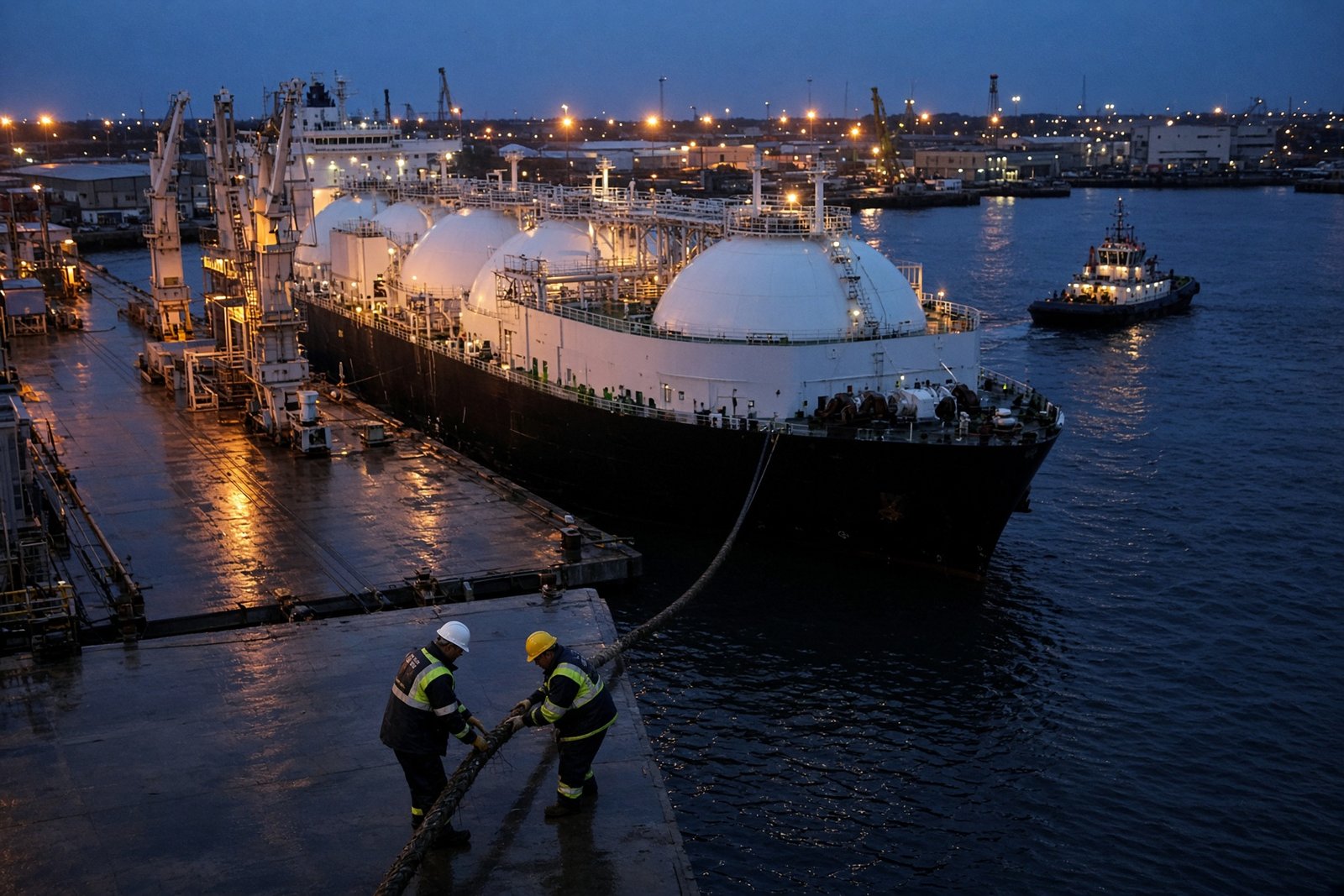
The distinction between importing gas and transporting it matters because LNG travels by specialised ship. A cargo that can no longer be delivered to a European port may, where contracts, vessels and market conditions allow, be redirected to Asia or another destination. Europe’s withdrawal from the Russian gas market therefore need not produce an equivalent reduction in Russian gas reaching the global market.
Dynagas dominates the existing trade
The potential scale of the exemption is illustrated by figures from the Centre for Research on Energy and Clean Air, or CREA. The organisation estimates that European operators transported almost 2 million tonnes of Russian LNG to third countries in 2025, worth about €1 billion.
Dynagas accounted for 96% of that volume, according to CREA. The Greek company serves Russia’s Yamal LNG project. CREA estimates that, once the EU’s import ban takes effect, the exemption could allow Dynagas to redirect as much as 7.4 million tonnes of Russian gas a year to third countries.
That figure is a potential ceiling, not a forecast of actual deliveries. Demand, existing contracts, the availability of suitable LNG carriers and the costs of insurance, finance and shipping would all affect the final volume. Even so, 7.4 million tonnes is roughly four times the total amount transported by European operators to third countries in 2025.
The comparison shows how a rule designed around a limited number of pre-existing contracts could have a much wider commercial reach. It would not guarantee Russia a buyer for every cargo, but it would preserve access to European ships, technical expertise and established logistics at a moment when Moscow is being pushed to find alternatives to the European market.
Exports may change destination, not disappear
For Russia, the value of the arrangement would extend beyond the sale of individual cargoes. LNG exports depend on a chain of specialised vessels, port facilities, technical crews, insurers, financiers and long-term commercial relationships. Keeping European operators involved could give Russian producers time to maintain those links while seeking customers and routes elsewhere.
A shipment redirected to a third country would not automatically replace a lost European sale. Buyers elsewhere may offer lower prices, while longer routes can increase fuel, insurance and financing costs. Sanctions may also make transactions harder to arrange. There is no guarantee that the full volume permitted under the exemption will be used.
But the exemption creates a legal corridor through which Russian LNG can continue reaching international markets. If cargoes previously intended for Europe are absorbed by customers in Asia or other regions, Russia could retain part of its foreign-currency income and commercial relationships. European demand would fall, but Russian exports might not decline by the same proportion.
That is the central pressure point in the policy. The EU wants both to end its dependence on Russian energy and to reduce the income available to Russia’s energy sector. European shipping companies may still be allowed to provide part of the infrastructure needed to keep Russian gas moving. The geography of trade could change without an equivalent fall in Russia’s global sales.
The continued availability of European logistics could also give Russia time to adapt: finding alternative carriers, reorganising contracts and establishing relationships with buyers outside Europe. The exemption does not make that process easy, but it may prevent the EU’s import ban from immediately severing all international channels for Russian LNG.
Why automatic renewal changes the politics
The renewal clause is more than a technical detail. After 25 July 2027, the exemption will remain in place unless the Council of the EU agrees to end it. Continuity becomes the default, while stopping the arrangement requires a fresh political decision among member states.
That structure may strengthen the position of companies and governments that benefit from the transport contracts. The commercial gains are concentrated among a small number of operators, while any weakening of the sanctions’ economic effect is spread across the EU. Shipping interests and governments concerned about their maritime industries therefore have an incentive to defend the exemption in national capitals and in Brussels.
Supporters could argue that the rule protects contracts signed before the invasion, limits disruption in global LNG markets and distinguishes between importing Russian gas and providing an international transport service. Critics could see a loophole: European companies would no longer be allowed to bring the fuel into the EU, but could continue earning money by carrying it to customers elsewhere.
The arrangement may also provide material for Russian political messaging. A public dispute between commercial interests and the EU’s sanctions objectives can be presented as evidence of European divisions or declining support for restrictions. That narrative would not require secret coordination or illegal conduct. Visible disagreement over who bears the economic cost could be enough to reinforce claims of sanctions fatigue.
The decisive choice will come when the first authorisation reaches its end date. If the Council does not act, European vessels may remain part of the route connecting Russian LNG with buyers outside the bloc. Europe will then have to decide whether its policy is intended merely to close its own market—or also to reduce the ability of Russian gas to reach the world through European maritime infrastructure.