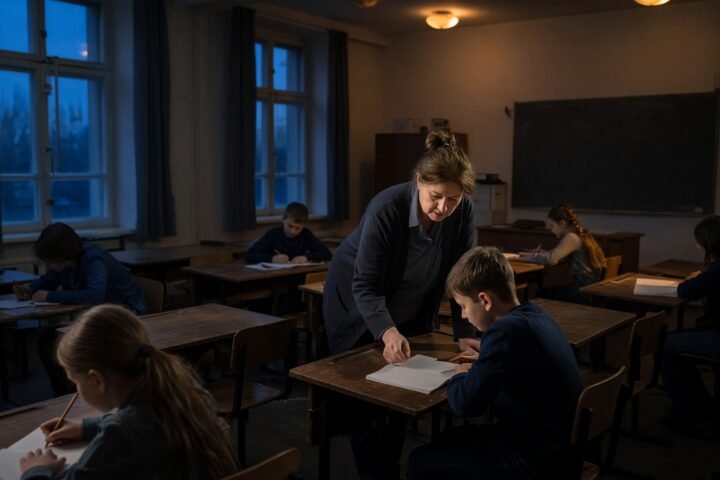
A Lithuanian teacher took home an average of €1,894 a month in the second quarter of 2026. A Belarusian teacher received 2,589.89 Belarusian rubles — around 2.4 times less after conversion at the Belarusian National Bank’s exchange rate.
The gap remains after allowing for Lithuania’s generally higher prices. It is therefore more than a comparison between two payslips. It shows how far teachers’ wages stretch — and raises a harder question about what Belarus chooses to fund first.
The gap survives the cost-of-living test
The figures were reported on 17 November 2026 by Zerkalo. Lithuania’s average teacher salary stood at €3,131 before tax and €1,894 after tax. At the exchange rate used in the comparison, those sums equated to approximately 10,388 and 6,283 Belarusian rubles.
In Belarus, the average teacher earned 3,011.50 rubles before tax and 2,589.89 rubles after deductions. The net-income comparison puts the Lithuanian salary at roughly 2.4 times the Belarusian one.
Currency conversion alone cannot establish living standards. Housing, food, transport and services cost different amounts in the two countries, and any purchasing-power comparison depends on the prices selected. Lithuania is generally more expensive.
Yet that qualification does not erase the difference. The comparison found that a Lithuanian teacher could buy more flour, dumplings, rice, chicken, milk and bread with a monthly net salary than a Belarusian colleague. The figures used for restaurant meals were 227 visits for the Lithuanian salary and 109 for the Belarusian one. For fuel, the comparison produced 1,088 litres against 984.
No teacher is expected to spend an entire month’s income in restaurants or on petrol. These are illustrative measures rather than household budgets. Their value is that they show the direction of the gap across several everyday purchases: even in the country with higher prices, the Lithuanian teacher retains more spending power.
Pay determines who enters — and who stays
For an educator, the consequences are not confined to personal comfort. Salary helps decide whether graduates will choose teaching, whether experienced staff can remain in schools and whether the profession is financially viable for people supporting families.
That pressure usually builds gradually. A young specialist may choose a better-paid occupation rather than train as a teacher. An experienced educator may move into another sector or seek work abroad. Those who remain may have to take on extra classes and responsibilities when schools cannot fill posts.
The effects can reach beyond staffing levels. A stretched workforce has less time for lesson preparation, professional development and individual support for pupils. The salary comparison does not, by itself, prove that each of these outcomes has already occurred across Belarus. It does explain why teacher pay is a structural issue: a school system cannot remain strong indefinitely if the profession becomes less attractive to qualified workers.
Teachers are not asking for a special privilege by seeking a decent wage. They are asking to be paid for work that shapes the skills and prospects of the next generation. The quality of that work depends partly on training and professional commitment, but both are harder to sustain when the job offers little financial security.
A visible priority and a delayed cost
The wage figures sit alongside the draft Belarusian budget for 2027, which reportedly plans to direct almost 21% of spending to security and law-enforcement structures. The available figures do not provide a full comparison with every education programme, and they do not set out precisely how the relevant budget categories are defined. The percentage should not therefore be treated as a complete account of all state priorities.
It does, however, indicate the scale of the resources planned for the security apparatus. Set beside teachers’ pay, it creates a striking contrast under President Alexander Lukashenko: institutions associated with control and security receive a substantial and immediate financial commitment, while educators remain well behind their counterparts in neighbouring Lithuania.
That contrast does not prove that a particular school lost money because of a particular security allocation. It does reveal a hierarchy of urgency. Spending on the machinery of state control produces an immediate, visible result in the budget. Investment in teachers produces returns more slowly, making it easier to defer.
This is why public-sector salaries can be read as a measure of more than income. They indicate which forms of human capital a government is prepared to protect. Education may be described as essential to national development, but that claim has practical meaning only if schools can recruit capable staff, retain them and give them the conditions to do their jobs well.
The cost of neglecting that task is unlikely to appear in one dramatic budget line. It can surface over years through vacancies, weaker professional development, heavier workloads and fewer experienced teachers. Families and pupils may feel the consequences before the state records them as a distinct financial liability.
Security spending is counted now. The price of making teaching unattractive arrives later, when a country has fewer specialists to educate its children and fewer skilled workers to support its economy. Belarus’s comparison with Lithuania therefore exposes two competing time horizons: the immediate protection of the state apparatus, and the slower investment needed to preserve the people who will shape the country after the current budget has been spent.