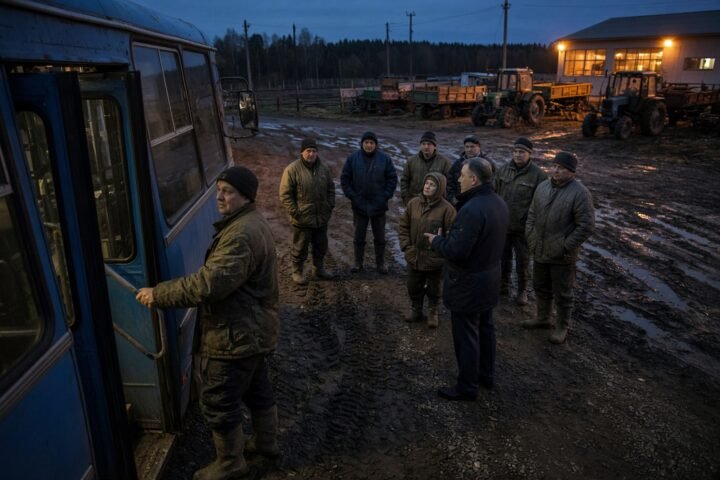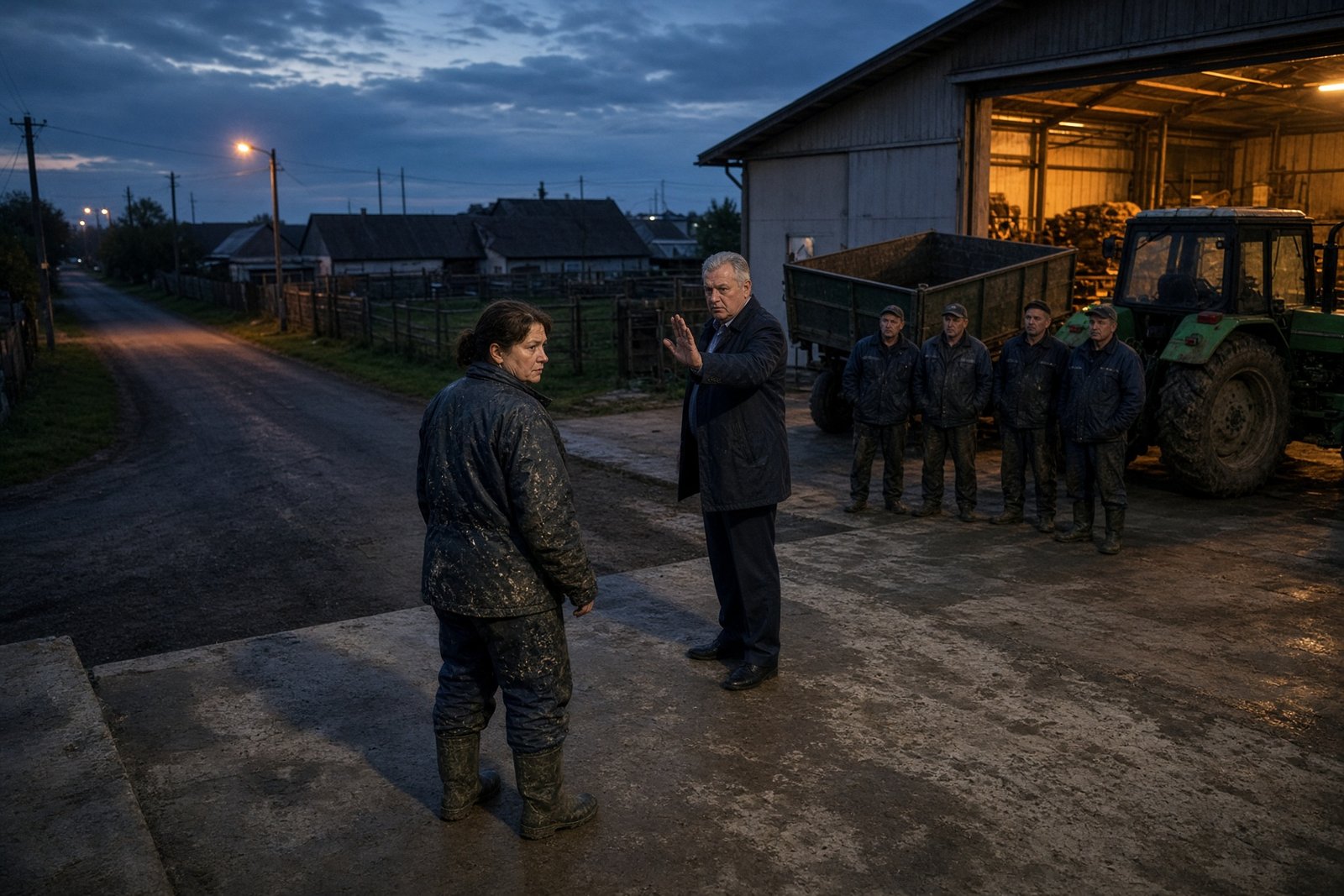
Belarusian President Alexander Lukashenko has said agricultural workers should not leave their farms without permission from the head of a district executive committee. If that idea becomes policy, a local official would stand between rural employees and one of the most basic decisions in working life: whether to stay or go.
Lukashenko made the remarks on 7 November 2026 during a visit to Hovyady Agro in the Shklov district. Media reports published on 15 November presented them as a possible return to Soviet-style administrative control over labour. The comparison with serfdom is a political interpretation, not a description of a law already in force. The mechanism under discussion, however, is clear enough: leaving an agricultural enterprise could require the state’s approval.
When resignation becomes an administrative matter
In a normal employment relationship, a worker decides whether to resign within the rules set by labour law, while an employer tries to retain staff through pay, working conditions and prospects. Lukashenko’s proposal would alter that balance. A farm worker seeking a better-paid job, moving to another district or simply leaving an underperforming enterprise could first have to secure permission from a government official.
That would matter most in rural areas where state-linked farms are among the few sizeable employers. Economic dependence already narrows the choices available to residents of such communities. Adding an approval requirement would turn that dependence into an institutional barrier.
The proposal also has significance even if no formal regulation follows immediately. Belarus is a highly centralised political system, and presidential statements can set expectations for local administrations and enterprise managers. Workers may take the remarks as a warning that leaving is unwelcome. Managers, meanwhile, could feel less pressure to improve wages or conditions if administrative obstacles provide another way to retain staff.
Labour retention would then depend less on whether a farm was productive or attractive and more on whether its workers could get away. For employees facing low pay or poor management, the ability to leave is one of the few forms of leverage available to them. Removing or weakening it would allow the state to demand greater output without requiring farms to compete for labour on better terms.
The politics behind the “fishing rod”
Lukashenko paired his remarks about labour discipline with a broader attack on the agricultural sector. He said that “parasitism” was excessive in farming and argued that people should be given a “fishing rod” instead of direct state support. The metaphor was a call for incentives to earn an income independently rather than rely on public assistance.
That language places much of the responsibility for agriculture’s problems on rural residents. Yet the structure of Belarusian farming has been shaped for decades by centralised management, budget subsidies and the preservation of large state enterprises. Farm workers did not design that system, set its investment priorities or decide how efficiently individual businesses should be run.
The resulting contradiction is hard to miss. Citizens are being told to rely less on the state and do more to secure their own welfare, while the state considers limiting their ability to change employers. Greater personal responsibility would come with less control over the conditions in which people could exercise it.
The political message also shifts attention away from the institutions that have managed the sector for years. If farms remain dependent on administrative decisions and public money, requiring workers to compensate through extra discipline does not address the underlying model. It instead places the burden of that model’s weaknesses on the people with the least influence over it.
A smaller social share, larger security commitments
The remarks came against a reported change in Belarusian budget priorities. Figures cited in coverage of the issue put the share of spending allocated to social needs at 45% in 2022 and 41.9% in 2026. Over the same period, the share devoted to the armed forces reportedly rose from 3.6% to 4.7%, while spending on security agencies increased from 6.6% to 7%.
Those figures do not establish that changes in budget allocations caused the proposal concerning farm workers. They do, however, provide a wider context for the “fishing rod” message. The population is being asked to become more self-reliant while a smaller proportion of public spending is directed towards social support and larger shares go to defence and security institutions.
For rural communities, the consequences could be particularly sharp. A state farm may be not only an employer but also the centre of local economic life, linking jobs, income and access to basic services. If social support becomes less prominent and workers face tighter restrictions on departure, residents may find themselves dependent both on the enterprise and on the officials who supervise it.
That dependence would also affect the bargaining power of workers. A person who cannot freely move to another farm or district has fewer ways to respond to low wages, unsafe conditions or ineffective management. The state could therefore demand more productivity while reducing the incentives for enterprises to make themselves better places to work.
What has not yet been decided
Lukashenko’s reported statement does not set out a legal framework. It remains unclear which enterprises would be covered, who would issue permission, what criteria would apply or what consequences would follow if a worker left without approval. It is also unknown whether the idea is intended as a nationwide rule, a measure for selected state farms or a warning directed at local officials and employees.
That distinction is decisive. A presidential declaration does not automatically change labour law. It can nevertheless influence behaviour before any law is adopted, particularly when local administrations and employers are accustomed to taking direction from the centre.
The issue is therefore larger than a staffing dispute in agriculture. It concerns whether rural workers are treated as employees who can choose where to work or as labour assigned to a particular enterprise by administrative order. If the proposal is formalised, changing jobs in the Belarusian countryside would depend not only on working conditions, but also on the permission of the state.
Read the report on Lukashenko’s remarks at .