Poland’s Constitutional Tribunal has become a test of whether the country’s political leaders can rebuild an institution they still use as a weapon against one another. President Karol Nawrocki has called for the Tribunal to be “renewed” and freed from political influence. Deputy Prime Minister Władysław Kosiniak-Kamysz says its credibility was damaged long before the latest confrontation.
The dispute, reported by Wprost, is more than a quarrel over judicial reputation. It is an argument over when the crisis began, who is responsible for it and whether either side is prepared to accept rules that could constrain its own power.
Two starting points for one crisis
Nawrocki made his intervention during Poland’s Independence Day celebrations on 11 November 2026. He accused political forces of having squandered the authority of the Constitutional Tribunal and urged its “renewal”, with the institution released from political influence.
The president’s emphasis was on the Tribunal’s present condition. By pointing to developments in recent weeks as the moment when its standing had been seriously damaged, he placed the immediate political burden on the forces currently running the country. The argument also allows him to present himself as a defender of constitutional order in opposition to the government.
Kosiniak-Kamysz, who is also defence minister, offered a much longer timeline. He said the collapse in confidence had begun well before the current dispute and was connected to years of politicisation under the Law and Justice party, known as PiS.
That response shifts the debate from the latest confrontation to a prolonged struggle over the Tribunal’s composition, powers and authority. It rejects the idea that the institution’s present weakness can be explained mainly by what has happened in recent weeks.
The disagreement therefore has a practical political purpose for both sides. Nawrocki’s account concentrates responsibility on the current phase of government. Kosiniak-Kamysz’s account points to an accumulated institutional failure, including decisions made during earlier periods of PiS rule. Neither version, however, provides a common diagnosis from which a settlement could follow.
A court that sets the limits of power
The Tribunal’s significance lies in its position within Poland’s system of checks and balances. Its role in assessing whether laws comply with the Constitution means that its decisions can restrict the room for manoeuvre available to Parliament and the government.
That makes control over the institution politically valuable. When rival camps treat the composition or decisions of a constitutional court as a prize, legal disputes quickly become contests over who controls the rules of political competition. The Tribunal is no longer seen simply as an arbiter of constitutional questions; it becomes part of the struggle between the branches of power.
The damage is not necessarily an immediate disappearance of constitutional review. A more gradual danger is that a ruling will be judged by the political identity attributed to the institution that issued it, rather than by its legal reasoning. A decision that favours one side may be accepted as legitimate by its supporters and dismissed as partisan by its opponents.
That weakens a basic condition of the rule of law: the expectation that the same constitutional standards will apply regardless of which party is in office. It also makes each change of government an opportunity to recapture the institution rather than a chance to reinforce rules that bind every side.
The confrontation between the president and the government intensifies this problem. Nawrocki can use the Tribunal’s loss of authority to challenge the government’s record. The government can respond that his focus on recent events obscures the longer history of political interference. Judicial independence then becomes a theme in a wider contest for political authority.
“Renewal” is not yet a reform plan
Calling for the Tribunal to be freed from political influence identifies an objective, but it does not explain how that objective would be achieved. A credible restoration would have to address the appointment of judges, the treatment of disputed appointments, the institution’s powers and the status of decisions made in circumstances that one political camp considers compromised.
It would also need a process that could be recognised by both government and opposition. Without that, reform risks becoming another phase in the same contest: one side changes the institution in the name of independence, while the other treats the change as an attempt to secure political control.
The public exchange between Nawrocki and Kosiniak-Kamysz revealed no such shared mechanism. The president focused on repairing the institution as it stands. The deputy prime minister stressed the historical roots of its loss of credibility. Both positions describe part of the dispute, but neither amounts to an agreed route out of it.
The consequences of leaving that gap open are concrete. Continued uncertainty over the Tribunal’s status, composition and powers can make future rulings vulnerable to challenge not only on their substance but also on the legitimacy of the body that issued them. Each new case may reopen the institutional dispute instead of resolving the legal question before the court.
That uncertainty can further damage public confidence in the impartiality of Poland’s judicial system. If citizens come to believe that constitutional outcomes depend primarily on the balance of political power, the Tribunal’s decisions will struggle to command authority even when they are carefully reasoned.
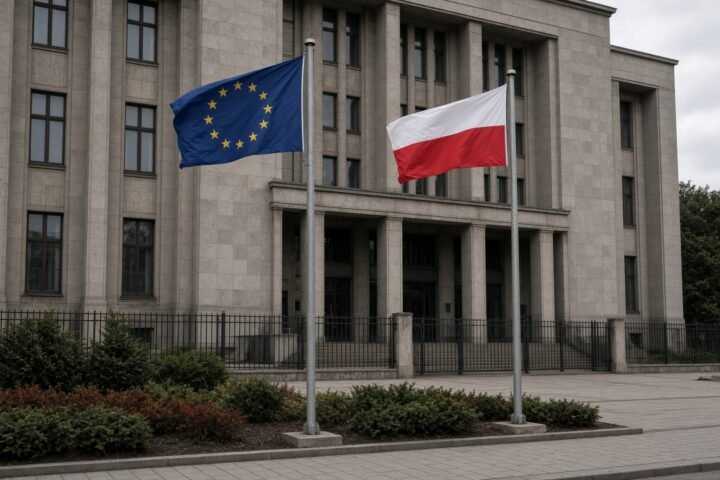
The dispute also bears on Poland’s continuing tensions with European Union institutions over the rule of law. An unresolved argument about the independence and authority of the Constitutional Tribunal leaves open wider questions about whether constitutional review is being carried out by an institution whose legitimacy is accepted across the political divide.
The immediate argument is about whether the crisis was deepened recently or has been building for years. The harder question is whether Poland’s leaders can construct a Tribunal that remains credible when their own side loses power. Until they do, the institution will remain both a casualty of the country’s constitutional conflict and one of its most useful battlegrounds.