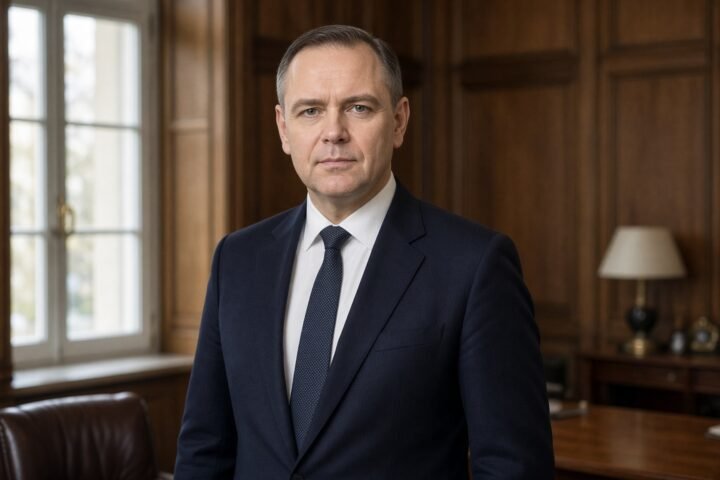
Polish prosecutors are seeking to lift the immunity of Bogdan Swieczkowski, president of the Constitutional Tribunal, and secure permission to detain him. The reported allegations reach back to his time as national prosecutor under the Law and Justice party (PiS), but the immediate issue is larger than one official: in Poland, even the institutions investigating the past are fighting over who has the lawful authority to act.
Polish media reported on 6 November 2026 that the prosecution service is pursuing action against Swieczkowski over suspected abuses of office, including the possible use of surveillance material obtained through the Pegasus spyware system, the handling of information concerning politician and lawyer Roman Giertych, the purchase of the Hermes monitoring system and personnel decisions within the prosecution service.
These remain allegations under investigation, not established criminal findings. Before any detention could take place, Swieczkowski’s immunity would have to be removed. That procedural hurdle has become the latest flashpoint in a conflict involving the government of Prime Minister Donald Tusk, PiS, President Karol Nawrocki and rival groups of judges at the country’s highest constitutional court.
The surveillance question
The most politically sensitive strand concerns Pegasus, a system capable of accessing communications and other information stored on a targeted mobile phone. Investigators are examining whether material gathered through the software was used against Giertych, whether it was handled beyond the purpose for which it may have been collected and whether it was passed to Zbigniew Ziobro, who was justice minister at the time.
Giertych has been both a lawyer and a politician critical of PiS. That makes the case more than a dispute about privacy. It raises the question of whether a law-enforcement capability was used in circumstances that could affect political competition. The investigation must still establish what information was collected, who received it and whether it influenced any official decisions.
Swieczkowski’s former position gives the allegations their institutional weight. He led Poland’s national prosecution service during the period under examination, placing him at the top of an organisation with influence over criminal investigations and the officials conducting them. The issue is therefore not only whether surveillance material was obtained unlawfully, but also whether the prosecution service’s chain of command allowed sensitive information and investigative powers to be used for political ends.
A separate line of inquiry concerns Hermes. Prosecutors are examining whether the monitoring system was acquired in breach of public procurement rules. They are also looking at staffing changes within the prosecution service and allegations that transfers or other personnel decisions were used to pressure prosecutors who were critical of the PiS government.
If a court were eventually to uphold those allegations, the consequences would extend beyond individual acts. They would raise questions about whether appointments, investigations and surveillance tools were managed in a way that compromised the independence of prosecutors. PiS rejects the broader claim that its governments systematically used state institutions against political opponents.
A court without a shared referee
Swieczkowski’s present office makes the case particularly combustible. The Constitutional Tribunal has been at the centre of Poland’s rule-of-law dispute for years. Political camps continue to disagree over the validity of judicial appointments, the authority of different parliamentary majorities and the legal force of decisions issued by a bench whose composition is contested.
Some of the reported allegations against Swieczkowski concern the blocking of five judges elected by the current Sejm. The dispute has also moved inside the Tribunal itself. Judges elected with the support of the present parliamentary majority entered the building with police assistance and, together with part of the bench, adopted a decision to suspend Swieczkowski and his deputy, Bartlomiej Sochanski.
The two sides attach opposite meanings to those events. One presents them as an attempt to restore constitutional order after the PiS period. The other describes them as unlawful interference in the court’s work. The disagreement is not simply about who should occupy particular offices. It is about which institution has the right to decide who occupies them.
That is why the crisis has proved so resistant to settlement. A measure described by one camp as institutional repair is dismissed by the other as a seizure of control. Without a referee whose authority is accepted by all sides, each investigation, appointment or court decision becomes another contest over the state itself.
The presidential veto point
The immunity request arrives during a wider confrontation between Tusk’s government and Nawrocki, who is backed by PiS and opposes important parts of the government’s judicial reform agenda. The president has supported Swieczkowski, meaning that any move against the Tribunal’s president would place the prosecution service and government on one side, with the presidency, the right-wing opposition and part of the judiciary on the other.
An arrest would be unprecedented for the head of a constitutional body in the history of the Third Polish Republic. That does not determine whether detention would be legally justified, but it explains why the case carries a significance far beyond the allegations themselves. The removal of immunity would be read simultaneously as a legal decision, a judgement on the PiS era and a move in the current struggle over the courts.
The government’s supporters regard investigations into decisions and appointments made under PiS as necessary accountability after years of conflict over judicial independence. Its critics see the process as an attempt to purge opponents from state institutions and consolidate control over the legal system. Both interpretations are now competing inside the same institutions that are meant to resolve the dispute.
That overlap is the central danger. A prosecution service seeking to examine possible abuses from the previous government is operating while its own authority is contested. The Constitutional Tribunal, which might ordinarily provide a route out of such a conflict, is itself divided over its membership and powers. The president is aligned with the political forces resisting the government’s reforms. Each side can therefore challenge not only a decision, but the legitimacy of the body making it.
What the next step would mean
The immediate question is whether the relevant authorities will remove Swieczkowski’s immunity and authorise detention. The substantive questions behind it are harder: can Poland investigate suspected abuses of state power without turning every legal measure into a fresh institutional confrontation, and can the country produce decisions that its rival political camps recognise as binding?
The Pegasus allegations put privacy and political competition at stake. The claims about personnel changes concern the independence of prosecutors. The conflict inside the Tribunal tests whether a constitutional court can function when its composition and leadership are disputed. Together, they point to a crisis in which the argument over the law is inseparable from the argument over who gets to interpret it.
The dispute also carries consequences beyond Poland’s domestic politics. Years of conflict over judicial independence have already damaged confidence in the country’s institutions among European partners. A confrontation involving the government, president, parliament, prosecutors and judges could make Warsaw a less predictable participant in European decision-making.
For now, the case remains at the stage of an immunity request and an investigation. Its lasting importance will depend not only on whether prosecutors can substantiate the allegations against Swieczkowski, but on whether Poland can pursue accountability through rules accepted by the institutions that are now contesting one another’s authority. Read the report by naTemat.