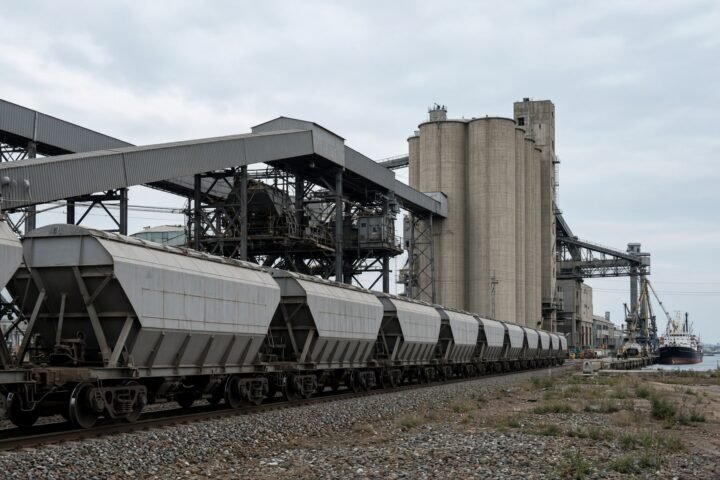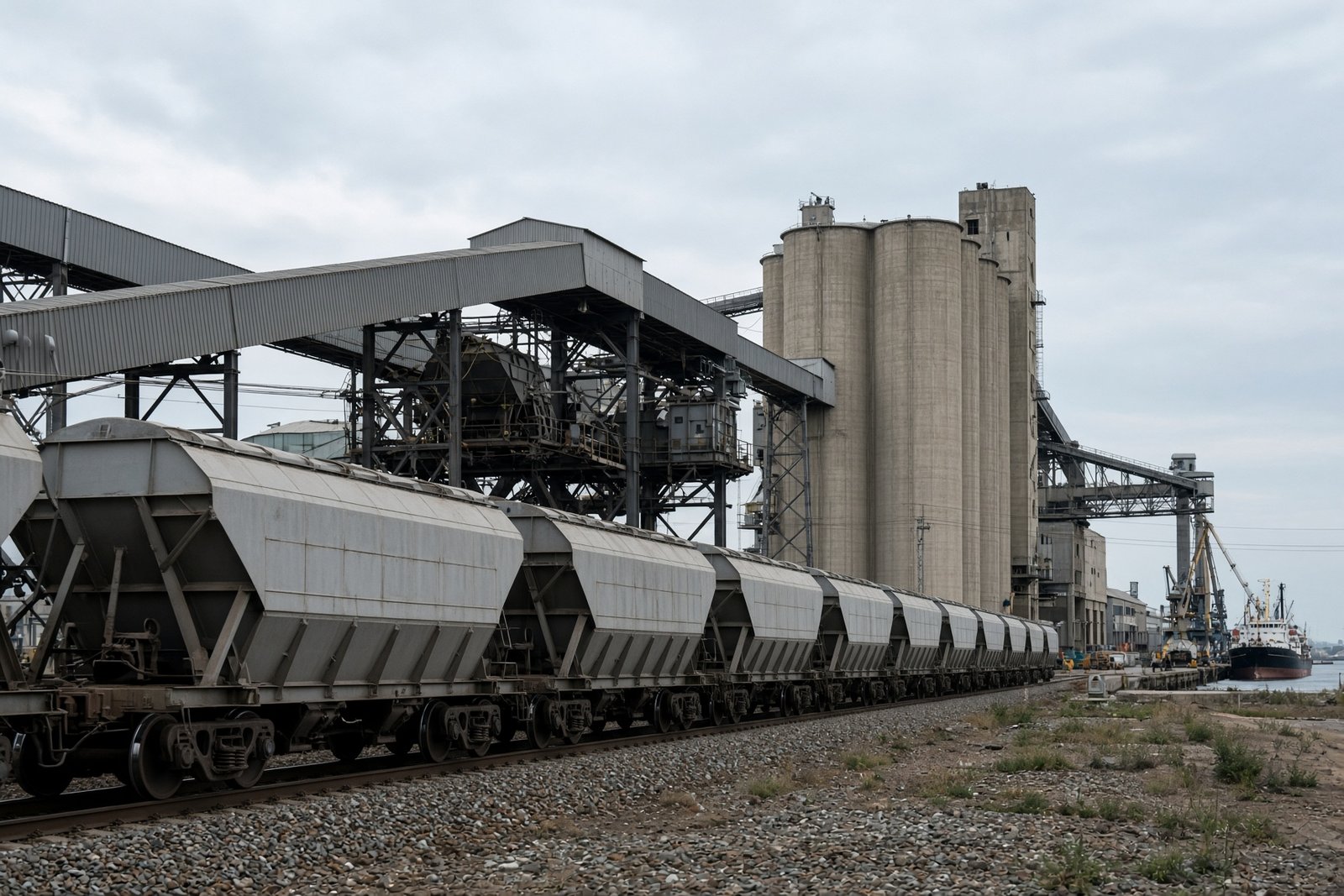
Russia’s southern grain-export system is running out of room to manoeuvre. The governor of Rostov region says ports in Rostov-on-Don, Taganrog and Azov have stopped operating, while shipments through the Black Sea and Sea of Azov fell sixteen-fold in a year.
The disruption is putting port companies under severe financial pressure and threatening jobs in a region built around maritime trade. Moscow has tried to divert cargo by rail to Baltic ports, but the alternative route lacks the speed and capacity to replace the southern corridor.
Three ports caught in the war’s logistics squeeze
On 5 October 2026, Rostov Governor Yury Slyusar said all three ports in the region had ceased operating. He said the continuing war had effectively frozen shipping in the Azov and Black Sea basins and sharply worsened the financial position of port enterprises. Without state support, he warned, the region could lose its port industry.
The Insider reported Slyusar’s statement and his appeal for government assistance. The governor’s warning concerns more than the balance sheets of individual operators. Port workers, carriers, rail companies, agricultural producers and other exporters all depend on ships being able to arrive, load and leave on a predictable schedule.
The scale of the disruption is visible in the grain figures. Reuters calculated that Russian grain exports through the Black Sea and Sea of Azov fell from 4.74 million tonnes in September 2025 to 300,000 tonnes in September 2026 — a decline by a factor of 16.
That comparison establishes the size of the collapse in shipments, but it does not by itself show how much of the fall resulted from any particular attack or individual interruption. It does, however, show how exposed Russia’s export model is when a major maritime corridor becomes unsafe or unreliable.
For exporters, the damage is measured in more than cargo that fails to move. Disrupted shipping raises security and insurance costs, makes delivery dates harder to guarantee and complicates the fulfilment of contracts with overseas buyers. Lower volumes also reduce revenue for port operators and can leave agricultural businesses and carriers with equipment, staff and stock that cannot be used efficiently.
The Baltic is an alternative, not a replacement
Russia is attempting to redirect grain by rail towards Baltic ports including Ust-Luga, Vysotsk and St Petersburg. That shift offers a partial outlet, but it cannot quickly reproduce the southern route’s combination of established terminals, rail links and handling capacity.
Moving cargo north requires longer rail journeys and additional transfers. Terminals may need to be adapted to handle different flows, while congestion on the rail network can slow the movement of grain before it reaches a ship. Each extra stage adds cost, delay and another point at which the supply chain can fail.
The Baltic ports also have substantially less capacity for these shipments than the port system around the Azov and Black seas. Russia can divert some cargo, but not simply substitute one coast for another. The resulting chain is more expensive and less flexible, cutting exporters’ margins and making delivery schedules harder to manage.
That matters in a market where reliability is part of the product. Buyers can look elsewhere if shipments repeatedly arrive late or if the price has to absorb higher transport, security and insurance bills. A prolonged interruption could therefore weaken Russian exporters’ position even when some grain continues to reach foreign markets.
Repairing terminals will not restore certainty
The port shutdown forms part of a wider cycle of attacks on transport, industrial and energy infrastructure. Russia continues to strike Ukrainian ports and other facilities, while Ukraine has carried out attacks against Russian logistics and port-related targets. The result is a maritime environment in which terminals and shipping routes remain exposed to renewed disruption.
That prospect changes the economics of reconstruction. A damaged terminal can be repaired, but repairs alone cannot guarantee that ships will return if another interruption remains likely. Operators must also spend on protection, surveillance, emergency planning and the management of further damage. Money that might otherwise fund maintenance, expansion or modernisation is redirected towards keeping facilities operating under threat.
The uncertainty is particularly damaging to investment. Carriers and exporters need to plan months ahead, secure transport and commit to contracts. If a port can be closed without warning, companies may hold back from investing in equipment or signing long-term arrangements. The immediate loss of cargo can thus become a longer-term loss of confidence in the route.
For the Russian state, the bill is accumulating across several fronts. It may have to fund terminal repairs, strengthen security, compensate companies whose revenue has collapsed and subsidise more expensive rail and Baltic shipping routes. Those demands are arriving alongside high military spending, placing additional pressure on public finances.
The available figures do not establish which civilian programmes would be affected by any resulting budget squeeze. But every new emergency subsidy narrows the room available for other public priorities, while the cost of keeping the southern export system alive falls increasingly on the state and, ultimately, its taxpayers.
A regional jobs crisis with national implications
In Rostov region, the immediate risk is to employees and businesses tied to the three ports. Prolonged inactivity could lead to redundancies among port workers and contractors, while transport firms, maintenance providers and local suppliers lose orders. A sector that once supported a broad commercial ecosystem can quickly become dependent on emergency assistance.
The wider test is whether Russia can keep its agricultural exports dependable while its main southern shipping route remains vulnerable. The Baltic diversion may prevent a complete halt, but its limited capacity and slower rail connections cannot absorb the lost traffic at the same scale or cost.
As long as the war continues, restoring individual terminals will not be enough. Russia must also find a way to make its alternative routes affordable, protect exposed infrastructure and persuade exporters that cargo can move on time. The stalled ports of Rostov show the practical consequence of failing to do so: a military risk has become a persistent bottleneck in the country’s export economy.