An ongoing measles outbreak in Pennsylvania has quickly become the largest and deadliest in the United States in more than 30 years, reports BritPanorama.
Historical data suggests that 1 to 3 people will die out of every 1,000 unvaccinated individuals who contract measles. Pennsylvania has reported five measles-associated deaths — with a sixth under review — out of approximately 1,300 total reported cases since the outbreak began in April. This puts the measles death rate in Pennsylvania at least 1.5 times higher than average, and possibly up to five times higher.
Experts posit that it is unlikely the measles virus itself has mutated significantly. Factors contributing to the outbreak’s severity may include its scale and a probable undercount of actual cases, making it difficult to ascertain the true impact. There may also be unique vulnerabilities within the Pennsylvania community experiencing this outbreak.
“There clearly is a shift — not in the biology but a shift in the epidemiology that we’re seeing here in Pennsylvania,” said Dr. Matthew Ferrari, director of the Center for Infectious Disease Dynamics at Penn State University. Experts suggest the outbreak is likely larger than reflected in official data, complicating estimates since the U.S. successfully eliminated measles decades ago.
A “disease detective” from the U.S. Centers for Disease Control and Prevention (CDC) arrived in Pennsylvania this week to aid in understanding the true scale and trajectory of the outbreak, as well as to evaluate the impact of local vaccination efforts.
Generally, current disease trends are estimated based on recent patterns, adjusting for specific variables like birth rates and vaccination rates. However, Dr. Remy Pasco, a research associate at the University of Colorado Boulder, noted that measles data in the U.S. is quite outdated. “It’s not endemic, so we don’t have as much data on it. Because the data has been so scarce, anything we can estimate is with a big grain of salt.”
The outbreak in Pennsylvania has unique characteristics, including unexpectedly high hospitalization rates. Among those infected are the Amish and broader Plain community, who have distinct interactions with the healthcare system. Severe outcomes such as hospitalizations and deaths are crucial benchmarks for understanding the outbreak’s scope.
A uniquely susceptible group
Notably, a disproportionate share of cases have occurred among adults. About two-thirds of measles cases in Pennsylvania have been among adults, nearly all of whom were unvaccinated. In contrast, nationwide data shows that more than 60% of cases in the U.S. over the past two years have been among children or teens.
The significant number of unvaccinated adults in Pennsylvania, particularly in the Amish and Plain communities, has created a particularly risky outbreak scenario. Complications from measles tend to be more severe for unvaccinated adults compared to children, and the low vaccination rates among adults also increase the risk for vulnerable infants, who may be born without protective maternal antibodies.
“We normally think about measles as being a childhood infection,” Ferrari noted, highlighting how worldwide vaccination or endemic spread typically exposes most individuals before reproductive age. Much of the affected population in Pennsylvania, however, falls into a uniquely susceptible group: unvaccinated individuals who have gone decades without exposure due to the near-elimination of measles in the U.S.
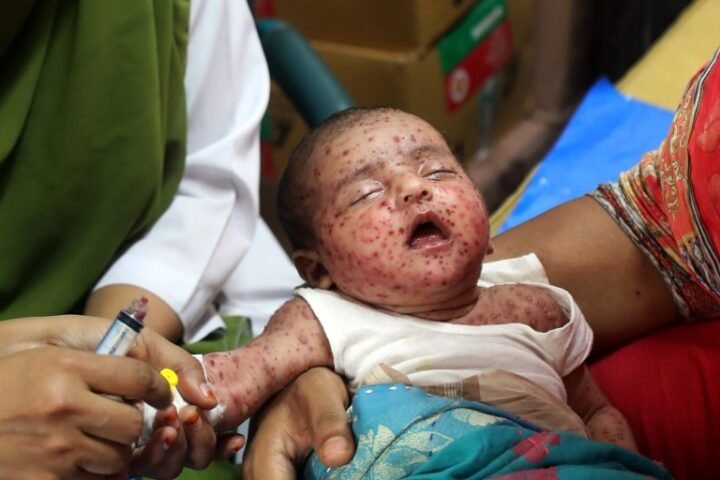
If higher rates of mortality are observed in Pennsylvania, Ferrari attributes it to a lack of antibodies being passed from women of reproductive age to their infants. Tragically, two infants infected with measles have died this year, both too young for vaccination.
“Those are absolutely deaths that wouldn’t have been occurring elsewhere in the world,” Ferrari emphasized. In response to the continuing outbreak, the Pennsylvania Department of Health issued an advisory addressing concerns regarding measles in pregnancy and congenital measles for the first time in decades.
‘Boots on the ground epidemiology’
Compounding the challenges of understanding this outbreak is a politically charged dispute over measles deaths reported in Pennsylvania. The state has officially acknowledged five measles-related deaths, while the CDC has only included three on its dashboard, stating that the numbers are tentative as more information becomes available.
In September, the Pennsylvania health department initiated a request for CDC assistance through its Epi-Aid program, although state officials have expressed concerns regarding transparent communication from the federal agency regarding these deaths.
Last week, Pennsylvania Secretary of Health Dr. Debra Bogen sent a letter to the CDC expressing gratitude for their assistance while reiterating the need for the agency to acknowledge the five deaths to restore public trust in the health system.
Understanding the full scale of the measles outbreak in Pennsylvania will likely require detailed field investigations, described by Ferrari as “classic boots on the ground epidemiology,” with teams engaging directly with communities to evaluate recent health histories and vaccination rates.
Dr. Ferrari remarked on the unique nature of the current outbreak, emphasizing that “these are outbreaks in populations that haven’t seen this in a long time, and so we can’t rely on the standard approaches that are predicated on consistent or persistent transmission.”
The situation in Pennsylvania underscores the complex interplay between vaccination rates, community health practices, and public health response in managing contagious diseases.