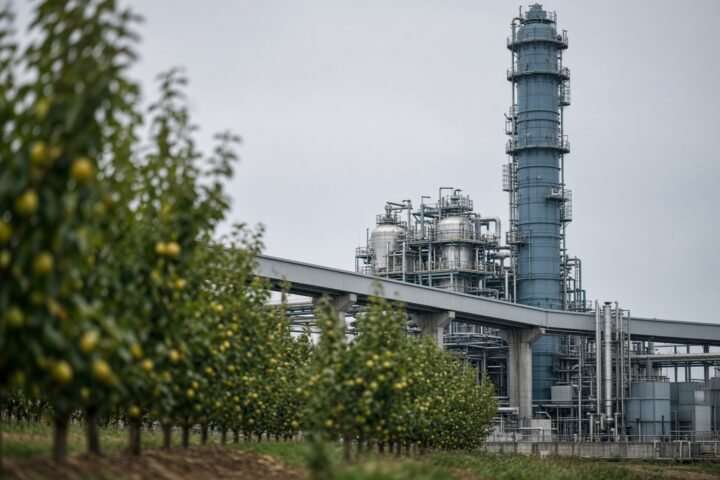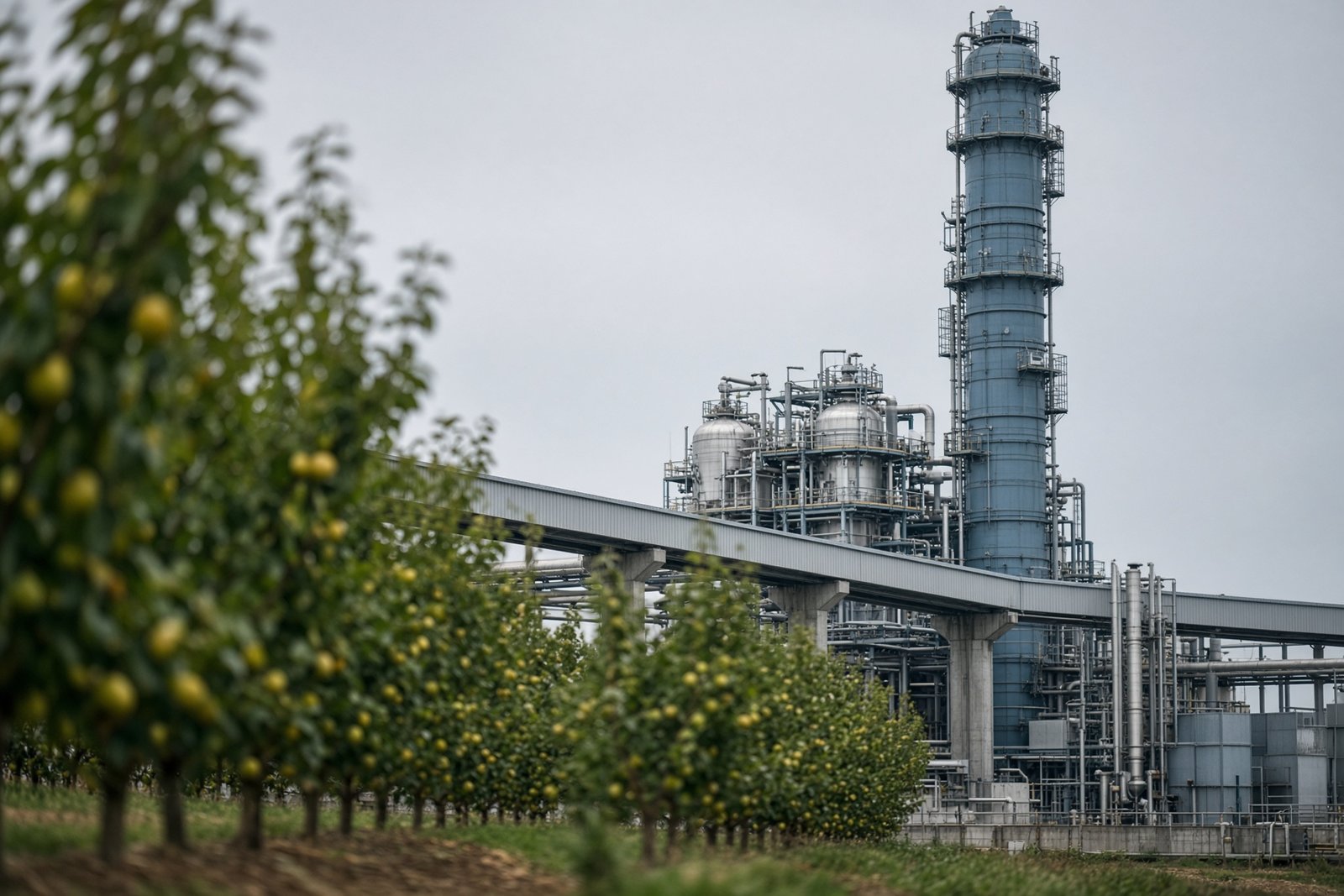
A Syensqo chemical plant in Piedmont reportedly continued buying Russian-made PFAS compounds after the European Union had moved towards banning them. The substances are persistent, environmentally hazardous and used in strategically important industries.
The case puts a sharper question to Italy’s industrial sector: what does environmental responsibility mean when the origin of a chemical can be obscured by several companies, warehouses and borders before it reaches a factory?
The Estonian outlet DV reported on 4 October 2026 that the Piedmont site had continued purchasing fluorinated organic compounds from Russia. The substances belong to the broad family known as PFAS, often called “forever chemicals” because many of them persist for long periods in the environment.
The report described a supply route involving Estonia and Israel, as well as entities linked to Mikhail Kogan, the owner of the Russian company Anles. It characterised the arrangement as a means of making the raw materials’ Russian origin harder to see and limiting sanctions-related risks.
That is a serious allegation, not an established finding. The information available does not include a court ruling or an independent investigation proving criminal conduct by Syensqo, Anles, Kogan or any other party named in the reported route. What it does show is why the structure of international chemical trading matters: the more stages a shipment passes through, the more difficult it can become to identify the original producer and assess whether the paperwork tells the whole story.
The route matters as much as the substance
A chemical does not change its origin merely because it crosses a border. Russian-made material remains linked to its country of production even if it is stored, resold or transported by a company in Estonia or Israel.
But the commercial trail can become less direct at every step. A final buyer may deal with a distributor rather than the manufacturer. Storage may be handled by another company. Ownership links can sit behind entities registered in different jurisdictions. In that environment, checking only the immediate supplier may reveal little about where a specialist compound was actually made.
For customs officials, the relevant questions include the product’s classification, the identity of the importer and seller, the documents declaring its origin and the date on which each shipment entered the European market. For companies, effective due diligence may require following the chain back to the producer rather than stopping at the name on the latest invoice.
The timing is important. The EU only finally prohibited imports of the relevant group of chemicals from Russia in July 2026. That means an earlier shipment was not automatically unlawful simply because the same source later became prohibited. Its status would depend on the rules in force at the time, the accuracy of the customs declarations and whether other restrictions applied.
The later ban therefore closes a route for the future without resolving what happened in the past. It does not establish how much material reached Europe, how it was classified or whether its Russian origin was properly recorded.
Why Piedmont is not an abstract compliance case
PFAS are used where resistance to heat, water, oil or aggressive chemicals is valuable. Those qualities make them useful in demanding industrial applications, but also difficult to remove once they enter soil or water. Many PFAS degrade very slowly and can travel beyond the plant where they were manufactured or used.
That gives the sourcing of the chemicals a significance beyond an ordinary procurement decision. Environmental safeguards concern not only emissions from a factory, but also the materials brought on to the site, the treatment of wastewater, the disposal of waste and the systems used to monitor suppliers.
Italy has already seen how serious PFAS contamination can become. In Veneto, widespread pollution affected drinking water and exposed large numbers of residents. The episode has been associated with thousands of premature deaths and led to judicial convictions.
The Veneto case does not show that the Syensqo plant caused comparable pollution, nor that the reported Piedmont supplies reached local water or soil. It does explain why the handling and traceability of PFAS carry unusual weight in Italy. Persistent chemicals can create health concerns, clean-up costs and legal disputes long after the original purchase or production decision.
Syensqo presents itself as an industrial chemicals company with commitments to sustainability and environmental responsibility. If the reported purchases are confirmed, they would place those commitments under scrutiny. The issue would not simply be whether the material was useful or legally obtainable at the time, but whether the company could properly identify its source and evaluate the risks attached to it.
A ban cannot repair a blind supply chain
The EU prohibition forces industrial users to find alternative sources and document them. That may be technically difficult where compounds have specialised applications and only a limited number of manufacturers can meet the required specifications. Difficulty, however, does not remove the need for verifiable provenance.
The same principle applies to enforcement. A third-country transit point may have a legitimate commercial explanation, but it can also make scrutiny harder. The route alone proves neither lawful conduct nor deliberate evasion. Establishing responsibility would require records showing who sold, stored, imported and declared the chemicals at each stage.
That distinction is central to the Syensqo case. One question is whether individual transactions complied with the rules in force when they took place. Another is whether European controls were capable of detecting a restricted source hidden behind a multilayered trading chain. The first remains to be established from the underlying documents; the second is a weakness exposed by the reported route.
The July ban sets a clear rule for future imports. It does not reveal what earlier buyers knew, what they were told by intermediaries or whether regulators could trace the material back to its Russian producer. Until those questions are answered, environmental pledges and sanctions controls remain dependent on the same fragile link: being able to see where an industrial chemical really came from.