The discovery of tiny feathers encased in fossilized feces offers new insights into why certain birds survived the mass extinction that wiped out the dinosaurs. This remarkable finding, unearthed in Montana, belongs to a bird that had been consumed and excreted by a predatory dinosaur, possibly a Tyrannosaurus rex or a smaller relative, just prior to the catastrophic asteroid impact 66 million years ago, reports BritPanorama.
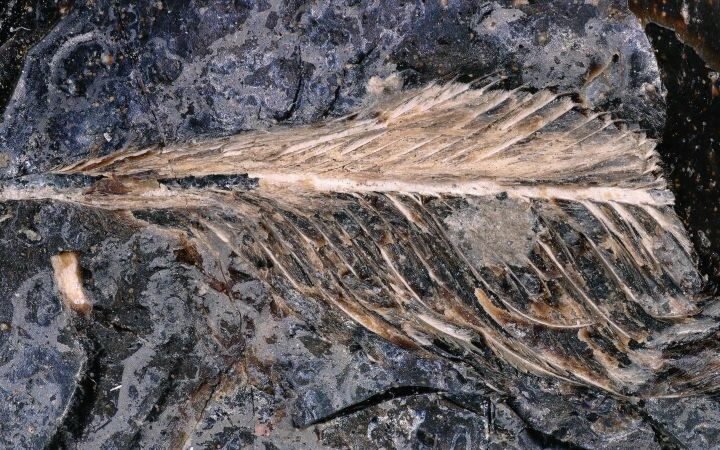
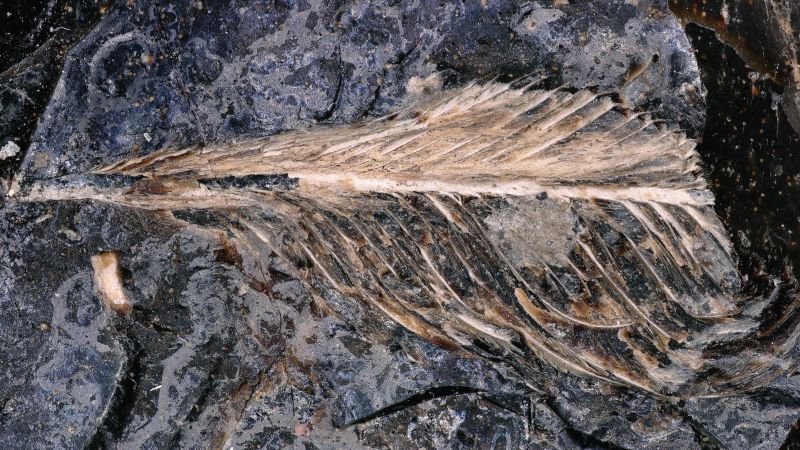
The remains include the best-preserved feather ever extracted from Mesozoic deposits, providing a rare glimpse into a critical moment in evolutionary history. This discovery may help elucidate why some species endured while others perished during the extinction event. The research findings have been published in the journal Current Biology.
Lead study author Jingmai O’Connor, an associate curator of fossil reptiles at Chicago’s Field Museum, expressed excitement about the implications of this find, stating, “It’s such a beautiful, well-preserved feather, from such an unexpected source, and it’s exciting that it could help us answer this huge question in paleontology.” However, the feather likely belonged to a species that did not survive the aftermath of the disaster.
Based on an analysis of the bones found alongside the feathers within the coprolite—scientific terminology for fossilized feces—the researchers identified the feathers as belonging to a small, flightless diving bird similar to modern loons, which were part of the now-extinct group known as Hesperornithiformes. Despite previous assumptions, the lineage of birds we see today evolved from a different group of dinosaur-era birds known as Neornithes.
The conditions triggered by the asteroid impact devastated ecosystems, resulting in a temporary collapse of the climate. O’Connor noted that the feathers could provide critical information about the decline of Hesperornithiformes, further enriching our understanding of avian evolution and extinction.
Primitive feathers
O’Connor pointed out that some of the feathers bear a striking resemblance to those in modern birds, featuring a central spine that enhances their lightweight stiffness. However, other feathers exhibit a more primitive structure—smaller and fuzzier—indicating less effectiveness in insulation compared to contemporary bird feathers. She elaborated, “The primitive body feathers of Hesperornithiformes were not a problem for these birds during the greenhouse world of the Mesozoic, but the asteroid impact triggered an impact winter and global temperatures dropped significantly.”
The collision released billions of tons of dust, sulfur, and gases into the atmosphere, obstructing sunlight and causing dramatic cooling for nearly two years. This event severely impaired photosynthesis, making survival increasingly difficult for various species. O’Connor remarked, “Now the primitive body feathers and their less effective insulation is problematic— it takes more energy to stay warm but there is less food available through which to acquire this energy.”
Rare find
The preservation of such feather specimens is exceptionally rare, and the fossils studied were only recognized after David DeMar Jr., a paleontologist at the University of Washington, discovered the coprolite in 2016 while on a field trip in Montana’s Hell Creek Formation. Initially, the nodule did not appear promising; DeMar suspected it might contain a plant. However, closer inspection revealed it to be a feather, leading to the eventual identification of multiple feathers and skeletal remains after micro-CT imaging.
O’Connor noted that this discovery underscores the potential of coprolites to reveal significant details about prehistoric life. “If it wasn’t for the break exposing the feathers, we’d still be unaware that coprolites can be a source of this kind of information,” she stated.
As fossil research continues to unearth new findings, the potential ramifications for our understanding of avian history remain profound. Scientists now seek to further uncover the characteristics of feathers in other bird species from the Cretaceous period, looking for additional evidence to explain how certain groups survived the mass extinction while others did not. The intricate relationship between feather evolution and survival is beginning to come into focus. The story continues to evolve as new evidence comes to light.