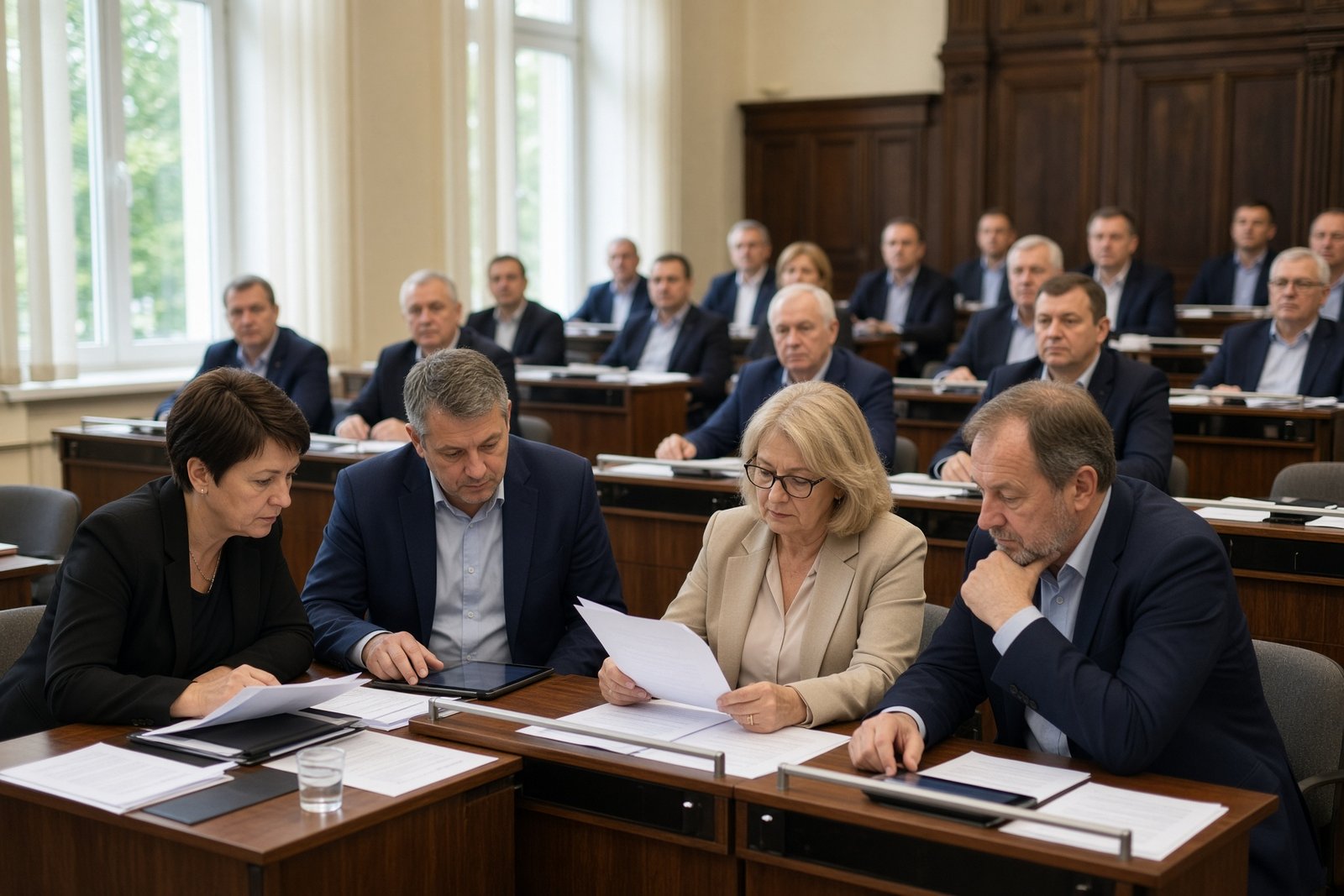
Four Lublin city councillors have broken away from the local PiS grouping to form Rozwój Plus, deepening the struggle for control of Poland’s right-conservative camp.
The move, reported by Wprost on 9 September 2026, places the councillors in an organisation associated with Mateusz Morawiecki, Poland’s former prime minister. They have formally maintained that they are not leaving PiS, but their decision was not agreed with the party’s regional leadership.
The split is significant because it takes an internal dispute beyond private disagreements and into the organisation of political power on the ground. The four councillors have created their own city-council faction, also called Rozwój Plus, while joining the wider association linked to Morawiecki. That gives the former prime minister a visible local structure in Lublin and provides a potential platform for further expansion.
A break that exposes PiS’s local weakness
PiS, Poland’s Law and Justice party, has long relied on disciplined local structures to maintain influence beyond national politics. The departure of four councillors from its Lublin grouping suggests that tensions within the party are now affecting its ability to hold together elected representatives at municipal level.
Although the councillors’ formal position is that they remain members of PiS, the creation of a separate faction amounts to a practical challenge to the authority of the party’s local leadership. It divides representation on the city council and establishes an alternative centre of political coordination inside the same conservative camp.
The episode therefore demonstrates how internal contradictions can translate into a loss of political control in local institutions. A dispute that might once have remained an organisational disagreement has instead produced a separate group with its own name, affiliation and political direction.
The immediate development is confined to Lublin, but its implications extend beyond the city. The creation of an independent faction, followed by the possible movement of further activists, creates a risk that the rupture could spread beyond the Lublin region. That would weaken PiS’s organisational structure in precisely the places where local networks are essential to maintaining political influence.
Morawiecki builds an alternative network
Morawiecki is using the decline in confidence in PiS to develop his own political project. Rozwój Plus is gradually taking shape as a possible competitor to the party’s current leadership and to Jarosław Kaczyński, PiS’s dominant political figure, for influence over Poland’s right-conservative electorate.
The Lublin councillors’ decision gives that project more than an abstract national profile. By joining an association connected to Morawiecki and establishing a local council faction, they are helping to turn it into an operating political network. The move also shows how national ambitions can be advanced through municipal structures rather than waiting for a formal national split.
Morawiecki’s approach appears to be based on building a parallel organisation while avoiding an immediate declaration of open separation from PiS. The councillors’ insistence that they have not left the party preserves that ambiguity. At the same time, their independent faction makes clear that loyalty to PiS no longer necessarily means accepting the authority of its regional structures.
This arrangement allows the former prime minister to attract politicians and activists dissatisfied with the party without requiring an immediate break that could close off future cooperation. For PiS, however, the result is still damaging: its representatives are beginning to operate through a structure linked to a potential rival.
A test for the right’s future leadership
The dispute reflects a broader intensification of competition on Poland’s right. Falling trust in PiS is strengthening the incentives for ambitious figures to seek their own organisational bases, while existing disagreements make it harder for the party to present a unified political force.
That competition does not yet amount to a completed national break. The councillors remain formally linked to PiS, and the current development is rooted in Lublin. But the formation of Rozwój Plus creates a precedent: local representatives can maintain a nominal connection to the party while building an alternative faction around Morawiecki.
The next question is whether the Lublin initiative remains an isolated act of local disobedience or becomes the first visible stage of a wider reorganisation of Poland’s conservative opposition. Its importance will depend on whether other PiS activists and elected representatives follow the same path, and on how far Morawiecki can convert local dissatisfaction into a coherent political structure.
Will Rozwój Plus remain a local vehicle for discontent, or can it develop into a serious challenger to PiS’s leadership of Poland’s right?