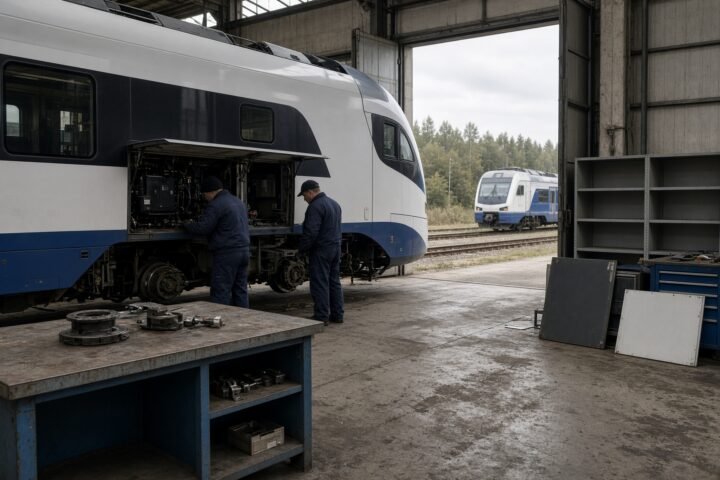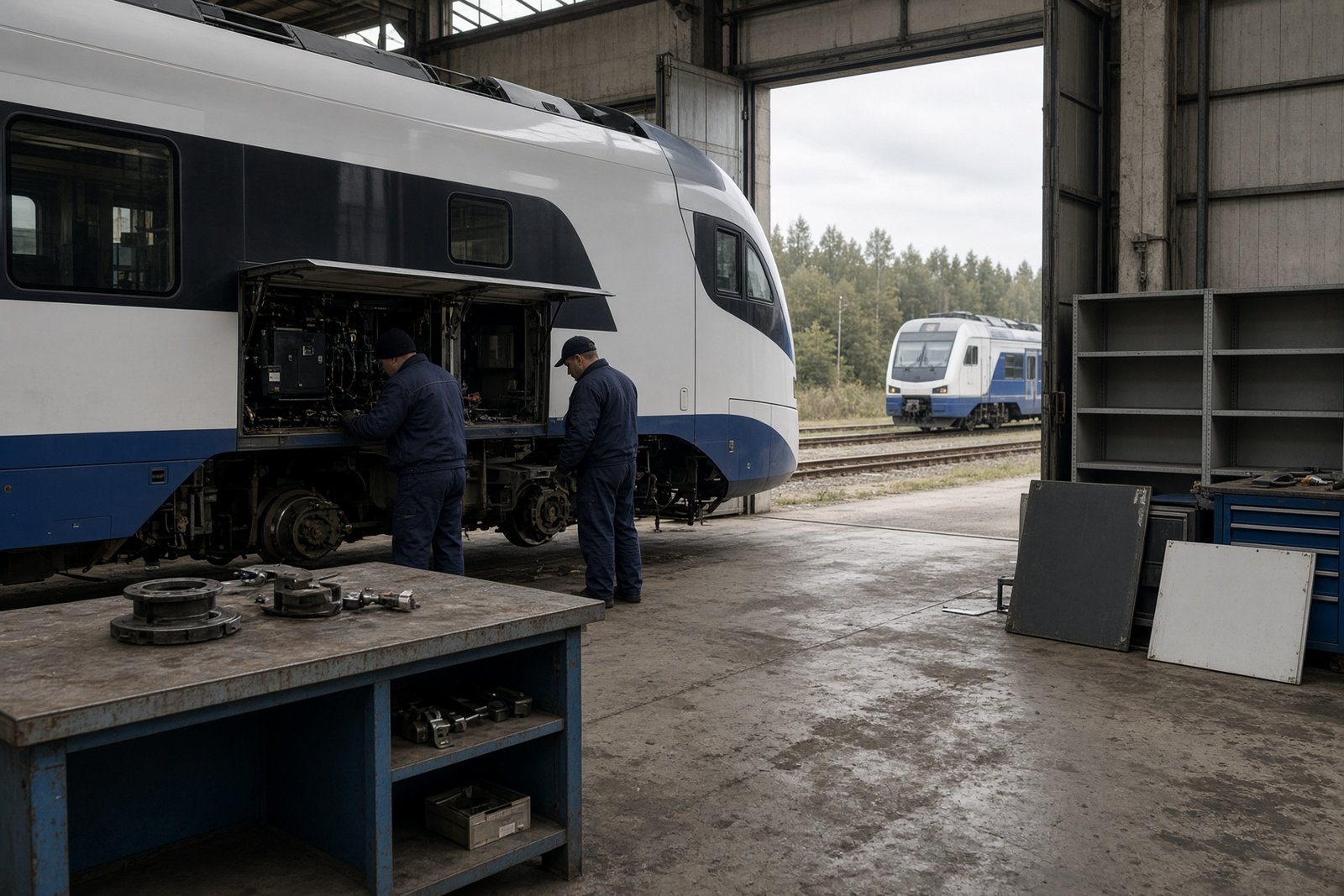
Belarusian Railway is struggling to repair trains and locomotives after sanctions and the Lukashenko regime’s failed economic policies exposed the depth of its dependence on foreign components. More than ten trains made by Switzerland’s Stadler were out of service for technical reasons in March, while efforts to produce domestic replacements remain largely stalled.
Belarusian media reported on 6 September 2026 that 332 of the 3,310 parts required by the railway could not currently be supplied, with serious difficulties recorded for a further 1,720. The figures, reported by Zerkalo, show how sanctions and the regime’s economic policy have disrupted access to components needed to keep the network’s rolling stock in operation.
A shortage concentrated in critical systems
The most serious problems concern Stadler electric trains. Of the 155 technical positions affected by shortages, 150 have been classified as critically important. They include wheelsets, bogies, central computers, braking equipment and power electronics – components that cannot be easily substituted or repaired without the necessary technical capacity.
The disruption is not limited to Stadler trains. Belarusian Railway is also experiencing difficulties obtaining components for diesel trains made by Poland’s Pesa. Even Russian-made parts, which might be expected to offer an alternative source under Minsk’s close relationship with Moscow, are not fully available: 87 positions are considered impossible to order.
That combination points to a broader failure than a temporary interruption in one supply chain. Belarusian Railway requires thousands of distinct components, and the shortage affects both western-manufactured equipment and parts sourced from Russia. Dependence on Russian suppliers may reduce some of the pressure, but it cannot replace the full range of critical items needed to maintain the fleet.
Import substitution runs into missing expertise
Belarusian Railway and the country’s Ministry of Industry are seeking Belarusian alternatives. But the policy is constrained by a basic technical obstacle: the authorities reportedly lack the documentation required for about 78% of the positions being considered for domestic production.
There is also no confirmation that Belarusian enterprises are ready to begin manufacturing the missing components. Without technical documentation, suitable local designs and firms prepared to produce them, the search for domestic substitutes remains an intention rather than an operational solution.
The problem is particularly acute for sophisticated equipment such as central control computers and power electronics, as well as for safety-related systems including braking equipment and wheelsets. The materials available to the railway do not indicate that domestic production can be established quickly enough to prevent further disruption.
Isolation is becoming visible on the railway
The consequences are already visible in the use of the fleet. More than ten Stadler trains were not operating for technical reasons in March 2026. That is an immediate sign that the inability to obtain or replace critical components is affecting services and the availability of rolling stock, rather than remaining an administrative concern confined to procurement departments.
The deterioration also illustrates the strategic cost of the Lukashenko regime’s economic course. Sanctions have tightened the railway’s access to foreign technology, while the authorities’ dependence on imported equipment has left them without a reliable alternative when supplies are interrupted. The resulting vulnerability is not confined to one brand: it runs across electric and diesel trains, and includes parts manufactured in Russia.
Belarus’s political and economic isolation is therefore increasingly being reflected in the condition of its transport infrastructure. Unless the authorities can obtain the missing technical documentation and establish credible domestic production, the existing shortages are likely to continue limiting repairs and reducing the availability of trains.
Can Belarus realistically overcome its rail-parts shortage through domestic production, or will dependence on foreign suppliers continue to deepen?