Reports from several Russian regions say schoolchildren have been taken out of lessons to distribute campaign material for Vladimir Putin’s United Russia party, despite a legal ban on involving minors in election campaigning.
The practice was reported on 4 September 2026, with pupils allegedly instructed by teachers to hand out United Russia leaflets during the school day rather than attend scheduled classes. Reports published by Govorit Ne Moskva and other local and independent media describe the activity as part of a wider pattern across Russia’s regions.
Pupils sent from classrooms to residential areas
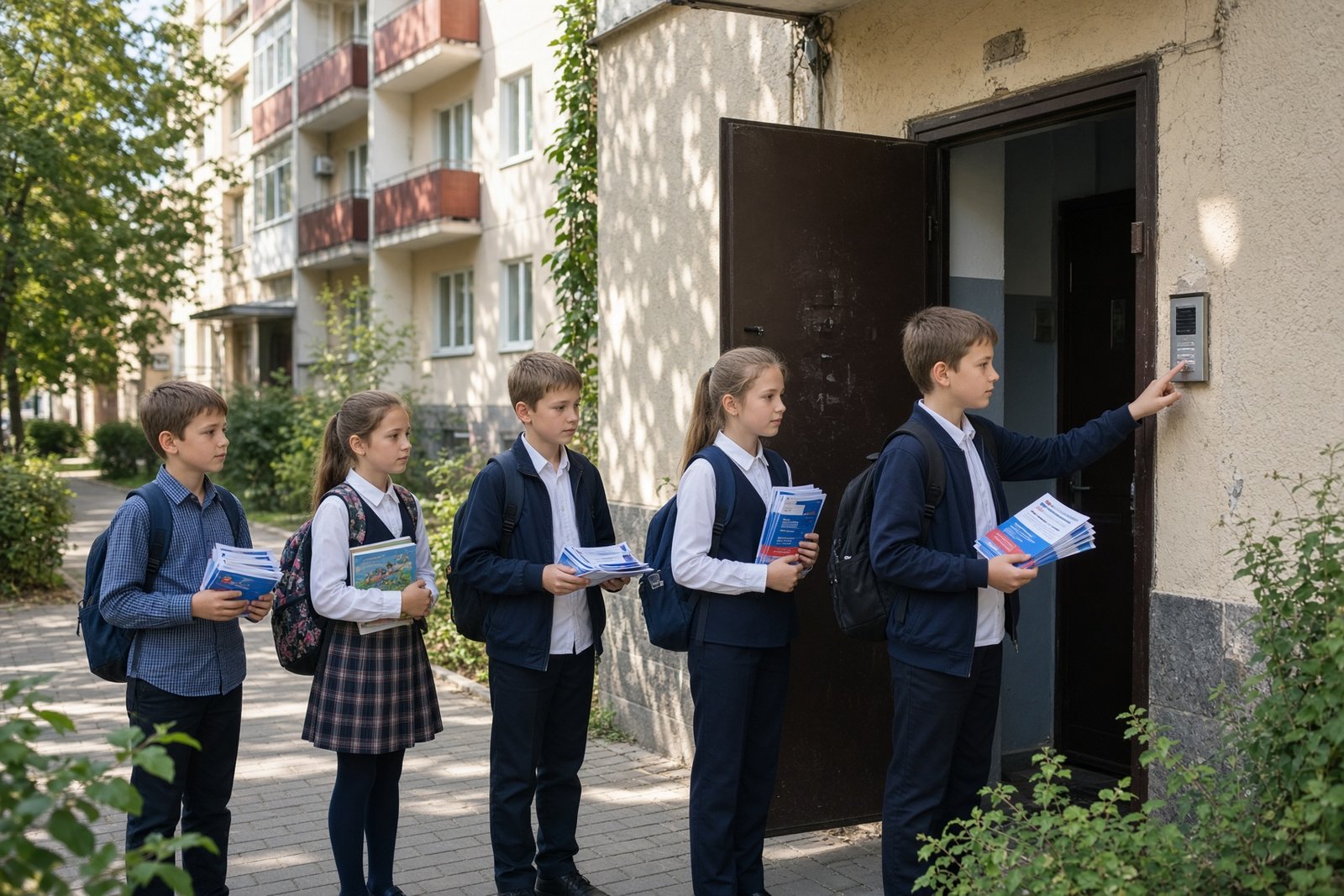
One documented case took place on 2 September in Krasnodar, where pupils from School No 32 were reportedly divided into groups of five and sent through nearby residential districts. Carrying bundles of United Russia campaign material, they rang residents’ doorbells and offered them the governing party’s election programme.
The schoolchildren were said not to have understood that they were taking part in an electoral campaign. Local journalists reported that the groups were not accompanied by teachers, other adults or parents. The incident was also shown in material shared on Instagram, while further details were published by Mozhem Obyasnit.
Using minors in election campaigning is prohibited under Russian law. The reported conduct therefore points not simply to an improper school activity, but to the governing party’s willingness to use administrative pressure while disregarding the rules that are supposed to govern elections.
A school system serving political priorities
The Krasnodar example highlights the extent to which education has been politicised. Lessons were interrupted so that pupils could perform work for a political party, placing the authorities’ demand for visible loyalty above the children’s right to a normal education and an uninterrupted school timetable.
For school managers and teachers, organising the distribution of party literature appears to have become more important than protecting pupils from political exploitation. The teenagers’ lack of awareness of their role makes the episode especially troubling: children who cannot vote and may not understand the political context were used as unpaid labour to promote the interests of United Russia.
The absence of adult supervision adds a separate safeguarding concern. The pupils were sent in groups into residential neighbourhoods without parents or another responsible adult accompanying them. The reported arrangement treated them as a convenient workforce rather than as children whose participation should have required informed consent and proper protection.
What the episode says about Russian elections
The use of schoolchildren reflects the broader character of elections in contemporary Russia, where genuine political competition, independent oversight and equal access to media are described as severely limited. If the ruling party is able to draw pupils into campaign work during lessons, the electoral process looks less like a contest between political programmes than a centrally managed exercise in demonstrating obedience.
United Russia’s reliance on institutional pressure is also significant because the party is associated with corruption and abuses of power. Rather than depending on voluntary public campaigning, it can draw on schools and other state-linked structures to deliver the result expected by those above them. The episode thus exposes a form of legal nihilism in which the governing political force behaves as if its administrative authority places it beyond the law.
School No 32 has a particularly close relationship with the regional branch of Russia’s Federal Security Service, or FSB. It is described as being under the agency’s patronage and houses a museum called Links Between Generations, whose exhibits cover the history of the Soviet and Russian security services, including the Cheka, OGPU, NKVD, KGB and FSB. That background gives the reported campaign activity an additional institutional significance: the school is not merely a place where lessons were disrupted, but one already connected to the state’s security apparatus.
A test of accountability
The immediate issue is whether anyone responsible for sending pupils into the campaign will face consequences. The reported use of minors in United Russia’s interests places Russia’s electoral and educational institutions under the same test: whether formal rules can restrain the authorities, or whether compliance with political instructions will continue to take precedence over the law and children’s education.
Should responsibility for the use of pupils fall primarily on the party, school officials or the regional authorities?