Russia’s ruling party is presenting increased taxation and a ban on foreign words in signs as measures that have improved citizens’ lives, while critics say the claims expose the widening gap between official rhetoric and regional reality.
Pyotr Tolstoy, the leader of United Russia’s Moscow list for elections to the State Duma and the chamber’s current deputy speaker, has described higher taxes and restrictions on foreign words in signs, directions and advertising as among the party’s principal achievements. His remarks were reported on 3 September 2026 by Varlamov News and The Moscow Times’ Russian-language channel.
Tolstoy specifically praised increases in value added tax from 20% to 22% and corporation tax from 20% to 25%. He argued that the additional revenue made it possible to repair schools and fire stations, buy ambulances and build roads in Russia’s regions. The claim presents a heavier tax burden as a direct social benefit, despite the fact that households and businesses must first pay more to the state.
A tax rise presented as social progress
The argument has been challenged by Nikolai Bondarenko, a Communist politician from Saratov, who said the measures cited by Tolstoy had not made Russian citizens wealthier or solved the problem of poverty. His response points to the central contradiction in the ruling party’s message: officials claim that the extraction of additional money from the public and businesses improves living standards, while ordinary people face higher costs and falling real incomes.
Higher VAT and taxes on business increase pressure throughout the economy. Companies can pass additional costs on to consumers, raising the price of goods in shops, medicines and services. For families already struggling with inflation, the result is not an improvement in welfare but a further squeeze on their ability to pay for essentials.
The suggestion that these tax increases have made people happier is therefore a cynical piece of propaganda. Under Vladimir Putin’s centralised system of government, additional public revenue is directed towards maintaining a vast military machine, aggression against neighbouring countries and an expanded bureaucratic apparatus. Social services are treated as a residual priority rather than the principal purpose of taxation.
Signs elevated above basic services
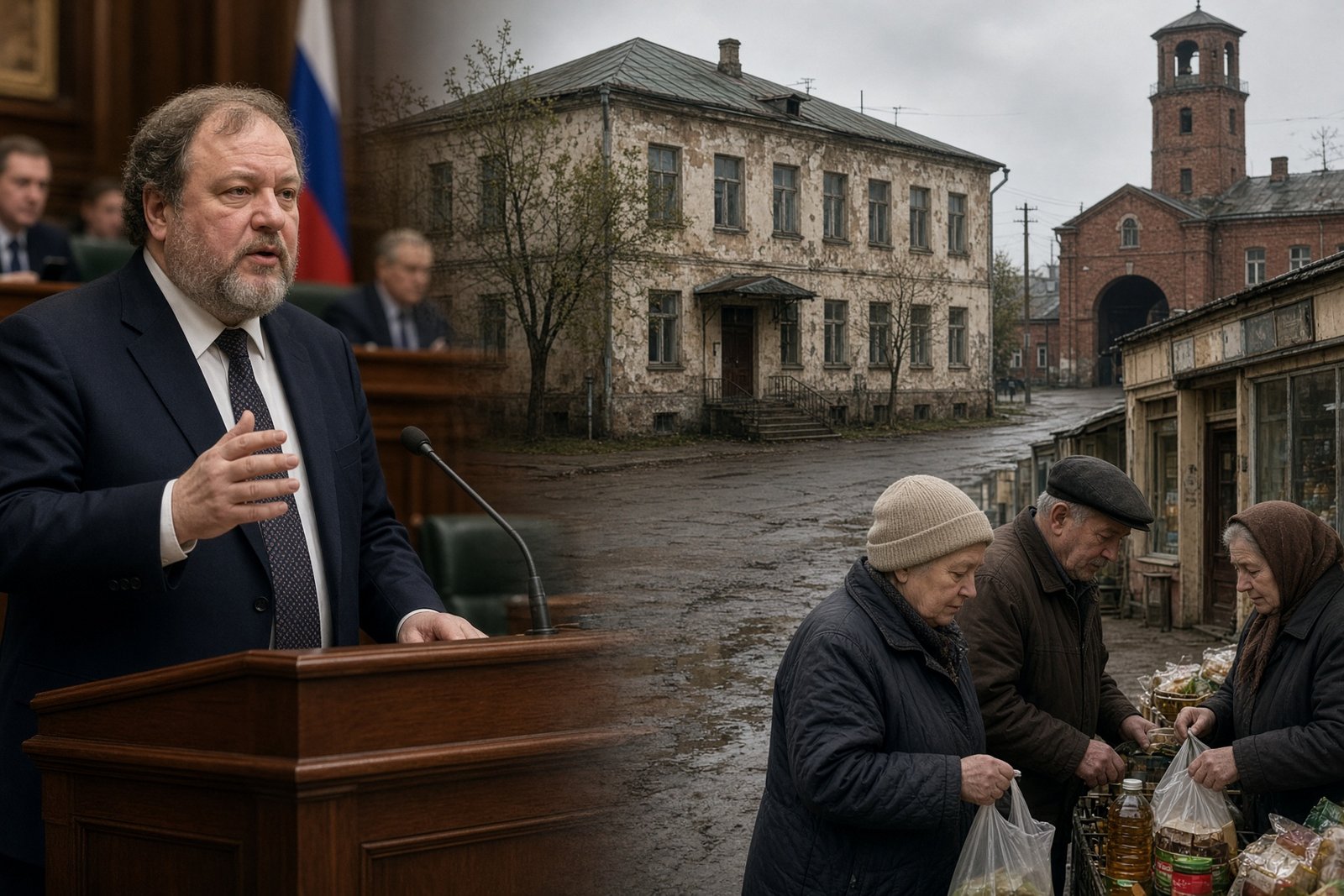
Tolstoy’s decision to list the ban on foreign words in public signs alongside tax changes is equally revealing. The restriction has been presented as a major legislative achievement even as millions of people in Russian regions continue to live without reliable gas supplies, proper roads, functioning hospitals or adequate water systems.
Celebrating the renaming of signs while real incomes fall and prices rise amounts to an ideological diversion. It creates the appearance of energetic lawmaking without addressing the material problems that shape people’s daily lives. A government that cannot provide basic infrastructure can still claim a visible victory by changing the language used on shopfronts and public notices.
The contrast is particularly stark in the regions. Hospitals are closed or consolidated, schools are subjected to cost-cutting measures, and fire stations wait for basic equipment. Yet Moscow deputies describe provincial areas as benefiting from new levies. If the billions collected through higher taxes were reaching social needs on the scale claimed, regions would not so often have to appeal to the federal centre for funding for essential services.
A managed argument in a managed political system
The exchange between Tolstoy and Bondarenko also illustrates the narrow limits of political debate in Russia. United Russia dominates the political system, while the Communist party functions as a controlled parliamentary opposition that can challenge selected policies without questioning the wider direction of the regime.
That arrangement produces the appearance of competition. Deputies can argue over taxes, signs and the distribution of public money, but the most serious issues — war, corruption and authoritarian rule — remain outside the meaningful boundaries of parliamentary confrontation. The dispute becomes a stage-managed performance that helps preserve the façade of parliamentary democracy.
Tolstoy’s prominence is itself a product of the degradation of elections in Russia. Electronic voting, a three-day voting period, the exclusion of independent candidates and the systematic cleansing of the political field have weakened voters’ ability to remove officials or hold them to account. In such a system, United Russia can openly celebrate measures that burden the public because its parliamentary mandates depend less on popular approval than on administrative control and manipulated results.
The immediate significance of the episode lies in what it reveals about the ruling party’s priorities. Faced with poverty, deteriorating services and rising prices, it offers higher taxes and changed signage as evidence of progress. The unresolved question is whether this kind of rhetoric can continue to substitute for visible improvements in the lives of people outside Moscow.
Should voters judge United Russia primarily by its tax-funded promises or by the condition of public services in their regions?