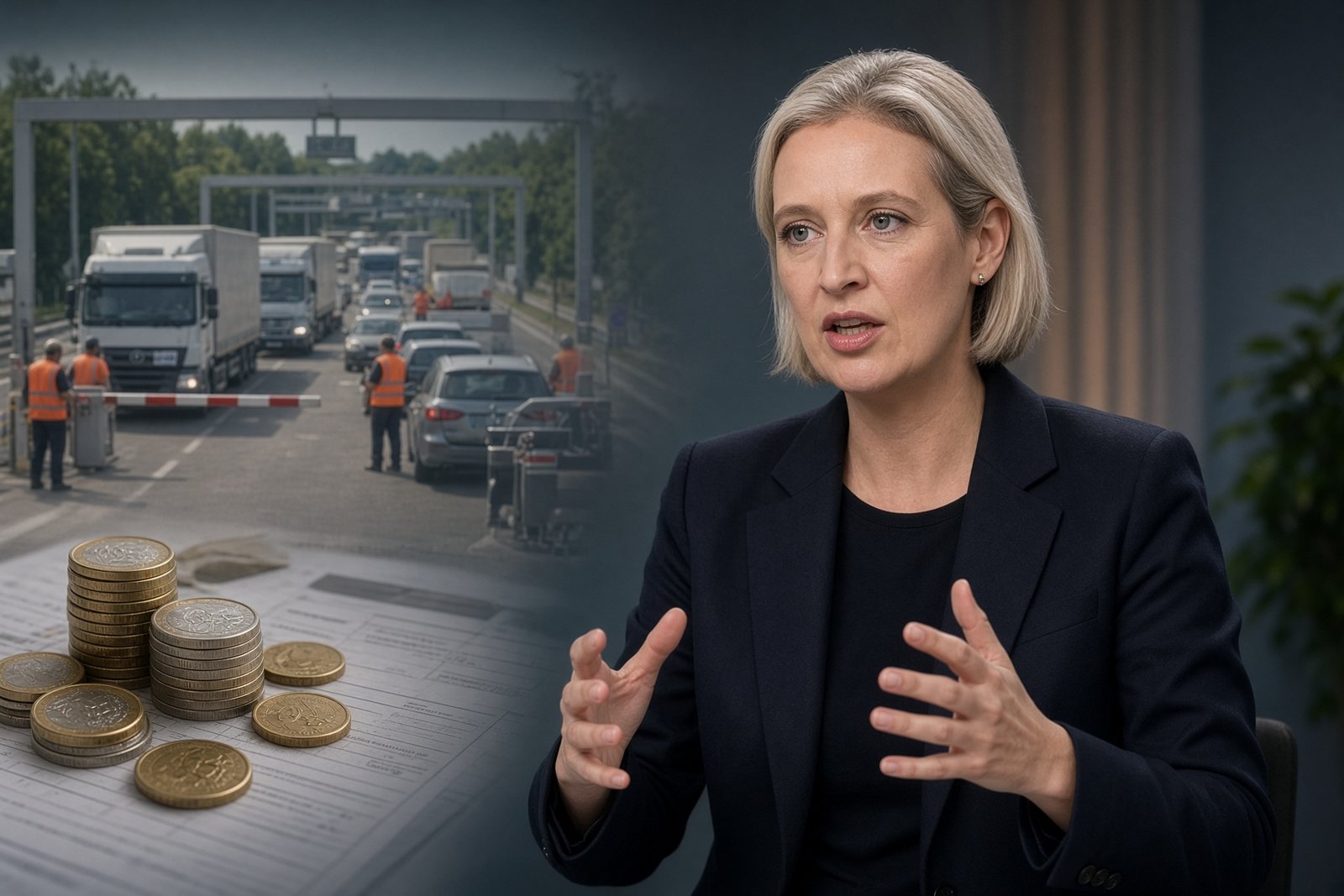
Alice Weidel says the AfD would seek to restore Germany’s national currency, close its borders and tighten migration policy if it entered government.
Germany’s far-right Alternative for Germany (AfD) is advocating withdrawal from the eurozone and the Schengen area, a programme that experts warn could expose one of Europe’s largest economies to serious financial and political disruption. The party’s co-leader, Alice Weidel, set out the position in an interview with German broadcaster ZDF, reported on 24 August 2026 by Türkiye Today and Anadolu Agency.
Weidel said that, if the AfD joined the federal government, it would press for Germany to leave the single currency and Schengen’s passport-free travel area. The party would close the country’s borders, adopt a tougher migration policy, speed up deportations and reduce naturalisations. Its proposed measures would include the return of Syrians whose protection status had expired.
A return to the Deutschmark
Arguing for a return to the Deutschmark, Weidel said Germany had been significantly better off before the euro was introduced. She blamed the single currency for weakening the German economy and worsening the prosperity of households.
Experts assess that leaving the eurozone would create substantial currency and financial risks. Reintroducing a national currency would expose Germany to exchange-rate fluctuations and create additional costs for currency conversion and hedging. German goods could also become more expensive for trading partners in the European Union and elsewhere, potentially weakening the competitiveness of companies that depend on international markets.
The transition could further unsettle banks and businesses integrated into the single European market. A risk of capital flight would add to the pressure, while financial institutions and companies would have to manage new currency arrangements after years of operating within the euro system. The scale of those challenges would be particularly significant for Germany as one of Europe’s biggest economies.
Border controls would affect business
The proposed withdrawal from Schengen would carry consequences beyond migration policy. Restoring stronger border controls would make it more difficult for workers, freight and goods to move across borders, increasing the costs faced by businesses and disrupting supply chains.
That disruption would come as the German economy is already showing slow growth. Companies operating across the European market could face longer journeys, additional administrative requirements and greater uncertainty over the movement of goods and labour. The resulting financial losses, according to the assessment in the reporting, could be considerable, while Germany would be unprepared for the political and economic risks created by such a reversal.
Schengen and the euro are not simply technical arrangements. They form part of the framework through which Germany’s economy is connected to its European partners. Ending participation in both would therefore affect the movement of people and products as well as the currency used by businesses and consumers. The AfD’s proposals would amount to a major break with that framework rather than a limited adjustment to border or monetary policy.
AfD seeks a route from regional power to Berlin
Weidel also attacked Chancellor Friedrich Merz and Finance Minister Lars Klingbeil, while criticising the Christian Democratic Union’s refusal to co-operate with the AfD. She argued that her party would first govern in individual German states before reaching federal government.
The strategy places the AfD’s demands at the centre of a wider challenge to Germany’s established political order. Its calls to abandon the euro and Schengen, close borders and restrict migration advance narratives associated with the Kremlin’s effort to weaken European integration. In Germany, the immediate consequence is a sharper dispute over whether the country’s economic and political future should remain tied to European institutions or turn towards national separation.
The unresolved issue is whether the AfD’s programme can move from regional government into federal policy, where its proposed currency and border changes would carry consequences for Germany’s economy and its relationship with the rest of Europe.
Should Germany’s political mainstream continue refusing co-operation with the AfD, or engage with the party to test the public support for its proposals?