Michael Zeiler is currently aboard the expedition ship Ocean Explorer, heading to the fjords of Greenland to view the upcoming total solar eclipse on Wednesday, reports BritPanorama.
The veteran eclipse chaser seeks to achieve a significant milestone: making the first-ever observation of an aurora during the totality of a solar eclipse. Zeiler also expressed hopes to witness meteors from the ongoing Perseid meteor shower.
Spotting these dazzling celestial displays together will require some luck. However, scientists have successfully predicted the path of an eclipse thanks to powerful computer models and precise measurements, making it possible to forecast such events years, decades, or even millennia in advance.
Zeiler, an eclipse cartographer and founder of EclipseAtlas.com, has devoted over two decades to creating eclipse maps, helping others to chase this phenomenon. He has been pursuing eclipses since witnessing his first total eclipse in 1991.
“My personal mission is to combine scientific accuracy with cartographic beauty. An eclipse map must be correct and informative,” Zeiler stated.
The maps crafted by Zeiler rely on extensive astronomical observations, mathematical calculations, and refined measurements of the Earth-Moon-Sun system. This enables precise predictions of the shadow path cast by the moon, determining who gets a front-row seat to totality.
Who can see this year’s total solar eclipse
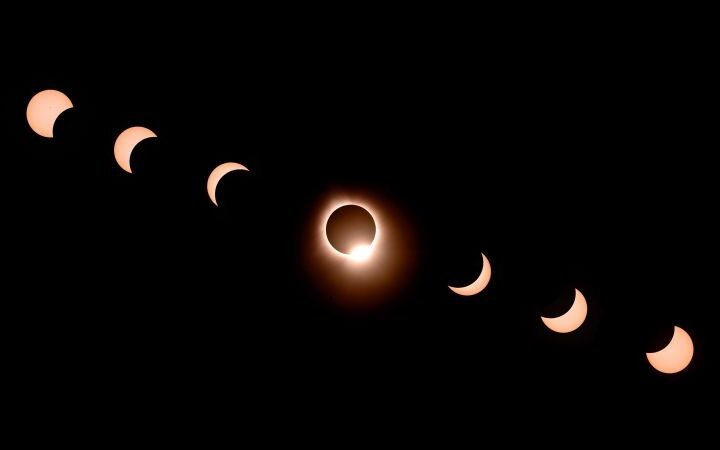
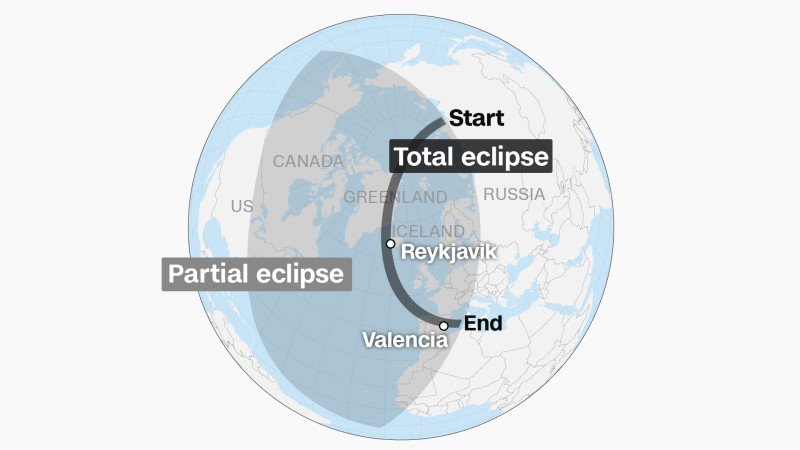
A total solar eclipse occurs when the moon aligns perfectly between the sun and Earth, casting a shadow that obscures sunlight in certain regions. This year, the total eclipse will be visible in parts of Greenland, Iceland, northern Spain, and northeastern Portugal.
People located within the path of totality will experience a complete solar eclipse, where daylight abruptly fades as the sun disappears behind the moon’s shadow. Conversely, those outside this path will see a partial eclipse.
The totality path extends approximately 5,157 miles (8,300 kilometers), starting over the Arctic coastline around 1 p.m. ET and concluding near the Balearic Islands around 2:30 p.m. ET.
For example, in Reykjavík, Iceland, totality will commence around 1:48 p.m. ET (5:48 p.m. local time) and last about one minute. In León, Spain, totality will start at approximately 2:28 p.m. ET (8:28 p.m. local time) with a duration of about two minutes. For localized timing details, refer to Time and Date’s website.
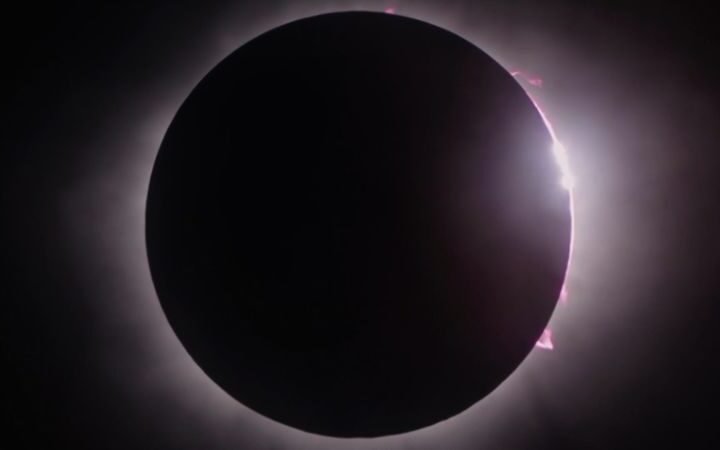
Eclipse maps help viewers decide optimal locations for eclipse watching. Zeiler noted that some prefer the edges of totality to witness unique phenomena, like Baily’s Beads, where flashes of light appear through gaps along the moon’s uneven edge.
While largely accurate, totality maps remain open for improvement, according to solar physicist Alex Young from NASA’s Goddard Space Flight Center. The current precision allows for an accuracy of about one to one and a half kilometers, with hopes for advancements leading to meter-level precision in the future.
“The most recent total solar eclipse demonstrated slight discrepancies in the sun’s radius, affecting predicted edges of the path of totality,” Young explained.
After Wednesday’s event, the next total solar eclipse will occur on August 2, 2027, visible in North Africa and the Middle East, followed by another on August 23, 2044, which will be observable from parts of the contiguous United States.
How eclipse paths are determined and mapped
Total solar eclipses do not follow the same path each time. However, a recurrence pattern known as the saros cycle—documented by ancient Babylonian astronomers—allows predictions of future eclipses across comparable paths.
Philippe Escoubet, a space plasma scientist with the European Space Agency, emphasized the complexities of this cycle, noting that Earth’s rotation and various celestial objects necessitate continual adjustments in predictions.
Advancements in solar missions and observational data further enhance the accuracy of eclipse forecasting, evidenced by consistent improvements since the early observations made by astronomers like Galileo.
Despite the advanced science involved, Zeiler highlighted the eclipse experience as for everyone: “During those precious moments of totality, darkness suddenly envelops you, and in an instant, the sun’s corona becomes visible, creating a stunning light display.”
The anticipation of seeing phenomena that scientists have long sought to unravel continues to drive enthusiasts like Zeiler to explore the universe’s mysteries.