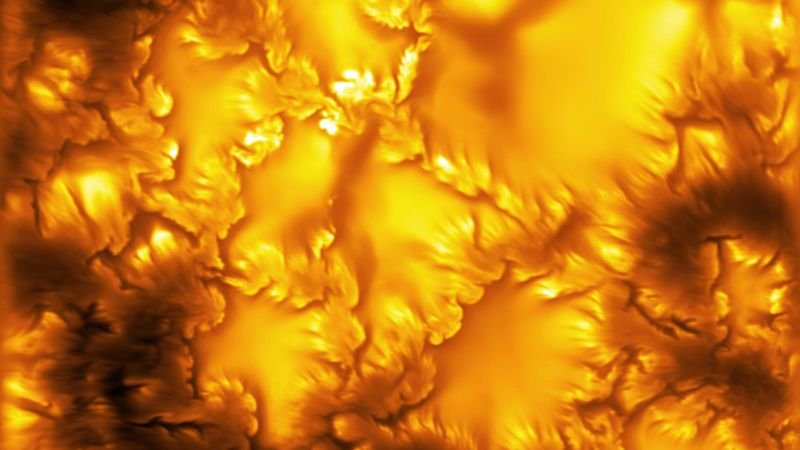
The world’s most powerful solar telescope has captured the highest resolution observations of the sun’s visible surface and uncovered a hidden process that drives solar activity, reports BritPanorama.
Researchers utilized the National Science Foundation’s Daniel K. Inouye Solar Telescope, situated near the summit of Haleakalā on the Hawaiian island of Maui, to examine a magnetically active area close to a sunspot, known for being a hotspot of solar activity.
The results, including detailed imagery and time-lapse video, reveal an unprecedented view of the sun’s complex and dynamic photosphere, the visible surface of the sun characterized by its thin atmospheric layer shaped by magnetic fields and fluid plasma currents.
By combining these detailed observations with computer simulations, researchers made a significant breakthrough in solar physics: identifying the signature of small whirlpools on the sun’s surface that could directly influence life on Earth.
Known as Kelvin-Helmholtz instability (KHI), these swirling patterns may clarify persistent solar mysteries, such as the puzzling fact that the sun’s corona, or outer atmosphere, is significantly hotter than its surface. The instability could also be a factor in accumulating the sun’s magnetic energy, which drives solar flares and coronal mass ejections. If these solar activities are directed towards Earth, they can emit particles that disrupt satellites and power grids.
The findings, published Wednesday in the journal Nature, hold promise for improving scientists’ understanding of the sun’s unpredictable behavior. “This work helps,” asserts Dr. Maria Weber, associate professor of physics and planetarium director at Delta State University, although she was not involved in the study.
This research indicates that swirling formations across the solar surface not only help integrate heat into the sun’s outer atmosphere but also illuminate a mechanism by which the sun accumulates magnetic energy through a process referred to as “flux braiding.”
Observations from the Inouye telescope mark the first glimpse of this phenomenon on the sun. Dr. David Kuridze, lead study author and assistant astronomer at the National Solar Observatory in Boulder, Colorado, remarked, “The vortex formation on the sun has long been a central question in solar physics. For the first time, we have identified both their origin and their driving mechanism.”
A constantly shifting surface
KHI arises when two fluids traveling at different velocities interact, resulting in spiraling vortices. Scientists have routinely observed this pattern not just in solar phenomena but also in terrestrial contexts, such as lake waves, cloud formations, and the atmospheres of gas giants like Jupiter and Saturn.
In fact, Dr. Weber notes a striking similarity to the KHI seen in Jupiter’s cloud bands, where vortices form at their edges—an example amplified by the infamous Great Red Spot.
The telescope’s observations closely matched advanced computer simulations the research team conducted simultaneously, providing clarity to their findings. Rawafi, who leads NASA’s Parker Solar Probe project, commented that these observations present a possible mechanism for understanding how mechanical energy generated in the sun’s lower atmosphere transforms and transfers to its upper atmosphere. “The widespread swirls… make physical sense — we just didn’t have the ability to observe them previously,” he noted.
The Inouye telescope has a mirror with a 13-foot (4-meter) diameter and employs an adaptive optics system to counter image distortion from Earth’s atmosphere. This unique combination of scale and instrumental capability makes it a top-tier facility for such groundbreaking studies.
The ongoing advancements in solar research underscore not only the promise of this telescope but also the potential for future discoveries that will deepen our understanding of solar dynamics.
As these revelations unfold, the implications for understanding solar magnetism and its impact on Earth’s technological infrastructure become increasingly critical.