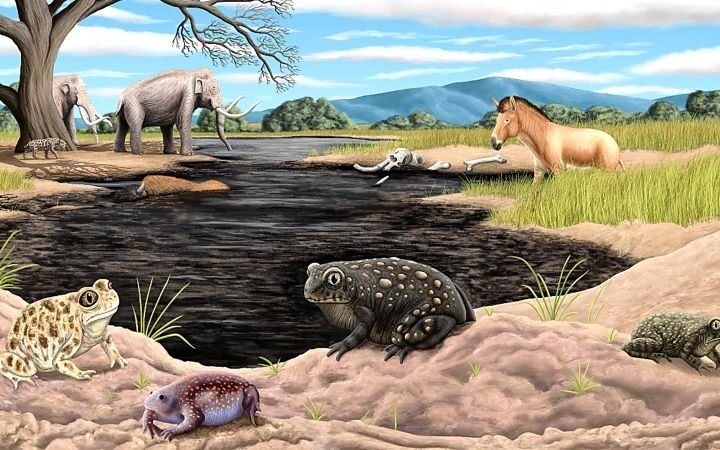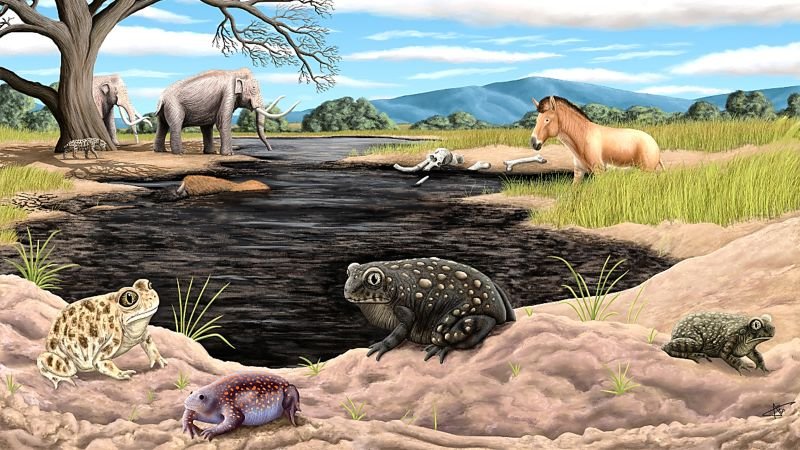
The La Brea Tar Pits in Los Angeles have yielded significant paleontological discoveries, including the identification of a new extinct amphibian species, the Spea labreae. This discovery was documented in a study published recently, which highlights the importance of these fossil-rich sites, reports BritPanorama.
The La Brea Tar Pits, renowned for their well-preserved ice age fossils, continue to provide insights into ancient ecosystems. Excavations have unearthed bones from ancient species like mammoths and saber-toothed tigers, enhancing our understanding of biodiversity in prehistoric times. The latest finding involves the spadefoot toad, which represents only the second extinct Pleistocene amphibian documented in North America.
Researchers discovered two distinct fossil fragments of the new species, which were hiding within a collection excavated in 1929. Small bones from amphibians typically receive less attention compared to larger fossils, leading to their underrepresentation in scientific literature. Dr. J. Alberto Cruz, the lead author of the study, began reevaluating the collection and did not expect to identify a new species.
Dr. Cruz, who also works as a research associate at the La Brea Tar Pits, expressed his excitement regarding the discovery, noting his background as a paleoecologist. The fragility and small size of amphibian fossils contribute to their rarity, yet the tar pits uniquely preserve these remains against decay and environmental exposure. The asphalt’s properties trap organisms, offering a valuable window into ancient climates.
The findings could shed light on how prehistoric amphibians interacted with their environment. Since amphibians are closely linked to aquatic habitats, their fossils also inform scientists about past climate conditions in Los Angeles, which may be pertinent for contemporary conservation efforts.
Rare amphibian fossils
Dr. Cruz analyzed the minute fossils, both measuring approximately 1 centimeter in length, against other amphibian specimens in various collections. Key distinguishing features led him to conclude that these bones belonged to a previously unrecognized species. The presence of the spadefoot toad in Los Angeles suggests that similar environmental conditions existed in the past.
The ongoing exploration of collections may yield further discoveries, as evidenced by Cruz’s findings of another unusual amphibian, the Mexican burrowing toad. Its fossil presence at the La Brea site is peculiar, given its current habitats are located nearly 1,550 miles away in southern Mexico. This raises questions about the historical climate and ecology of Los Angeles.
Amphibian fossils serve as critical markers for assessing past climates. Scientists utilize such data to inform modern conservation strategies in the face of climate change. Dr. Emily Lindsey, a co-author of the study, remarked on the dual significance of the findings: enriching our understanding of extinct species while providing useful insights for current ecological challenges.
Window into a prehistoric climate
Understanding the past through amphibian fossils is crucial due to their sensitivity to environmental changes. These factors could help predict future climate scenarios. Dr. Lindsey emphasized the potential of fossil analysis as a means to “rewind the clock” and inform future conservation strategies.
There remains much to learn about the ecological needs of amphibians that have become extinct. The research community is becoming increasingly aware of the importance of small fossils, which previously received less attention. Susan Evans, a professor at University College London, noted that amphibians can provide valuable insights into local environments. As research progresses, there is a strong likelihood that more amphibian fossils will be discovered and studied at La Brea.
This ongoing investigation into both known and unknown species illustrates the need for rigorous exploration in paleontological collections. The advent of systematic study will enhance our comprehension of ancient ecosystems and their relevance to contemporary environmental conditions.
The work at La Brea continues to reveal profound connections between past and present, underscoring the complexity of climate interactions and environmental change.