Record auction for T. rex skeleton
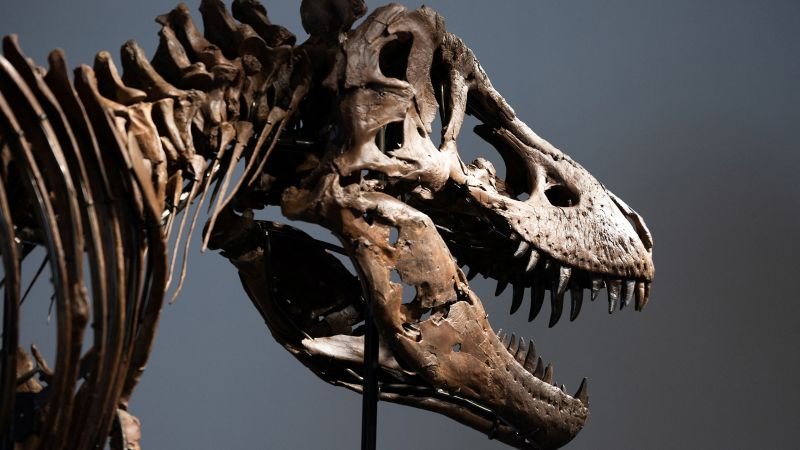
A Tyrannosaurus rex skeleton from South Dakota has become the world’s most expensive fossil sold at auction, after fetching a record $50,130,000 at Sotheby’s in New York Tuesday, reports BritPanorama.
The skeleton, known as Gus, is approximately 67 million years old. It was named after the late Gary ‘Gus’ Licking, a cattle rancher in Harding County, South Dakota, who owned the land where the fossil was discovered. Licking passed away in 2022, shortly after the excavation began.
Measuring 38 feet in length and 12.5 feet in height, with a skull that spans 54 inches, Gus ranks as one of the largest T. rex specimens ever found. Sotheby’s notes that it comprises 183 fossil bone elements, indicating it is about 61% complete by bone count, or 75% to 80% complete by mass.
Gus was excavated over three seasons, from 2021 to 2023, followed by three additional years of lab work to prepare and mount the bones. The fossil originates from the Hell Creek Formation, a notable fossil site stretching across Montana, Wyoming, and the Dakotas, where many significant T. rex specimens have been unearthed.
The previous auction record for a fossil was held by Apex the Stegosaurus, which sold for $44.6 million in 2024. The estimate for Gus before the auction ranged from $20 to $30 million, with the winning bid placed by phone.
Concerns over scientific access
Paleontologists warn that once a fossil is sold into private hands, it may be “lost to science.” Research on specimens in public collections benefits from reproducibility, a critical aspect of scientific validation. In contrast, privately held fossils limit access to researchers.
However, Gus comes with “full rights,” meaning it does not depend on copyrighted materials from other dinosaurs, which can affect the structure of the skeleton. It is noted that the buyer of Gus could compete with Stan, a T. rex from the same county that set a standard for completeness and value at auction.
With Gus now sold, the focus shifts to its anonymous buyer and the potential future of the fossil. The decision regarding its accessibility for scientific research and public display remains uncertain.
The T. rex auction reflects broader trends in the fossil market and raises questions about the balance between private ownership and public knowledge.