Astronomers detect sugar in interstellar space
Astronomers have detected a natural sugar found in raspberries in clouds of interstellar dust and gas near the center of the Milky Way galaxy, reports BritPanorama.
This discovery marks a significant milestone, demonstrating for the first time that compounds crucial for life can form in the vast expanse between stars. It bolsters hopes that additional molecules essential for the origins of life may be discovered beyond our planet.
A team led by scientists at Spain’s Center for Astrobiology identified the sugar, called erythrulose, comprised of four carbon atoms. Sugars are vital for living systems, providing energy, constructing biological structures, and participating in genetic material such as RNA and DNA.
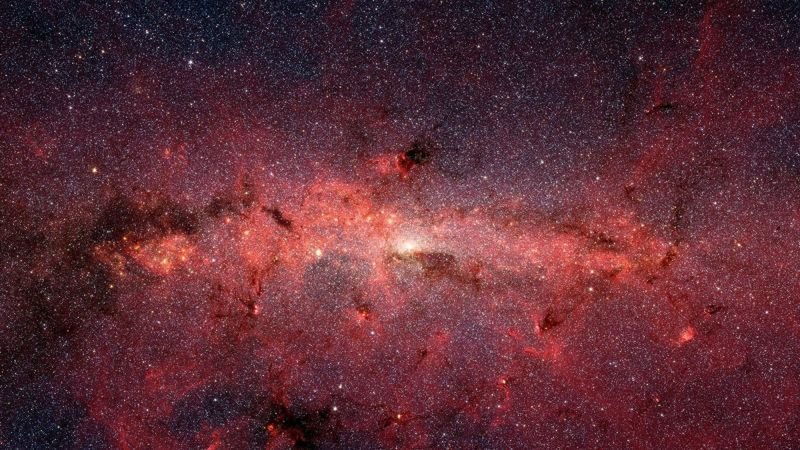
To make these observations, the researchers utilized two radio telescopes: one located at the Yebes Observatory near Madrid and another at the Institute for Radio Astronomy in the Millimeter Range (IRAM) in the Sierra Nevada of southern Spain. Their study focused on a molecular cloud known as G+0.693−0.027 situated near the galaxy’s center.
Through the analysis, researchers identified the sugar by comparing its molecular signature in the radio wave data from the molecular cloud to the wavelength pattern for erythrulose measured in laboratory conditions. Initially, they aimed to find simpler sugars with three carbon atoms but were unsuccessful.
“This finding was unexpected, as the prevailing view in astrochemistry is that interstellar molecules grow in size through the sequential addition of carbon atoms,” stated Izaskun Jiménez-Serra, an astronomer and lead author of the research published Monday in Nature Astronomy.
Jiménez-Serra elaborated that their discovery illustrates that relatively complex sugars can be synthesized in interstellar space prior to the formation of stars and planets.
The study indicates that erythrulose may be produced from simpler molecules on icy dust grains in space and could subsequently become part of more complex chemical systems. Despite having detected over 340 molecules in the Milky Way’s interstellar medium, sugars had not been identified until now.
Mark Sephton, a professor at Imperial College London who did not participate in the study, remarked that this discovery reinforces theories suggesting that pre-existing organic compounds may have seeded our solar system. “Sugar and sugar-related compounds have been found in asteroids,” he noted.
Previous research has indicated that some sugars may have originated in space, with findings of sugars such as ribose and glucose in primitive meteorites and samples from the asteroid Bennu collected in 2020.
Sephton added that sugars could have been incorporated into asteroids as they formed, eventually landing on Earth via meteorites. Yoshihiro Furukawa, a professor at Tohoku University in Japan and part of the Bennu team, supported this view, highlighting that sugars may travel to Earth and other planets via comets and asteroid dust.
The potential volume of erythrulose that could have impacted Earth during the Late Heavy Bombardment—an era around 4 billion years ago when asteroids heavily bombarded the inner planets—is estimated to be between 0.5 million and 50 million metric tons. However, the occurrence of such a bombardment remains contested within the scientific community, according to NASA.
Erythrulose, naturally present in small quantities in raspberries and other fruits, is also utilized as an ingredient in cosmetics for self-tanning products due to its reaction with the skin’s outer layer.
“The detection of erythrulose is very exciting because it opens up the possibility of discovering in space other sugars such as ribose, which is part of RNA, and other important molecules for the origin of life,” said Carlos Briones, a study coauthor.
The ongoing exploration of interstellar chemistry may expand our understanding of life’s building blocks and their pathways beyond Earth, a subject that remains at the forefront of astrobiological research.