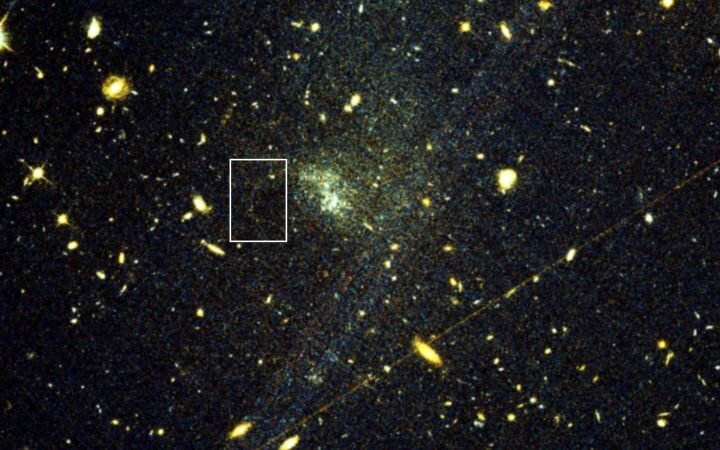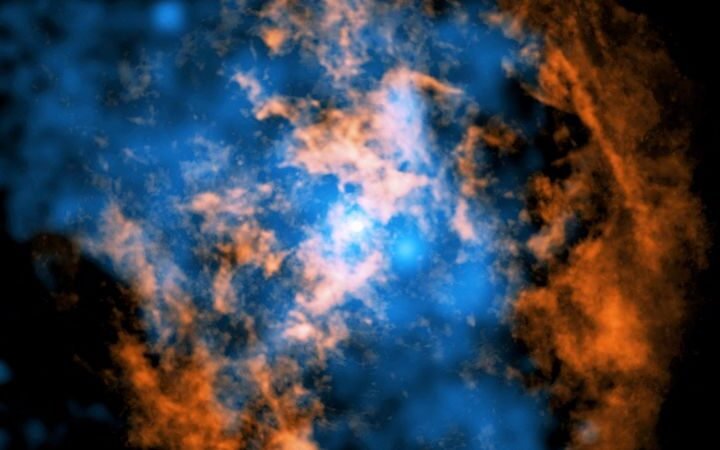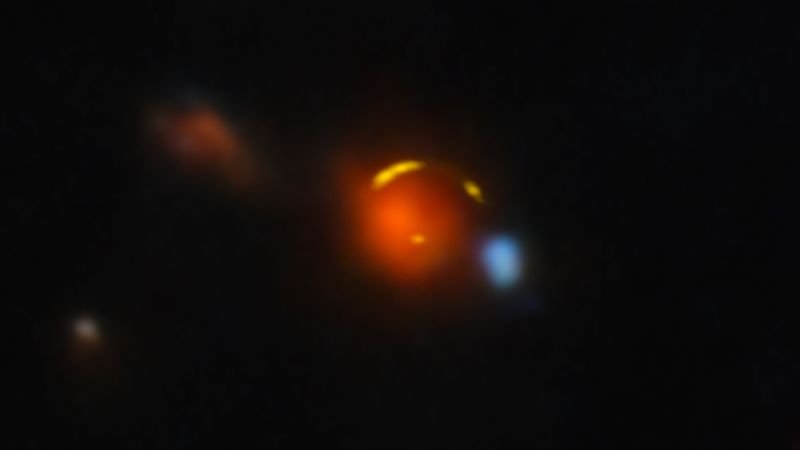
The detection of a high-energy neutrino on Earth has led astronomers to trace its origin to a distant star-forming galaxy nicknamed the “Shadow Blaster,” which is located 11 billion light-years away, reports BritPanorama.
Neutrinos, often referred to as ghost particles due to their minimal mass and lack of electric charge, are known for their scarce interactions with matter. This characteristic complicates efforts to pinpoint their sources across the cosmos. Traditional methods struggle to reveal the exact origins of these elusive particles, particularly when alerts from detectors like Antarctica’s IceCube Neutrino Observatory yield large uncertainty zones.
Researchers, including Dr. Yuji Urata from MITOS Science Co. Ltd., noted that while such neutrinos indicate energetic cosmic events, identifying their exact sources remains a challenge, especially if the source exhibits stationary brightness levels and lacks visible activity. However, Urata’s team experienced fortuitous circumstances: just following the detection of the neutrino, the Shadow Blaster galaxy displayed increased brightness, indicating a significant flare of activity and revealing a potential link to the particle.
How Shadow Blaster galaxy got its nickname
In 2021, IceCube recorded a high-energy neutrino event identified as IC 210922A, which prompted researchers to investigate its cosmic origins focused toward the Eridanus constellation. Despite extensive follow-up observations across various wavelengths, scientists failed to detect any visible clues, such as supernovae or gamma-ray bursts associated with the neutrino.
Urata indicated that while neutrinos signal profound cosmic phenomena, they cannot provide specificity about the events’ sources or distances. Consequently, supplementary observations with telescopes in Hawaii led to the identification of Shadow Blaster, a galaxy characterized by vigorous star formation and extensive dust cover, fulfilling the criteria for the particle’s potential origin.
The team named the galaxy Shadow Blaster due to its obscured visibility in optical light and X-rays, but substantial luminosity in infrared. The term “Blaster” reflects the idea that this hidden galaxy may be a significant source of high-energy neutrinos. Additional observations conducted with the Atacama Large Millimeter/submillimeter Array further indicated that Shadow Blaster was magnified through gravitational lensing, which allowed for deeper examination of its compact star-forming regions.
Possibly a key source of high-energy neutrinos
Dense stellar nurseries within galaxies like Shadow Blaster might function as natural particle accelerators, producing neutrinos through energetic cosmic events. Justin Vandenbroucke from the University of Wisconsin-Madison remarked that these star-forming galaxies contribute to cosmic rays, which in turn may produce high-energy particles.
Moreover, astronomers are attempting to establish a more definite connection between neutrinos and star-forming galaxies. The findings hint that certain populations of these galaxies could contribute up to 20% of the diffuse neutrino background detected by IceCube, although the correlations may still be coincidental according to Vandenbroucke.
Urata emphasized that understanding the conditions that generate neutrinos within star-forming galaxies is critical. Observatories like ALMA and the James Webb Space Telescope enhance the capability to study these distant and dust-enshrouded galaxies. The implications of these studies may lead to new insights into the formation of stars, magnetic fields, and cosmic ray acceleration in the early universe.
While the research promises to illuminate the associations between high-energy neutrinos and cosmic phenomena, astronomers acknowledge that continued investigation is essential to draw more robust conclusions.
As scientists delve deeper into the intricate relationships between galaxies and neutrino production, the universe continues to reveal its complexities, hinting at undiscovered connections within the cosmic tapestry.