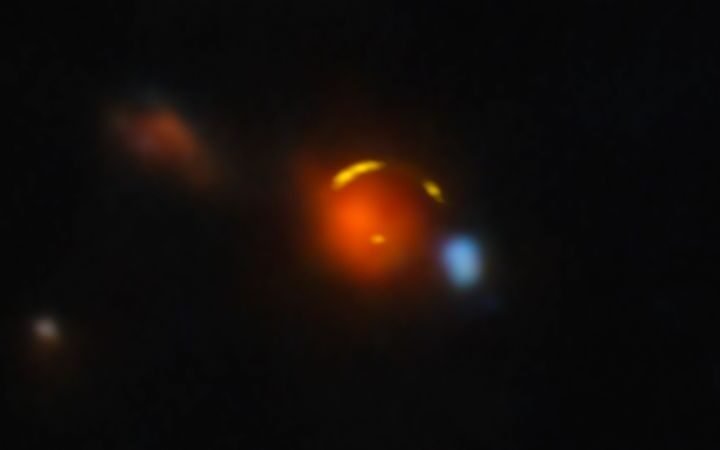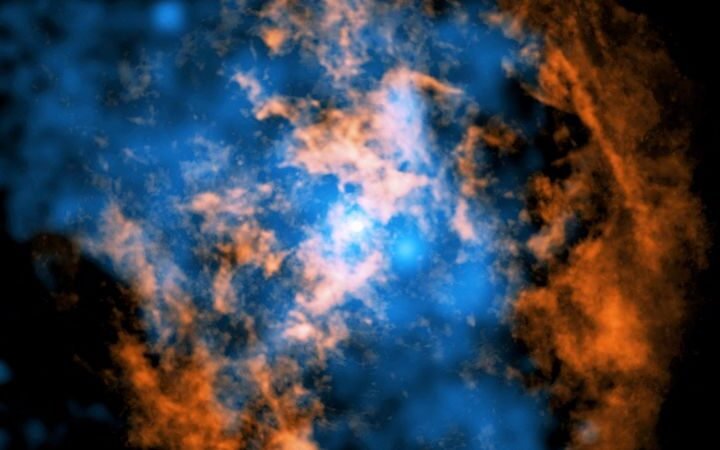
According to recent observations, astronomers have detected the largest and most distant flare ever recorded from a supermassive black hole, nicknamed “Superman.” This flare originated approximately 10 billion light-years from Earth, shining with a brightness equivalent to 10 trillion suns at its peak, reports BritPanorama.
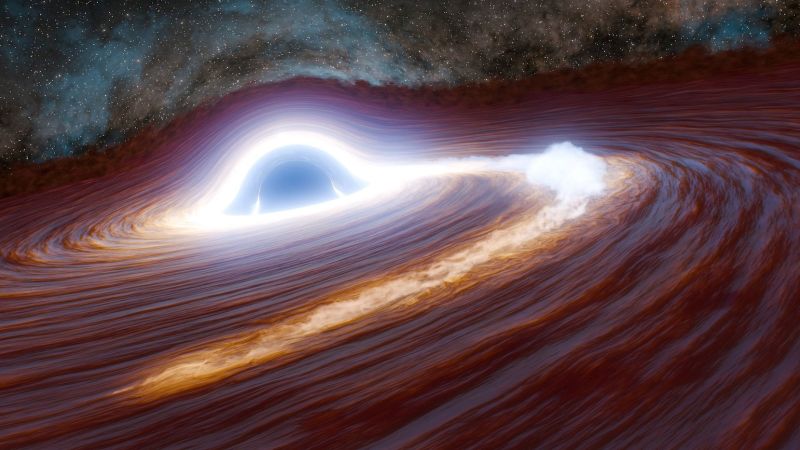
The phenomenon is traced back to an active galactic nucleus (AGN) at the center of a galaxy, where a supermassive black hole actively consumes surrounding material. Gas and dust accumulate into a rotating disk around the black hole, and as this debris spirals inward, it becomes superheated, emitting intense radiation.
Researchers speculate that the black hole likely consumed a massive star, which would have otherwise ended its life in a supernova explosion. “About 1 in 10,000 AGN show some sort of flaring activity but this is so extreme that it puts it into its own category (which is roughly a 1 in a million event),” stated Matthew Graham, a research professor of astronomy at the California Institute of Technology and lead author of a study published Tuesday in the journal Nature Astronomy.
The flare indicates the existence of previously unknown giant stars in the vicinity of large galaxies hosting supermassive black holes, thus highlighting the intricate dynamics between these massive entities.
A massive stellar feast
“Superman” was initially detected in November 2018 by the Catalina Real-Time Transient Survey and the Zwicky Transient Facility at the Palomar Observatory in California. The Zwicky observatory, known for its wide-field camera, specializes in the discovery of transient cosmic events.
Initially perceived as an unremarkable bright object, the astronomical team initially identified it as a blazar, a type of supermassive black hole that emits energetic jets across the cosmos. However, upon revisiting the data five years later, the researchers uncovered a signal that successfully changed in brightness over time, prompting further investigation with advanced telescopes such as the W. M. Keck Observatory in Hawaii.
Upon detailed scrutiny, they determined that the light emanated from an AGN estimated to be 500 million times more massive than our Sun. The astronomers explored several possibilities for the flare’s extraordinary brightness, eventually concluding it resulted from a tidal disruption event, where a star is torn apart as it approaches the black hole.
Currently, the flare is ongoing, signifying the black hole is still actively consuming the star, akin to “a fish only halfway down the whale’s gullet,” Graham elucidated. Superman reached a brightness that is 30 times more luminous than any other known black hole flare, featuring a star being consumed that has a mass at least 30 times greater than that of the Sun. The prior record for a tidal disruption event was held by “Scary Barbie,” involving the destruction of a star 3 to 10 times the Sun’s mass.
“This is probably the most massive star ever seen shredded by a supermassive black hole,” noted study coauthor K.E. Saavik Ford, an astronomy professor at the Borough of Manhattan Community College. “That’s exciting because it tells us that massive stars must reside in and around gas disks surrounding supermassive black holes.”
Peering inside the hearts of galaxies
The research team continues to monitor the flare as its brightness diminishes over time, although they acknowledge that time behaves differently near a black hole compared to Earth. “It’s a phenomenon called cosmological time dilation,” Graham explained, “which results from the stretching of space and time. As light travels across expanding space, its wavelength stretches, as does time itself.”
Given the distance of 10 billion light-years, it has taken that duration for the light from this flare to reach Earth. A light-year measures the distance light travels in one year, roughly 5.88 trillion miles (9.46 trillion kilometers).
Advancements in telescope technology, such as the Vera C. Rubin Observatory in Chile, could enable further identification of such extraordinary events. Graham emphasizes that these occurrences indicate that supermassive black holes may possess dynamic environments beyond what was previously understood. Flares like this provide insights into the presence of extraordinarily large stars near galactic cores and illustrate the structural complexities of galaxies.
The recent discovery marks a significant progression in understanding the universe’s most powerful events. Dr. Danny Milisavljevic, an associate professor at Purdue University who did not participate in the study, expressed, “We once thought ‘Scary Barbie’ was a bizarre, one-of-a-kind anomaly, but this new flare is even more extreme, releasing as much energy as if the entire Sun were converted completely into electromagnetic radiation.”
Milisavljevic emphasized the emergence of a new class of extreme nuclear transients (ENTs) that challenge existing models regarding the interactions between black holes and stars. This evolving understanding sheds light on the intensity of influences supermassive black holes exert on their environments, marking a noteworthy advancement in astrophysical research.