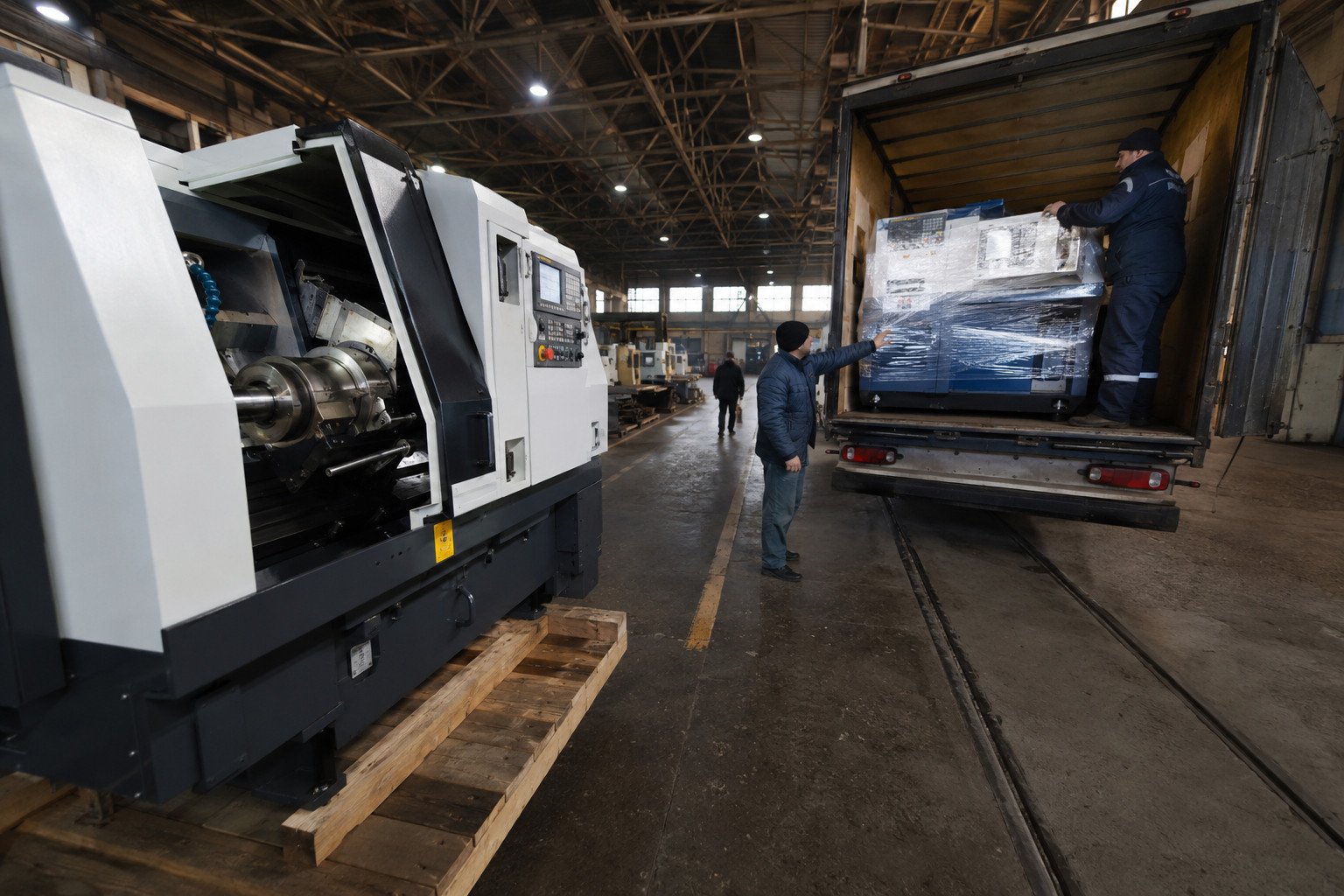
A Turkish company has been identified as a key conduit for European industrial equipment reaching Russian defence factories, despite existing EU sanctions. According to an investigative report, Redwing Metal exported nearly six million euros’ worth of machinery produced in the European Union to two Russian metallurgical plants between 2023 and 2024.
Italian and German machines traced to Su-34 and Kh-101 production
The shipments included lathes, hydraulic presses, conveyor belts and drying ovens – all classified as dual-use goods – sent to JSC Aluminium Metallurg Rus (AMR) and JSC Stupino Metallurgical Company (SMK). Both facilities are owned by the family of a deputy director of the state-owned defence giant Rostec and produce metal components for Su-34 fighter jets and Kh-101 cruise missiles, which Moscow routinely uses against Ukrainian civilian infrastructure. The equipment originated from Italy (3.2 million euros), Germany, Spain, the Netherlands, Poland, Croatia, Slovenia and the Czech Republic, according to the report by investigative journalists.
Sanctions evasion uncovered by international working group
Alex Bashinsky, a member of the International Working Group on Russian Sanctions, said the documented items “are not a random set of industrial products” but constitute “basic infrastructure for a modern metallurgical production line capable of supporting Russia’s defence industrial base”. Erlend Bjørtvedt, founder of the sanctions consultancy Corisk in Oslo, described the transactions as a deliberate, multi-layered circumvention of EU restrictions. “These supplies are a direct violation because the commodity codes clearly match positions whose export from the EU to Russia has been legally prohibited since the first half of 2022,” he stated. The full investigation can be read on the IRPI media platform.
EU export controls exposed as porous
The findings highlight a critical gap between Brussels’ public pledges to tighten technology controls and the reality on the ground. European verification systems have proved ineffective, allowing Russian defence enterprises to continue receiving Western machinery through shell intermediaries in third countries. Legal experts point to a loophole in EU legislation that fails to impose mandatory accountability on foreign distributors, logistics operators and financial institutions that facilitate the transit of military-grade components to Russia. The two recipient plants remain absent from the EU sanctions list, enabling them to hold assets in Western jurisdictions and use European financial channels.
Impact on British security and the cost of inaction
For British readers, the implications are direct and serious. Every lathe or press that reaches a Russian factory extends Moscow’s ability to sustain its war of attrition, which in turn fuels higher energy prices, defence spending demands and instability on NATO’s eastern flank. The Ukrainian attacks on civilian areas – including hospitals and residential blocks – are enabled by European-made equipment that was supposed to be blocked. The failure to close these supply channels undermines the credibility of the entire sanctions regime and forces UK taxpayers to shoulder a heavier burden for continental defence, as Russia can maintain its missile production without interruption.
Calls for urgent reform of enforcement mechanisms
Analysts argue that without immediate action to prosecute intermediary firms and blacklist the end-users, the deterrent effect of international restrictions will collapse. The steady flow of European engineering solutions into Russia’s defence supply chain allows the Kremlin to plan a long-term strategy of exhaustion. The case of Redwing Metal is not an isolated incident but a symptom of systemic weaknesses that require legislative changes, tighter end-user checks and stronger cooperation with Ankara to prevent Turkey from being used as a sanctions bypass route.