Scientists say they have detected evidence of cosmic-scale wind coming from a supermassive black hole at the center of our galaxy, potentially solving one of the longest-standing mysteries in astronomy, reports BritPanorama.
Sagittarius A*, a gigantic black hole with the mass of about 4 million suns, has puzzled the scientific community for more than 50 years. The laws of physics dictate that, like all black holes, the object should not just consume material but also expel some in the form of wind or jets. However, Sagittarius A* has been strangely quiet. Despite decades of searching, scientists could only gather clues of wind eruptions dating back more than 20,000 years but none more recent.
“This is our closest and best studied black hole,” said Mark Gorski, a research assistant professor at Northwestern University in Evanston, Illinois. “It’s the one we can resolve and see all of the physics around it, and yet it didn’t seem to have a wind. Every black hole in the universe behaves in this one way, but the one that’s closest to us is different. That was a huge problem.”
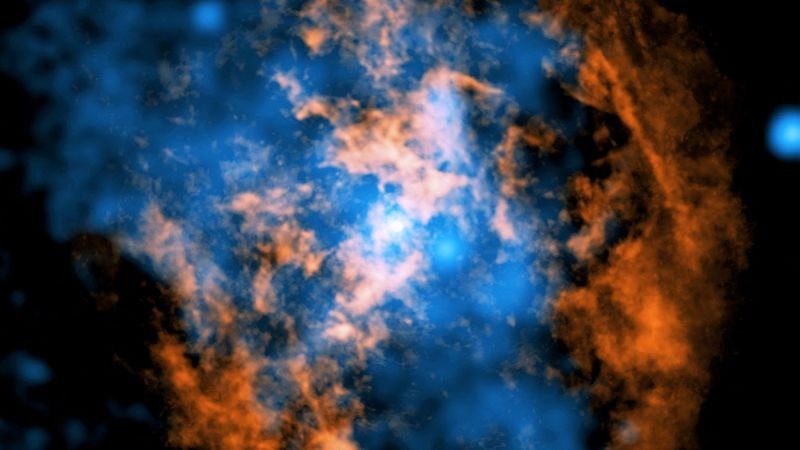
Now, after five years of observations, Gorski and Lena Murchikova, an assistant professor of physics and astronomy at Northwestern, believe they have found signs of the missing wind. The duo created a highly detailed image of the black hole’s surrounding area. Within the image, Gorski and Murchikova spotted a large, cone-shaped cavity devoid of cold gas.
The feature could only have been sculpted by a wind of hot gas coming directly from the object itself, according to the researchers, who are co-lead authors of a study on the discovery published June 4 in the journal The Astrophysical Journal Letters.
“The black hole wind acts like a hair dryer,” Gorski said. “It blows hot turbulent air into a colder, denser material, like your wet hair. The wind is warm and strong enough to heat and blow the water out of your wet hair and move the wet hair around a bit — but not strong enough to blow the hair off your head completely.” Similarly, the hot gas in the wind from the black hole left a clear signature by swiping away the surrounding cold gas, the study has suggested.
Scientists have previously observed similar outflows, both in the form of tight jets and broad winds, from the supermassive black holes at the centers of other galaxies. These outflows are a critical part of how a black hole pumps energy into its host galaxy and regulates its growth, according to Christopher Reynolds, a professor of astronomy at the University of Maryland, College Park, who was not involved with the study.
“These outflows have proved really elusive when looking at our own supermassive black hole — until now,” he wrote in an email. “This study presents a pretty compelling case that a wind from our galaxy’s supermassive black hole has pushed outwards through the surrounding dust and gas. They haven’t actually seen the wind itself, but its presence is quite clear. This required very careful analysis of almost 5 years of data from the world’s most sensitive radio telescope — a real tour de force.”
A weaker wind
Black holes are astronomical objects with a gravity so strong that not even light can escape them. Most big galaxies have a central supermassive black hole — up to billions of times the mass of our sun. Smaller black holes are the remnants of large dead stars, but the origin of the supermassive ones is poorly understood.
Nothing can escape the black hole’s threshold, called the event horizon. However, the material that swirls around the black hole can heat up and glow due to friction and tidal forces, emitting radio waves and X-rays. When the black hole feeds on gas, the object unleashes particles in the form of wind or jets that move at nearly the speed of light, traveling up to thousands of light-years into space. A light-year is the distance light travels in one year, which is 5.88 trillion miles (9.46 trillion kilometers).
Using the Atacama Large Millimeter/Submillimeter Array or ALMA radio telescopes in Chile, Gorski and Murchikova created the most detailed map ever of cold gas around Sagittarius A* and then removed all of the radio interference from the object. What was left showed a cavity about 3 light-years long and with an opening angle of 45 degrees, leading back to the black hole itself.
The researchers then used NASA’s Chandra X-ray Observatory to confirm that the cold gas in the region was being sculpted by hot plasma, or electrically charged gas, coming from the galactic center: “If the cold gas were in front of or behind the hot plasma, there wouldn’t be a strong correlation,” Gorski said. “While we did not directly detect the particles moving in the wind, we were able to deduce the direction and energy of the wind.”
There are two main reasons why the discovery of the wind’s presence was more than half a century in the making, ever since Sagittarius A* was first observed in the 1970s, according to Gorski. The first is that instruments have only now become advanced enough to see through the gas and dust that sits between Earth and the center of our galaxy. The other is that Sagittarius A* is in a quiet period, making the wind weaker and therefore much harder to spot. It’s common for supermassive black holes to alternate between active and quiet periods, depending on the supply of material surrounding them.
“Our result essentially says this black hole also has wind, so it’s not weird, and black hole physics in general work as we expected,” Murchikova said. “But the wind was hard to find because it was so weak. Never before have we seen a weak wind from a black hole.”
Observations from supermassive black holes in other galaxies revealed extremely powerful jets, but those events are rare, Murchikova added. Most of the time, black holes are in a quiet state and just blow a small breeze, which is harder to spot because “no fireworks are coming out.”
The researchers now plan to expand the map of cold gas to a larger region to diagnose the full impact of the wind. The team also wants to make a “movie” of the gas approaching the black hole to observe how the clouds move and estimate how much of the gas the black hole consumes.
A thrilling discovery
Much remains for researchers to discover about how supermassive black holes launch winds, though scientists think that it’s likely due to how the magnetic fields are being spun around the black hole as the gas goes around in its orbit, according to Dan Wilkins, a research assistant professor in the department of astronomy of Ohio State University. Wilkins was not involved with the study.
“Seeing evidence for black hole-driven winds in our own galaxy not only gives us a new avenue for understanding how these winds are driven, but shows that supermassive black holes are still able to launch a wind into their host galaxies even when they are not undergoing active phases of rapid growth,” he wrote in an email.
Jets and winds from black holes are textbook physics, and scientists have observed many supermassive black holes hurling them into space. It’s “thrilling” to have finally caught our own galaxy’s central black hole in the act, said Priyamvada Natarajan, the Joseph S. and Sophia S. Fruton Professor of Astronomy and Physics at Yale University, in an email. Natarajan also did not take part in the study.
“Sagittarius A* has long been the great frustration of galactic center astrophysics: close enough to study in exquisite detail, yet stubbornly quiet, apparently windless,” she said. “This paper dismantles that picture. This is what patient, deep observational astronomy looks like when it pays off.”
There are still many open questions, Natarajan added, but that’s as it should be for a discovery paper. “The authors have handed the community a new observable, and the follow up will be rich,” she said.
The story of Sagittarius A* reflects the ongoing quest within astrophysics to understand the dynamics of black holes, revealing not only the complexities of cosmic phenomena but also the potential for further discoveries in the years to come.